
ORDER Prompting Guide
Download (PDF)
For MPs and Staff When Using Commercially Available LLMs
The performance of Large Language Models (LLMs) — such as ChatGPT, Claude, and Gemini — largely depends on how users ask questions or assign tasks to the AI. This is known as prompting or prompt generation. ORDER is a five-step framework built for parliamentary staff to assist with building stronger prompts and improving the usefulness of commercially available LLMs..
Before you begin: Check your institution’s or office’s AI guidance. Never input non-public, sensitive, or constituent-identifying information. Remember, AI is a tool to assist with information access and content creation. You are responsible for the work you create; all AI-generated information should be double checked.
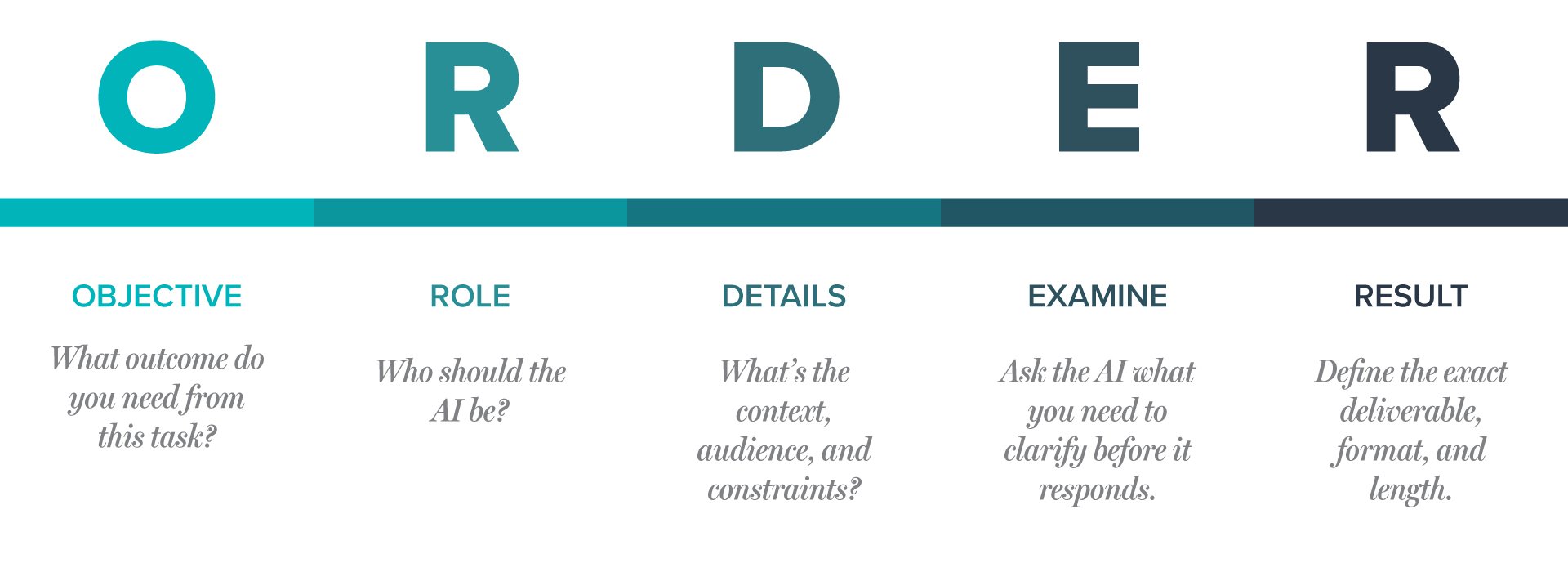
Objective
What outcome do you need from this task?
Ask yourself: “What am I trying to accomplish right now?”
Before the AI can help you, it needs to know what “done” looks like. Are you trying to draft something, research something, simplify something, or brainstorm?
A vague objective produces a vague answer. The more specific you are about the end goal, the less back-and-forth you will need.
Do
Draft a constituent response letter addressing concerns about prescription drug costs.
Don’t
Help me with a letter about drug prices.
Role
Who should the AI be?
Ask yourself: “What kind of person or expert would I hire to do this task?”
Assigning a role dramatically sharpens the AI’s focus because it provides it with the perspective through which to approach and undertake the task. A policy analyst thinks differently from a communications staffer, who thinks differently from a constituent engagement expert.
Naming the role you want the AI to play (even if it is filling your shoes) primes the AI to match the right tone, depth, and framing before it writes a single word.
Do
You are a policy staffer assisting an MP in responding to constituent mail. Draft a constituent response letter addressing concerns about prescription drug costs.
Don’t
You’re an AI assistant.
Details
What’s the context, audience, and constraints?
Ask yourself: “What does the AI need to know to get this right?”
This is where you hand the AI the background it needs: the MP’s position, the audience for the output, the political context, any constraints on length or tone, and the specific situation prompting the task.
The more relevant context you share, the more tailored the output. But a critical rule applies here: never paste in constituent personal information, non-public data, or any sensitive material. Keep it to context the AI needs, not information it shouldn’t have.
Never include constituent names, contact details, case numbers, or any non-public information in your prompt.
Do
You are a policy staffer assisting an MP in responding to constituent mail. Draft a constituent response letter addressing concerns about prescription drug costs. Please write it at a sixth grade reading level, and use a professional but relatable tone that is warm and clear, but not overly technical. The MP you work for used to be a doctor and is passionate about this issue. Have the letter be solution oriented.
Don’t
Here’s the background. [pastes full constituent email with name and address]
Examine
Ask the AI what you need to clarify before it responds.
At the end of your prompt, ask the AI what additional information it needs to succeed at the task.
This allows the AI to surface gaps in your prompt you did not know were there and address any omitted information that the LLM will try to fill on its own. Simply add: “Before you respond, what additional information can I provide or questions do you have?”
Do
You are a policy staffer assisting an MP in responding to constituent mail. Draft a constituent response letter addressing concerns about prescription drug costs. Please write it at a sixth grade reading level, and use a professional but relatable tone that is warm and clear, but not overly technical. The MP you work for used to be a doctor and is passionate about this issue. Have the letter be solution oriented.
Before you begin drafting, what additional information can I provide, or what questions do you have?
Don’t
Go ahead and write the letter.
Result
Define the exact deliverable, format, and length.
Ask yourself: “How do I want this delivered, and what will I do with it?”
If you don’t specify your desired format of the response, the AI will decide for you. When a specific output would be the most helpful to save you time, tell the LLM exactly what you want it to create for you: Do you want your question answered in one paragraph or three? Bullet points or prose? Formally structured like a professional letter or laid out as a memo?
And when it gives you a draft, remember: treat it like a first attempt. Read it carefully, check any facts it asserts, and revise before it is used in any official capacity.
Always review and fact-check output before use. The AI can confidently state things that are incorrect.
Do
You are a policy staffer assisting an MP in responding to constituent mail. Draft a constituent response letter addressing concerns about prescription drug costs. Please write it at a sixth grade reading level, and use a professional but relatable tone that is warm and clear, but not overly technical. The MP you work for used to be a doctor and is passionate about this issue. Have the letter be solution oriented.
Please have the letter be no more than 1 page in length and have it follow the same template and style of the attached sample letter. [Attached: a PDF of a prior letter that was sent.]
Before you begin drafting, what additional information can I provide, or what questions do you have?
Don’t
Have it look like a letter.
ORDER in Action
Copy, adapt, and paste into any approved AI tool
Before you begin: Check your institution’s or office’s AI guidance. Never input non-public, sensitive, or constituent-identifying information. Remember, AI is a tool to assist with information access and content creation. You are responsible for the work you create; all AI-generated information should be double checked.
Constituent Response Letter
O - Draft a constituent response letter about public investment in under-resourced schools.
R - Act as a senior parliamentary constituent services staffer.
D - The Member supports increased public investment in under-resourced schools and opposes cuts to education funding. The constituent is a parent of two children in an underfunded public school district concerned about classroom resources and teacher shortages. Tone: empathetic, direct, and accessible. Do not include any personal constituent details.
E - Before drafting, ask me any clarifying questions that would improve the letter.
R - Write one letter, 3 paragraphs, formal but warm, under 300 words, in standard parliamentary correspondence style.
Final Prompt
I’m a senior parliamentary constituent services staffer drafting a response letter on behalf of my Member. A constituent has written in — they’re a parent of two children in an underfunded public school district, worried about classroom resources and teacher shortages. My Member supports increased public investment in under-resourced schools and opposes cuts to education funding. Acting as an experienced parliamentary correspondence writer, please draft one formal but warm constituent response letter — 3 paragraphs, under 300 words, in standard parliamentary correspondence style. The tone should be empathetic, direct, and accessible. Do not include any personal constituent details in the letter. Before you draft anything, ask me any clarifying questions that would help you produce a better letter.
Mastering a New Policy Issue
O - Help me quickly get up to speed on the basics of “agentic AI.”
R - Act as a nonpartisan IT policy analyst briefing a new legislative staffer.
D - I’m a legislative assistant who just picked up the tech portfolio. I have a hearing in two weeks and need to understand the landscape, key players, and main debates about agentic AI.
E - What additional information do you need at this time?
R - Give me a structured 500-word overview with a bullet-point summary of the 5 things I most need to know.
Final Prompt
I’m a legislative assistant who just picked up the tech portfolio. I have a hearing in two weeks and need to understand the landscape, key players, and main debates about agentic AI. Acting as a nonpartisan IT policy analyst, please help me quickly get up to speed on the basics - including key policy debates or topics related to AI agents. Let’s start by having you present me with a structured 500-word overview with a bullet-point summary of the 5 things I most need to know. What additional information do you need at this time?
This guide was developed by POPVOX Foundation to support legislative staff in using AI tools responsibly and effectively.
About POPVOX Foundation
POPVOX Foundation is a 501(c)3 nonpartisan nonprofit organization with a mission to help democratic institutions keep pace with a rapidly changing world. Through publications, events, prototypes, and technical assistance, the organization helps public servants and elected officials better serve their constituents and make better policy.
Questions or feedback? Contact us at info@popvox.org