
Download (PDF)
Introduction
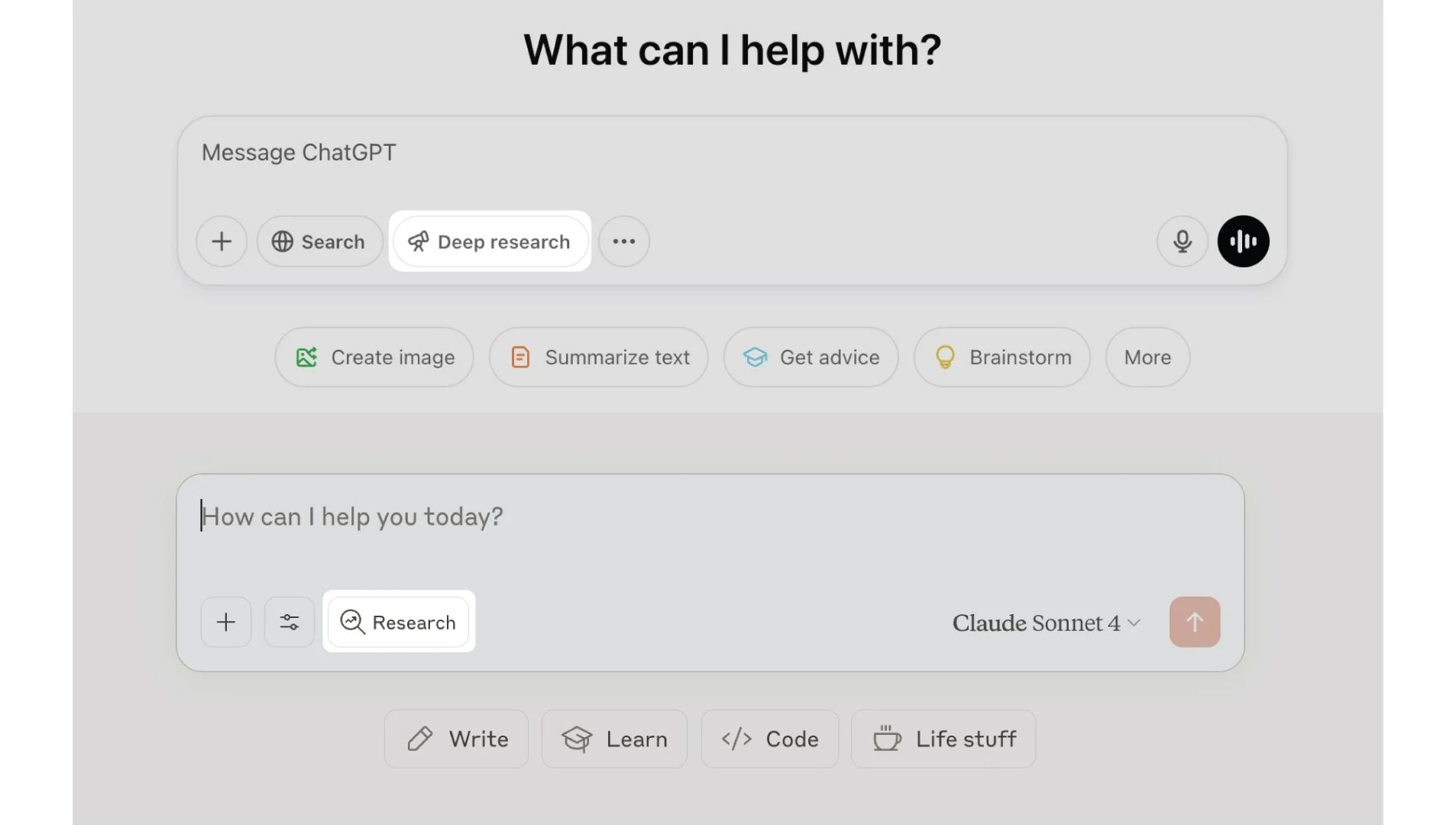
In recent months, numerous commercially available large language models (LLMs), including Google’s Gemini, OpenAI’s ChatGPT, and Anthropic’s Claude, have released Deep Research plugins on their interfaces. This brief guide presents an overview of what these capabilities can entail, how they differ from the more traditional approach to interacting with LLMs, sample use cases, and best practices.
What is Deep Research?
Deep Research is an advanced AI capability that goes far beyond a single prompt-and-response interaction. Unlike typing a question and receiving one answer, Deep Research tools conduct multi-step investigations — automatically searching multiple sources, cross-referencing information, and synthesizing findings into comprehensive reports. These tools can be configured to prioritize specific types of sources, such as academic databases, government repositories, or curated document collections, rather than conducting broad internet searches.
Think of it as the difference between asking a research assistant one quick question versus assigning them a complex research project that requires consulting numerous sources, analyzing trends, and preparing a detailed briefing.
How Deep Research Differs from Standard Prompts
Standard Prompt
- Single question → Single answer
- Uses AI's existing knowledge
- Immediate response (seconds)
- Limited to one perspective
- Basic fact-checking
Deep Research
- Complex query → Multi-step investigation
- Actively searches current sources
- Extended research process (10-20 minutes)
- Cross-references multiple viewpoints
- Comprehensive source verification
When to Use Deep Research
The use of Deep Research might be helpful for:
Complex policy analysis requiring multiple data sources
Comprehensive background research on emerging issues
Competitive landscape analysis of legislation or programs
Trend analysis across multiple time periods or jurisdictions
Multi-stakeholder perspective gathering
The use of an LLM’s standard tool offering is helpful for:
Quick fact-checking
Summarization of a particular resource
Simple definitions or explanations
Draft writing assistance
Basic Q&A
Legislative Staff Use Cases
The following hypothetical use cases showcase the difference in approach of querying an LLM’s default functionality compared to using Deep Research functionality. Before any use of an LLM, consult your institution’s guidance regarding authorized and appropriate use on official devices.
Oversight Preparation
Standard Prompt: “What is the Department of Education’s budget for Title I programs?”
Deep Research: “Conduct comprehensive analysis of Title I funding trends, implementation challenges, and outcomes across states over the past five years, including GAO reports, state audits, and academic studies.”
Policy Position Development
Standard Prompt: “What are the arguments for renewable energy tax credits?”
Deep Research: “Analyze the effectiveness of federal renewable energy incentives, comparing approaches across different technologies, examining economic impacts in various districts, and reviewing recent policy proposals from think tanks and industry groups.”
Legislative Comparison
Standard Prompt: “How does our introduced healthcare bill compare to similar legislation?”
Deep Research: “Compare pending healthcare legislation across all states, analyzing key provisions, stakeholder positions, implementation timelines, and projected outcomes, with focus on bipartisan elements and potential federal implications.”
Best Practices for Legislative Offices
Before Starting Deep Research
Review institutional guidance - Ensure that your use of the LLM is authorized and that you’ve reviewed all best practices to ensure responsible and safe use
Define your scope clearly - The more specific your research question, the better the results
Identify key stakeholders you want perspectives from
Set realistic timeframes - Deep research takes 10-20 minutes
Consider sensitivity - Do not include confidential or non-public information in research queries
During the Research Process
Monitor progress - Most tools show real-time research steps
Prepare for refinement - You may need to narrow or expand scope based on initial findings
Stay available - Some tools may ask clarifying questions mid-process
After Research Completion
Verify claims - Always fact-check information through official sources
Cross-reference findings - Compare results with your office’s existing research
Adapt tone and perspective - Remember that any work produced and used is done so at your discretion. You are responsible for the quality of the final product.
Cite appropriately - Use (and verify) provided sources
Security and Compliance Considerations
Follow institutional guidance from House Information Resources or Senate Sergeant at Arms.
Never input personally identifiable information, information that is classified, or information that is not publicly available.
Review outputs carefully before using in an official capacity.
Maintain awareness that research queries may be logged by AI providers.
Getting Started
Check approved tools - Verify your institution and office has approved for use specific platforms with Deep Research capabilities
Start small - Begin with non-pressing research topics to learn the interface
Practice scoping - Experiment with different levels of detail in your research questions
Build templates - Develop standard research question formats for common use cases
Share learnings - Help us understand how you and your team are using Deep Research in a legislative setting and the best practices that you’ve uncovered!
Have questions about implementing Deep Research tools in your office? Contact us at info@popvox.org.
This guide was developed by POPVOX Foundation to support Congressional staff in using AI tools responsibly and effectively.
About POPVOX Foundation
POPVOX Foundation is a 501(c)3 nonpartisan nonprofit organization with a mission to help democratic institutions keep pace with a rapidly changing world. Through publications, events, prototypes, and technical assistance, the organization helps public servants and elected officials better serve their constituents and make better policy.
Questions or feedback? Contact us at info@popvox.org