How Institutional Practices Foster Personality-driven Politics
A pet peeve about Congressional websites
BY ANNE MEEKER
Y’all, I hate the URL slugs for House websites.
For those without the misfortune of knowing this off the top of their heads: the URL slug formula for Members of the House of Representatives is almost always the same: LastName.house.gov. This means that whenever a Congressional district changes Members or parties, the website changes too.
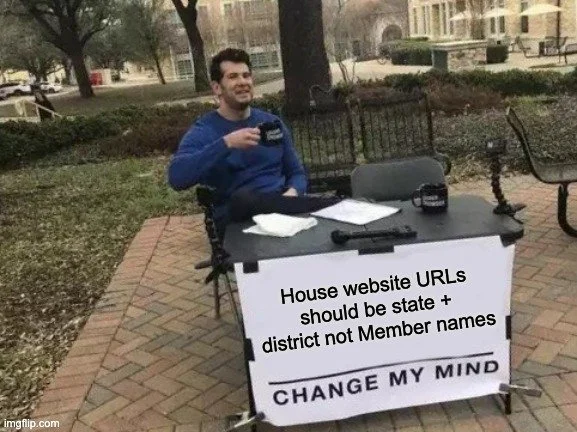
For a constituent, this means that finding the website for their Congressional district — the main portal to participate in the legislative process between elections, or access services they can’t get anywhere else — requires knowing or figuring out their Member’s name. It also leads to a host of other problems: dead links for anyone who’s linked to a Member’s website; awkward work-arounds for multiple Members with the same last name (see: biggs.house.gov and sheribiggs.house.gov); not to mention hours of staff time for the Clerk of the House to swap dozens of URLs every two years.
And the most frustrating part is that there is a clear and obvious better way to do this.
If I were queen for a day — and ironically used my authority to mess around in our system of representative democracy — House URLs would not include Member last names, but instead reflect the district and state. So instead of shontelbrown.house.gov, to use my current Member, the site would be OH11.house.gov. Or MA06.house.gov. Or TX20.house.gov.¹
Elegant, easy, less stupid.

This is obviously not the main issue facing Congress today.
But I can’t shake this one particular pet peeve because it is a perfect example of how small, technical decisions at the institutional level can have outsized implications for the full legislative body and process — in this case, reflecting and reinforcing personality-driven politics.
In this particular moment for the para-Congressional world, when organizations are re-examining strategies that focus on institutional structure and capacity vs. political structure and willpower, I think it’s also a cautionary example to remind us to not lose sight of the details.
Members =/= Their Districts
The Congressional district is one of the most imaginary of the multiple and overlapping units of political representation in the US. City boundaries remain more or less fixed, as do counties. States are probably immutable. But Congressional districts? Less so.
This is frustrating because for many states, the Congressional district is actually an in-between political unit that fills some important gaps: in Massachusetts, for example, the "North Shore" of the 6th district is a distinctive regional cultural and geographic area, with shared natural resources, industries, and historical specificity. The convening power of a House office brings together sub-state regional municipal and county leaders with shared interests to coordinate and collaborate as a unit in a way that the state can't do, and individual local leaders can't do on their own. But we hardly ever think about the House district as a unit of representation.
I think there are a bunch of reasons for this, but two big ones in particular:
First, we keep moving the dang borders. Gerrymandering and how we address it is out of scope for this particular newsletter, but it’s hard for a political unit to develop a stable cultural identity when it’s treated as a temporary container for voters that can be redrawn for political advantage every few years.
Second — and back to House websites — we have made political and institutional choices to center the House district on whoever happens to occupy the seat at any given time, rather than the shared and stable interests of whoever happens to live there. The Congressional district is legally the extension of whoever occupies the seat, not the people represented. Constituent data collected in the course of the Member’s work is that Member’s personal property — not the property of the district itself, or the constituents who shared it. That question of property extends to material assets, including office leases, and institutional knowledge: for the most part, each Member hires a brand-new staff when elected, meaning that the relationships each Member’s team builds up are reset in the transition.
To be clear, incoming Members absolutely should have the wherewithal to make a clean break with their predecessors. But the current model of transition takes this to an extreme: it’s as if a private company was expected to fire all of its staff, delete its files, give up its trademarks, and sell its physical assets when it hired a new CEO.
And it means that from the constituent’s perspective, engaging with Congress means engaging with a specific person’s brand. The website is their name. The office signage is their name. The casework data is their property. The staff are their employees. Everything about the institutional design signals that this operation exists to serve the Member’s career — even if that’s not the intent.
If the whole thing looks like it’s built around one person’s career, it’s not hard to understand why so many constituents assume that person is acting in their own interest, not the interests of the people they represent. The conditions are set up to make even good-faith representation look self-interested. I show up to my local block club because I’m a resident, regardless of who’s chairing it — but it’s a lot harder to feel that way about an institution that is, in every visible way, branded as belonging to someone else.
Institutional practices for a constituent-driven policies
I’m not claiming that a Member-last-name URL slug creates a system of representation that highlights the personal careers and accomplishments of individual representatives over the people they serve, and that switching to a more generic website would fix Congress.
But thinking about a different URL slug invites other questions about what a Congressional district could be as its own legal, political, and cultural entity, and how that would change the constituent experience.
Going back to the CEO analogy: right now, a change in leadership means the whole company fires its staff, deletes its files, gives up its trademarks, and sells its physical assets. But what if we treated a Congressional district more like the company itself — an institution that retains its own identity, property, and operations regardless of who’s in charge?
What if constituents retained rights to the data they share via casework so that open cases didn’t vanish or get abandoned in a transition? What if some core district office staff were career roles that persisted across Members, the way committee staff do, so that institutional knowledge and community relationships weren’t rebuilt from scratch every two years?
None of these would require a Member to keep their predecessor’s team or agenda. A new CEO sets new strategy, hires new senior leadership, changes direction — but they inherit a functioning organization. The infrastructure serves the mission, not the other way around.
It hurts to use this analogy as a Clevelander, but it’s almost like sports teams: even if I didn’t grow up in a big football house, I absorbed some understanding of who the Browns are as part of my particular cultural identity as a Northeast Ohioan. Browns fans don’t stop coming to games when their favorite player or the coach leaves — instead, the players and the coaches and everyone else are understood, as part of a true institutional identity in the anthropological sense of the word, as a social structure that persists and adapts through multiple generations. The team gives the coach cultural salience in Northeast Ohio, not the other way around.
That’s the kind of relationship I’d love to see between constituents and their Congressional districts — where the district is something you belong to and participate in because it’s yours, not because of who happens to occupy the seat.
A final note on why institutional, technical, capacity-focused changes matter
I recognize that quibbling about website URLs seems small when there is so much to be frustrated about with Congress today.
There is a lot of conversation in my particular slice of the world right now (para-Congressional nonprofits, think tanks, institutionalists) about where best to deploy limited resources to fix Congress. I am certainly observing a growing chorus arguing that previous efforts that exclusively focused on technical changes² to how the institution functions were misguided: instead, there should be more resources toward building political support for a stronger, more effective First Branch, using the political process itself to make the wider-reaching reforms necessary to maintain our system of checks and balances, build Congress’ capacity, etc.
Sure, probably. I am also frustrated with the pace of progress, compared to the scope of challenges facing the whole concept and institution of representative democracy.
But my caution would be to not throw the capacity baby out with the political bathwater.
Many of these technical decisions are reflections and reinforcements for the political structures — and sometimes looking at the technical ways the institution works is a lens through which to better understand the philosophical and political decisions we’ve made (or let happen) about how our institutions work.
Political change requires both the politics and the technical rules, mechanics, and practices that make an institution run. In an ideal world, there is philosophical continuity all the way down: the way we want Congress to work, the philosophy behind it, is reflected all the way down, even into decisions as small as website URLs.
¹ I also think this is possible on the Senate side, with an extra step — one landing page for the state’s Senate delegation that takes you to individual pages for each Senator.
² It’s a rant within a rant! But for the record: I really, really don’t like the term “technocratic” to describe some of these types of changes. We’re talking about the rules, mechanics, and practices of Congress. That’s about fostering and strengthening rule by the people via elected representatives (i.e., democracy) not figuring out how to facilitate rule by experts.
Voice/Mail is a Substack newsletter about how people and their governments talk to each other. Learn more and subscribe at voicemailgov.substack.com.