
AI Starter Kit for State Legislators
Download (PDF)
Getting Started with Artificial Intelligence Tools
Commercially available AI tools offer state legislators opportunities to enhance legislative effectiveness, improve constituent engagement, and maximize limited resources (including time). This guide provides examples of easy ways to begin incorporating AI into legislative operations and workflows starting today.
Before You Begin
Primary Platforms
Popular, commercially-available Large Language Models (LLMs) that offer free and privacy-supported paid subscriptions include ChatGPT, Claude, Copilot, and Gemini.
Start With What is Available
Many of AI’s benefits can be accessed through the free versions of the commercial platforms, but premium (or paid) accounts offer enhanced privacy and data protection features that are considered best practice for official use. You can begin experimenting and learning with basic access in your personal time, but upgrade to a paid account with privacy settings enabled once you start using it in the workplace.
Choose Your Model Intentionally
Most AI platforms offer multiple versions of their tools. Claude, for example, offers Opus, Sonnet, and Haiku; ChatGPT offers different numbered versions. More advanced models use more computing power, measured in units called tokens, and both your prompt and the AI’s response count toward your usage. As providers shift toward usage-based pricing, heavier models mean higher costs.
The practical takeaway: match the model to the task. For routine work like drafting an email or summarizing a document, a lighter model is often plenty. Save more advanced versions for complex tasks like multi-source research or detailed analysis. As AI use scales across your office, choosing models intentionally rather than defaulting to the most powerful option is an emerging best practice for managing cost and resources effectively.
Consider Pooled Resources
Smaller legislative offices or committees can maximize value by coordinating AI tool subscriptions accordingly. Explore team subscriptions instead of individual licenses. Premium and team accounts also provide advanced features and higher usage limits, which is valuable for busy legislative schedules.
Build Gradually
Using AI is similar to toning a muscle. Begin with simple use cases and expand as your confidence and knowledge of the technology’s capabilities grow.
Remember: Everyone is at the starting gate of learning how to use this technology in a legislative setting. You are not behind and there are many resources available to support you.
The Anatomy of an Effective Prompt
The question or task description that you type into an LLM is called a “prompt.” Similar to asking a coworker to assist in accomplishing a task, the more information you provide within your prompt, the more successful the LLM will be in helping to answer your question or accomplish your task.
Be Specific and Provide Context
Instead of: “Help with education policy”
Try: “I’m a state legislator in [State]. Draft key talking points for a floor debate on primary education funding in my state. Address common challenges like teacher retention, classroom resources, infrastructure limitations, and curriculum relevance. Cite all sources. Tone should be constructive and focused on practical solutions. Please provide talking points in bullet point format.”
Attach Sources Directly
You can focus an LLM on where it finds information by directly providing resources to it. For example, if you would like it to summarize the key findings of a recently released state agency report, you can attach the report directly to the chat where you input your prompt.
Instead of: “The State Dept. of Transportation just released a report on highway hauling limit restrictions. What does it say?”
Try: “Attached is the State Dept. of Transportation’s recent report on highway hauling limit restrictions. Please read the report and provide for me a 2-page memo that covers:
Key findings of the report
Key policy recommendations
Any noteworthy statistics, and
An analysis section of questions that a state legislator might ask as follow-up or oversight.”
Inspiration
Sample use cases of how to leverage AI for common legislative needs:
- » "Help me prepare questions for a committee hearing on [X topic] focused on the recent development of [Y and Z]. Attached is the hearing packet provided by staff, including witness testimony."
- » "I'm a state legislator in [State] representing [District/Region]. Brainstorm policy approaches for youth unemployment that have worked in similar states and communities as…"
- » "Assist in drafting a constituent newsletter explaining recent legislative changes including [X, Y, and Z.] My views on these changes are [A and B]. Attached is a sample constituent letter I sent in the past. Please match length, tone, and structure."
Protect Sensitive Information and Verify Information
A risk of using a commercially-available AI tool without privacy settings enabled is that it can learn from the information you give it and save the data you share. To ensure data privacy and respect constituents’ and coworkers’ privacy, it is important to be aware of the risks and follow these best practices:
Never include constituent names, personal details, or confidential legislative materials.
Use general terms when discussing scenarios such as “a constituent” instead of “Maria.”
Describe situations without identifying details. Use “our state’s tourism sector” rather than naming specific businesses.
Another known risk of using generative AI tools is the occurrence of “hallucinations,” false information that the technology presents as fact. To mitigate this risk:
Verify Key Claims: Ask the LLM for citations, and fact-check information and assertions.
Use Multiple Sources: Cross-reference AI outputs with trusted state and local sources or experts.
Maintain Critical Perspective: Remember that AI reflects broad knowledge that may not fully understand local contexts or have access to up to date information. AI systems’ knowledge is also limited to information that is publicly available online, so it may not have access to your state’s historic legislative records or debates.
Maximize Limited Time with Structured Requests
The more context you give AI, the better: it saves you time and lets you shape how the information comes back to you.
Try: “Create a brief summary of [topic] with three key points, potential counterarguments, and suggested follow-up actions. Format as bullet points for quick reference.”
Try: Attach a public report by a government agency or research organization and ask, “Create a 2-page memo on this report that includes a summary of the key points, supporting proof, and policy recommendations.”
Custom GPTs & Knowledge Bases for Legislative Work
Beyond engaging with commercially-available LLMs through submitting a prompt, these platforms offer the ability for you and your team to build customized versions of an LLM that is specialized in a topic or task of your design. These custom AI assistants reference only your selected documents which create reliable, focused research tools from limited legislative resources.
How to Get Building
Choose your platform (ChatGPT, Copilot, Claude, or Gemini) and ask it for step-by-step instructions for creating a custom bot. Each of these platforms calls these bots something different: ChatGPT Custom GPTs, Copilot Agents, Claude Projects, and Gemini Gems.
Build confidence by starting with a use case that only needs access to publicly-available documents.
Follow the instructions and continue to ask follow-up or clarifying questions as needed.

Inspiration
Sample use cases of a ChatGPT Custom GPT, Claude Project, Copilot Agent, or Gemini Gem:
- » Committee Preparation: Upload relevant bills, previous committee reports, and background materials to create a focused research assistant for specific policy areas.
- » Institutional Memory: Preserve legislative knowledge by creating databases of procedures, precedents, and past decisions.
- » Constituent Outreach: Build a knowledge base from your office's past anonymized constituent correspondence and FAQs to help staff draft consistent, on-message responses.
Deep Research for Legislative Analysis
Beyond their potential to be valuable brainstorming partners, commercially-available LLMs can be powerful research assistants. If you invest in a paid account with an LLM, you will gain access to its Deep Research capabilities. While you can compare a regular prompt inquiry to an advanced Google search, Deep Research is similar to having a fast virtual research assistant assigned to you. A problem or question directed to Deep Research will trigger the AI system to design a full research plan, access dozens (if not hundreds of) resources, and write a thoroughly cited and researched report for you. Where an LLM will respond to a regular prompt in a matter of seconds, an LLM will take often 15 to 40 minutes to respond to a Deep Research prompt.
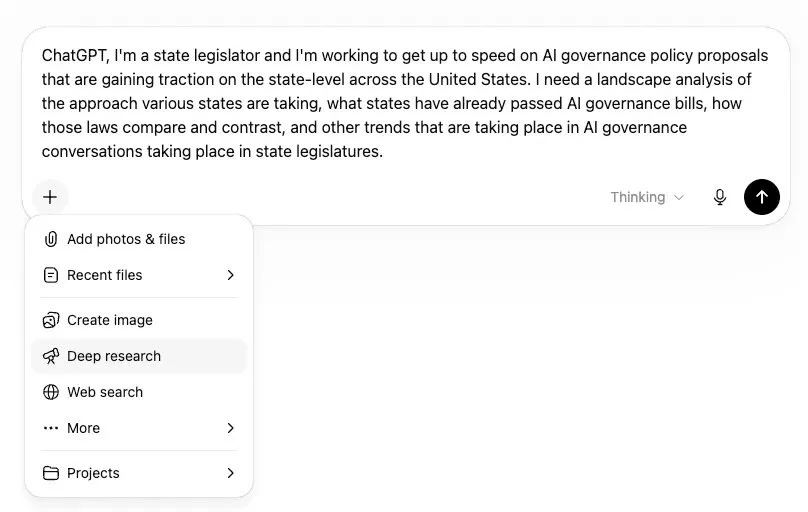
How to Maximize Deep Research Value
Add context and specify constraints: Include context such as budget limitations, population size, or geographic considerations.
Request actionable outcomes: Ask for implementation steps or policy recommendations, not just analysis.
Seek comparable examples: When appropriate, specify the desire to have the research prioritize solutions from states with similar size, demographics, or policy contexts.
Inspiration
Crafting effective Deep Research prompts:
- » Policy Development: "Research legislative oversight mechanisms in states with populations similar to ours, [State]. Compare committee structures, questioning procedures, and accountability measures. Identify adaptable best practices for resource-constrained environments."
- » Constituent Issues: "Examine approaches to rural healthcare delivery in states with large rural populations. Include telemedicine programs, mobile clinic models, and public-private partnerships. Focus on cost-effective, scalable solutions."
You can begin experimenting with and learning how to use AI today.
AI technologies are continuing to develop and change, but they show great potential in supporting legislators and democratic institutions. The best way to begin to understand AI is to gain first-hand experience using the technology. Start small, learn continuously, and share knowledge with trusted colleagues to adapt AI capabilities to serve your office’s unique needs and circumstances.
Continue Your AI Journey: Find additional guides, case studies, and technical resources at popvox.org/ai. For additional support or questions, email caitlin@popvox.org.