
Understanding AI-Powered Deep Research Tools: A Primer for MPs and Staff
Download (PDF)
Introduction
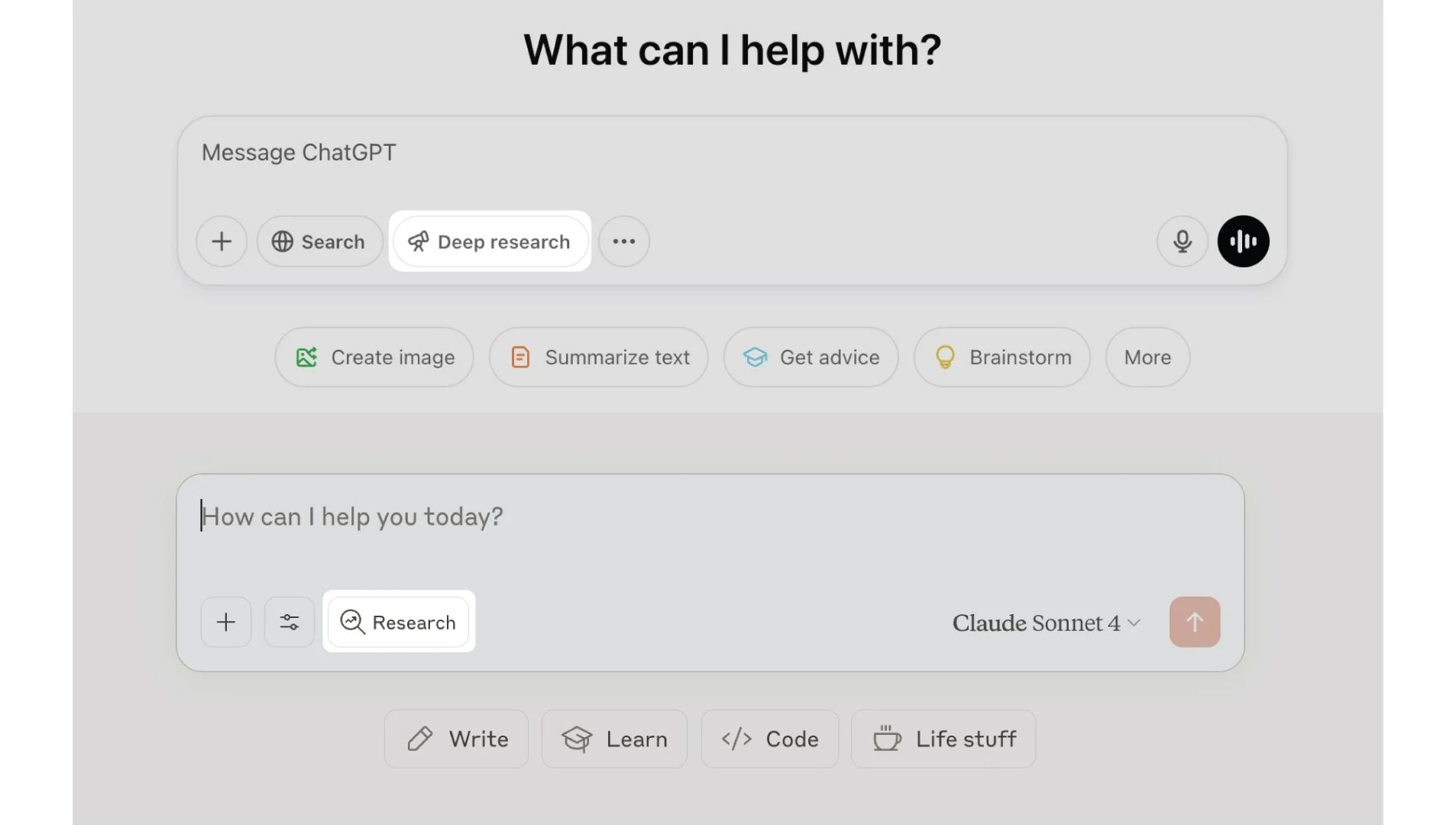
Numerous commercially available large language models (LLMs), including Google’s Gemini, OpenAI’s ChatGPT, and Anthropic’s Claude, have released Deep Research plugins on their interfaces. This brief guide presents an overview of what these capabilities can entail, how they differ from the more traditional approach to interacting with LLMs, sample use cases, and best practices.
What is Deep Research?
Deep Research is an advanced AI capability that goes far beyond a single prompt-and-response interaction. Unlike typing a question and receiving one answer, Deep Research tools conduct multi-step investigations — automatically searching multiple sources, cross-referencing information, and synthesizing findings into comprehensive reports. These tools can be configured to prioritize specific types of sources, such as academic databases, government repositories, or curated document collections, rather than conducting broad internet searches.
Think of it as the difference between asking a research assistant one quick question versus assigning them a complex research project that requires consulting numerous sources, analyzing trends, and preparing a detailed briefing.
How Deep Research Differs from Standard Prompts
Standard Prompt
- Single question → Single answer
- Uses AI's existing knowledge
- Immediate response (seconds)
- Limited to one perspective
- Basic fact-checking
Deep Research
- Complex query → Multi-step investigation
- Actively searches current sources
- Extended research process (10-20 minutes)
- Cross-references multiple viewpoints
- Comprehensive source verification
When to Use Deep Research
The use of Deep Research might be helpful for:
Complex policy analysis requiring multiple data sources
Comprehensive background research on emerging issues
Competitive landscape analysis of legislation or programs
Trend analysis across multiple time periods or jurisdictions
Multi-stakeholder perspective gathering
The use of an LLM’s standard tool offering is helpful for:
Quick fact-checking
Summarization of a particular resource
Simple definitions or explanations
Draft writing assistance
Basic Q&A
MP or Legislative Staff Use Cases
The following hypothetical use cases showcase the difference in approach of querying an LLM’s default functionality compared to using Deep Research functionality. Before any use of an LLM, consult your institution’s guidance (if guidance has been issued) regarding authorized and appropriate use of GenAI tools for official parliamentary use.
Oversight Preparation
Standard Prompt: “What are common challenges with public works employment programs?"
Deep Research: "I am an MP serving in [Country]. I'm preparing to question the Minister about our national public works employment program, which has been running for 5 years with an annual budget of approximately $200M. Please analyze: (1) how similar programs in other countries measure success beyond job placement numbers, (2) common audit findings and implementation failures in public employment schemes globally, (3) what leading indicators suggest a program is underperforming before final outcomes are measured, and (4) specific questions I should ask about contractor oversight and wage payment verification."
Policy Position Development
Standard Prompt: "What policies help address housing affordability?"
Deep Research: "I am an MP serving in [Country]. My party is developing its housing affordability platform for the upcoming session. Please research: (1) policies that have backfired or produced unintended consequences (with specific examples), (2) how housing advocates, developers, and economists critique common approaches from different ideological perspectives, (3) politically viable policies that have achieved cross-party support in other parliaments, and (4) implementation timelines — which interventions show results within an electoral cycle versus longer-term…"
Legislative Comparison
Standard Prompt: "How do different countries regulate social media platforms?"
Deep Research: "I am an MP serving in [Country]. Our committee is drafting legislation on online platform accountability. Please compare approaches in at least 5 jurisdictions (including EU, UK, Australia, and examples from Asia, Africa, or Latin America) covering: (1) how each defines platform liability for user content, (2) enforcement mechanisms and penalties, (3) implementation challenges each has faced since passage, (4) industry and civil society criticisms of each approach, and (5) which provisions have been tested in court. Identify provisions that could be adapted for a small-to-medium sized country with limited regulatory capacity."
Best Practices for Legislative Offices
Before starting Deep Research
Review institutional guidance - Ensure that your use of the LLM is authorized and that you’ve reviewed all best practices to ensure responsible and safe use.
Use a paid, subscription version of an LLM - Paid accounts come with additional data security settings.
Define your scope clearly - Detailed research questions produce stronger results.
Identify key stakeholders you want perspectives from.
Set realistic timeframes - Deep research takes 10-20 minutes.
Consider sensitivity - Do not include confidential or non-public information in queries.
During the research process
Monitor progress - Most tools show real-time research steps.
Prepare for refinement - You may need to narrow or expand scope based on initial findings.
Stay available - Some tools may ask clarifying questions mid-process.
After research completion
Verify claims - Always fact-check information through official sources.
Cross-reference findings - Compare results with your office's existing research.
Adapt tone and perspective - Remember that any work produced and used is done so at your discretion. You are responsible for the quality of the final product.
Cite appropriately - Use (and verify) provided sources.
Security and Compliance Considerations
Use a paid, subscription version of an LLM, keeping all data security settings enabled.
Follow institutional guidance.
Never input personally identifiable information, information that is classified, or information that is not publicly available.
Review outputs carefully before using in an official capacity.
Maintain awareness that research queries may be logged by AI providers, especially if privacy settings are not enabled.
Getting Started
Start small - Begin with non-pressing research topics to learn the interface
Practice scoping - Experiment with different levels of detail in your research questions
Build templates - Develop standard research question formats for common use cases
Share learnings - Help us understand how you and your team are using Deep Research in a legislative setting and the best practices that you’ve uncovered!
This guide was developed by POPVOX Foundation to support parliamentarians and their staff in using AI tools responsibly and effectively.
About POPVOX Foundation
POPVOX Foundation is a 501(c)3 nonpartisan nonprofit organization with a mission to help democratic institutions keep pace with a rapidly changing world. Through publications, events, prototypes, and technical assistance, the organization helps public servants and elected officials better serve their constituents and make better policy.
Questions or feedback? Contact us at info@popvox.org