A State of the Art Welcome
AI Governance: Idaho's Model, the Adoption Gap, and Resources to Help Close It
State of the Art is a newsletter spotlighting innovation, technology, and institutional capacity in America’s statehouses. Learn more and subscribe at stateoftheartgov.substack.com.
Welcome to the first edition of State of the Art, a newsletter for state legislators, staff, and anyone curious about how state legislatures are modernizing. At POPVOX Foundation, we work to support legislators and their staff with practical, nonpartisan resources. We have recently expanded that work into the state legislative space, offering free tools, trainings, and research at popvox.org/states. This newsletter is a part of that work.
Yes, the title is a play on words. It will not be the last. When it comes to AI and modernization more broadly, no matter what “state” you are in — one of flux, limbo, shock, denial, or calm — you are not alone. Legislatures across the country are navigating many of the same challenges: outdated systems, lean staff, and pressure to keep pace with technology that is not slowing down for anyone. Legislatures are experimenting and modernizing, but often doing so in silos, with limited ways to learn from what other states are trying.
State of the Art aims to change that. Each month, we will provide nonpartisan, comparative analysis of how statehouses are building capacity and modernizing their operations — whether through AI or other means. We will:
spotlight individual use cases or pilots,
track how legislatures are approaching technology adoption across different functions,
flag governance and risk considerations, and
share insights directly from the staff doing the work.
We are here to inspire and encourage you to explore this emerging technology to strengthen your capacity, not to weigh in on AI policy or sell you a product.
This newsletter is also a space for exchanging ideas and best practices where we will provide practical, cross-state perspectives on AI adoption during this dynamic time.
State of the Art is only as good as the community behind it. If you have insights, best practices, or inspiring work worth sharing — or just want to connect — reach out at caitlin@popvox.org. I would love to hear from you.
Until next time,
Caitlin McNally
Program Associate
POPVOX Foundation
State Spotlight
Inside Idaho’s Legislative Services Office’s Model for Staff AI Guidance
When Idaho’s Legislative Services Office (LSO) released internal AI guidance for staff in April 2026, it joined a very short list of state legislative staff agencies that have formalized how staff should use these tools. The guidance takes the form of two staff-facing documents covering responsible and effective AI use, paired with in-person training sessions to support adoption. We got the opportunity to sit down with the creators of this policy to learn about the approach.
Source: National Conference of State Legislatures (NCSL), "Legislative Use of Artificial Intelligence: 2025 Survey," ncsl.org
What the Idaho LSO’s staff AI guidance covers
The package consists of two documents that work together:
1. Use Guide
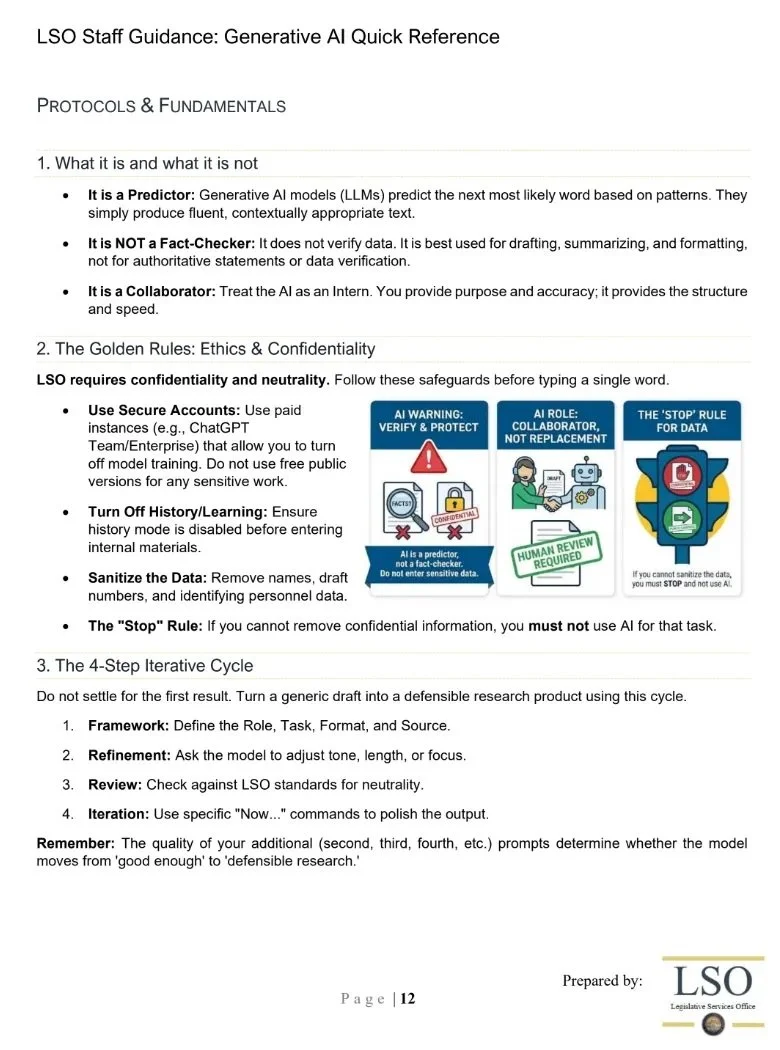
The Use Guide is the conceptual foundation: it opens with a plain-language explanation of how large language models(LLMs) work — specifically, that they generate text through prediction rather than fact retrieval — and uses that definition to draw a clear line between what AI is good for (drafting, summarizing, formatting) and where it should not be trusted (authoritative statements, data verification).
It covers confidentiality, establishing a hierarchy for what can and cannot go into free public tools, and applying a hard rule that if confidential information cannot be removed from a prompt, staff should not use AI for that task at all.
It also builds out a four-part prompting framework (Role, Task, Format, Source) as the foundation for every AI interaction, grounded in the idea that being specific when prompting is an important skill. The Quick Reference page below captures the core of the Use Guide in one place, including the prompting framework and a checklist for reviewing AI outputs before they go into any work product.
2. Walkthrough
The Walkthrough is where that framework gets applied. Rather than working through generic examples, it follows an actual legislative research task: summarizing funding appropriated to the Southwest Idaho Treatment Center (SWITC) for presentation to Idaho’s Joint Finance-Appropriations Committee. The opening prompt instructs the model to “take on the role of legislative researcher” drafting a summary of Health and Human Services funding for Joint Finance-Appropriations Committee members, with the instruction to “keep the language simple.” Successive prompts narrow the output, first identifying what section of the appropriation bill covers SWITC funding, then surfacing differences between the appropriation bill and the Legislative Budget Book, then requesting a one-page summary of the most important takeaways.
The guide requires fact-checking every figure and statement before it goes into an LSO work product. Step 5 reads: “This is where we leave ChatGPT and do the remaining work by hand. We need it to be perfect, a step above ‘good.’”
Why other states should take a look
What makes this guidance particularly transferable is that the problems it addresses — confidentiality risk, unverified AI outputs entering work products, staff needing practical prompting skills — are common across legislative staff agencies regardless of size or resources. Developed by a small team of internal IT analysts, these resources are grounded in how legislative offices actually operate.
If your office is working through similar questions, we are happy to connect you with the people who developed these materials.
The Adoption Tracker
A regular feature of each edition, the Adoption Tracker maps who’s piloting what tools and for which legislative functions — research, bill drafting, constituent services, committee operations, back-office administration — including non-AI modernization wins.
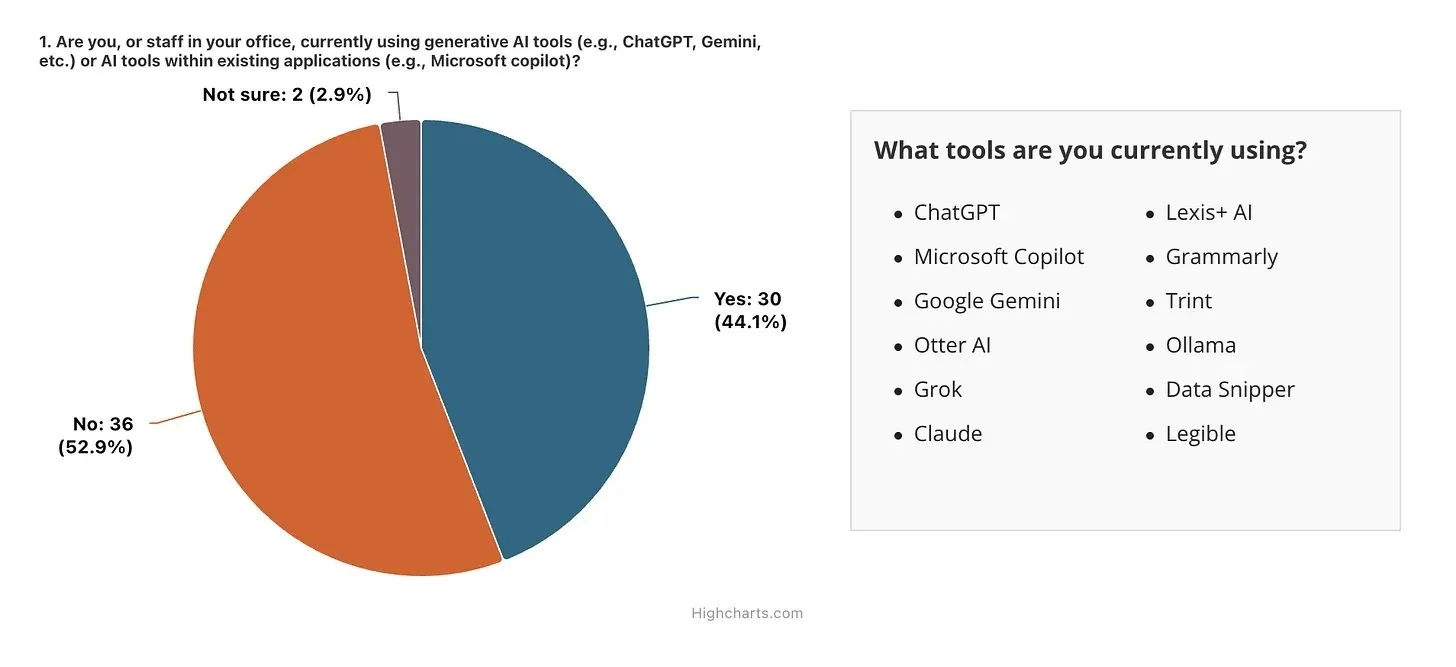
NCSL’s 2025 survey makes clear why that kind of tracking matters: AI use among legislative staff more than doubled in a single year, from 20% in 2024 to 44% in 2025. OpenAI’s ChatGPT and Microsoft Copilot are the most commonly used tools. As NCSL’s Will Clark noted, the real number is likely higher: “these are people taking surveys willing to admit that they’re using this.” Meanwhile, the number of legislatures with a formal AI use policy has stayed flat. Adoption of AI in legislative workplaces appears to be outrunning governance.
Here is what we are tracking:
Massachusetts - Legislature-specific AI rollout
While Governor Healey’s ChatGPT announcement made headlines, we have been told that the state legislature had already quietly rolled out Microsoft Copilot for its own staff last summer — one of the first known instances of a legislature directly provisioning a commercial AI tool.
Iowa - Bill analysis and legislative tracking
Iowa’s House deployed Legible, a purpose-built AI platform, during its 2025 session. Both Republican and Democratic caucus staff used the tool for bill analysis, tracking 2,000+ bills, and streamlining workflow. Legible’s “bill chat” feature lets staff interrogate documents directly. The platform is actively mapping expansion into new states.
Arizona - AI Committee
In January 2026, House Speaker Montenegro created the House Committee on Artificial Intelligence & Innovation — one of the first standing legislative committees in the country dedicated to AI — to shape state policy on workforce, education, and emerging technology.
Colorado - Gemini pilot
The state required training before tool access, then collected 2,000 use cases from 150 employees — one-third saved over six hours a week. It is an Executive branch model, but the training-first, use-case-inventory approach is directly applicable to legislative offices. Full case study.
Washington - AI acceptable use policy
The Washington Legislature is one of the few state legislatures with a formal, legislature-wide AI acceptable use policy. And it is currently redrafting it. A key question driving that process: whether staff prompts entered into tools like ChatGPT constitute public records under state law. Has your state taken a position on this question? We’d love to know about it!
Governance & Risk
Staff AI use is outpacing institutional policy; the same NCSL survey that found AI use among staff doubled in a single year shows that the share of offices with a formal use policy grew only marginally, from 20% to 23.5%.
For offices working through these questions, Idaho’s model above is a useful starting point, and POPVOX Foundation has also published a free, customizable AI use policy template for state legislative offices.
What We Are Watching
Events, resources, and tools:
NCSL Legislative Summit — July 27–29, Chicago
Two sessions worth flagging: a panel on what internal AI adoption actually looks like in practice (When Generative AI Joins the Staff, Monday), and AI “godfather” Geoffrey Hinton gives the keynote on risks and rewards for state government (Tuesday). Full agenda.
Code for America’s 2026 Government AI Landscape Assessment
Just released, this resource maps all fifty states on AI readiness. It is focused on executive agencies not legislatures, but provides useful context for how each state is progressing with AI adoption in government.
NCSL’s AI Essentials for State Legislatures
A free on-demand video resource specifically for legislators and staff on integrating AI into legislative work. A good starting point if your office is in the early stages of exploring AI adoption.
Claude Code for State and Local Government
Anthropic's recorded webinar provided an overview of what state agencies are already piloting, and included a discussion on challenges and security/compliance during the Q&A section that state legislature audiences may find valuable.