
Notes from the World e-Parliament Conference on what “keeping humans in charge” of AI really means in parliaments
BY BEATRIZ REY
Cambridge Dictionary named “human” its word of the year, defining it as “having the qualities, faults, and feelings that people have, as opposed to gods, animals, or machines.” I think it’s the right choice, especially after this week. At the European Parliament in Brussels, I watched a video that imagined a future in which, by 2050, chatbots had replaced all humans in parliaments, presented as a provocation. I was there for the World e-Parliament Conference, which I attended as part of my research on AI in parliaments. For two days, I sat through panels on how parliaments are adopting AI. When I went back through my notes, the word I had written most often was “human.”
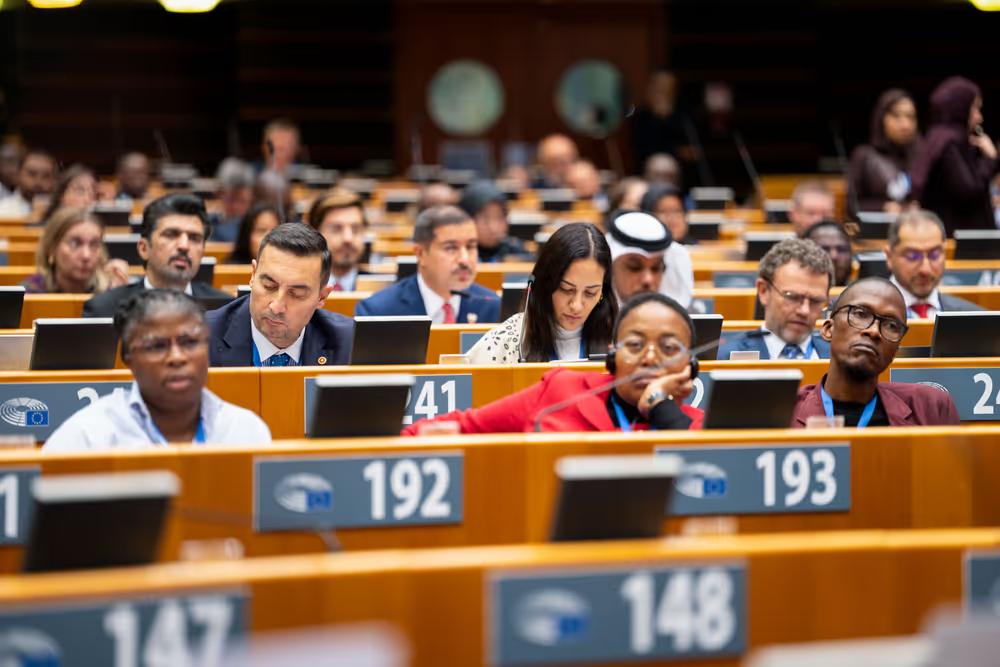
Attendees at the World e-Parliament Conference in Brussels (© European Union 2026 - Source : EP)
But “human” meant two different things in Brussels. Sometimes it meant a person checking the machine’s work, such as reviewing a transcript or verifying a translation. Other times it meant the political judgment and accountability that belong to elected representatives. The first kind will matter less as AI becomes more capable for work that can be automated, like transcription, translation, and document search. The second will become more important as AI spreads, because someone elected still has to answer for what a parliament decides.
The Inter-Parliamentary Union (IPU) launched the World e-Parliament Report 2026 during the conference. Of the chambers the IPU surveyed in 89 countries, 88% already use AI in some form, yet 46% don’t currently check whether that use complies with any rules. The report’s answer is governance, and many of its examples rely on the first kind of human: a person reviewing the output. The Swiss Parliamentary Library lets users switch off its AI search tool, and staff keep the final say. Estonia’s parliament transcribes its meetings with AI, but people still review the result. France’s National Assembly requires a person to verify any AI-assisted legislative work. These checks make sense for today’s tools, but as AI improves, more of this work may be possible without a person reviewing every step.
That doesn’t mean parliaments will stop needing people. To illustrate, the report notes that the German Bundestag found AI did little for bill drafting because drafting depends on judgment and context that current tools cannot reliably reproduce. AI will get better at the technical side of drafting. But behind every bill sit choices that belong at the core of politics: deciding which problems deserve attention, weighing competing views and possible solutions, and reaching a decision that represents, as well as possible, what the majority wants.
If AI can take over the work that can be automated, people in parliament have more time for the work only they can do. That’s why the human obstacles the report identifies are a real problem. Risk aversion, fear of failure, and resistance from middle management can stall AI projects that would make parliaments work better. On the first day, I talked with Rodrigo Goñi, president of Uruguay’s Chamber of Representatives, about exactly that. He said there is broad agreement that one of the biggest obstacles is parliamentarians’ reluctance to move toward a parliament powered by AI but run by humans. He sees AI as an opportunity, because “parliaments were already losing credibility before the AI revolution.”
One way past that risk aversion may be learning from each other, another theme that kept coming up at the conference and in the report. Eighty-eight percent of parliaments say they learn from their peers, and 34% already offer AI support to other parliaments. The report finds that help from other parliaments often works better than assistance from outside organizations. Chile’s Chamber of Deputies, for example, adopted ArchileBot, an AI assistant for legislative archives first developed by the European Parliament, and then showed Argentina, Mexico, Peru and Uruguay how it built and tested the tool.
I saw other examples at the conference, and I’ll write about them in the coming days. Until then, here is the question from the report that stayed with me. AI agents, systems that can carry out a series of tasks on their own, are starting to reach parliaments. In the near future, an agent might search past debates, draft a briefing and circulate it to committee members, and no one will check every step along the way. The IPU report warns that agents need clear lines of accountability, even when no one person intervenes at each step, and that parliaments should set these up before they deploy them – not after. In a parliament, those lines have to lead back to elected officials. How to make that work with agentic AI is a question I’m still thinking about after reading the report.
Modern Parliament (“ModParl”) is a newsletter from POPVOX Foundation that provides insights into the evolution of legislative institutions worldwide. Learn more and subscribe at modparl.substack.com.