

Building the Future of Parliaments, Together: Digital Parliaments Project 2026 Q3 Convening Progress Report
The Digital Parliaments Project's Q3 2026 convening recaps summer regional workshops in Albania, Ghana, and Miami, new ParlLink updates including a chatbot creator and added languages, upcoming AI assessment and training resources, vibe coding experiments, and plans to expand the global parliamentary community.
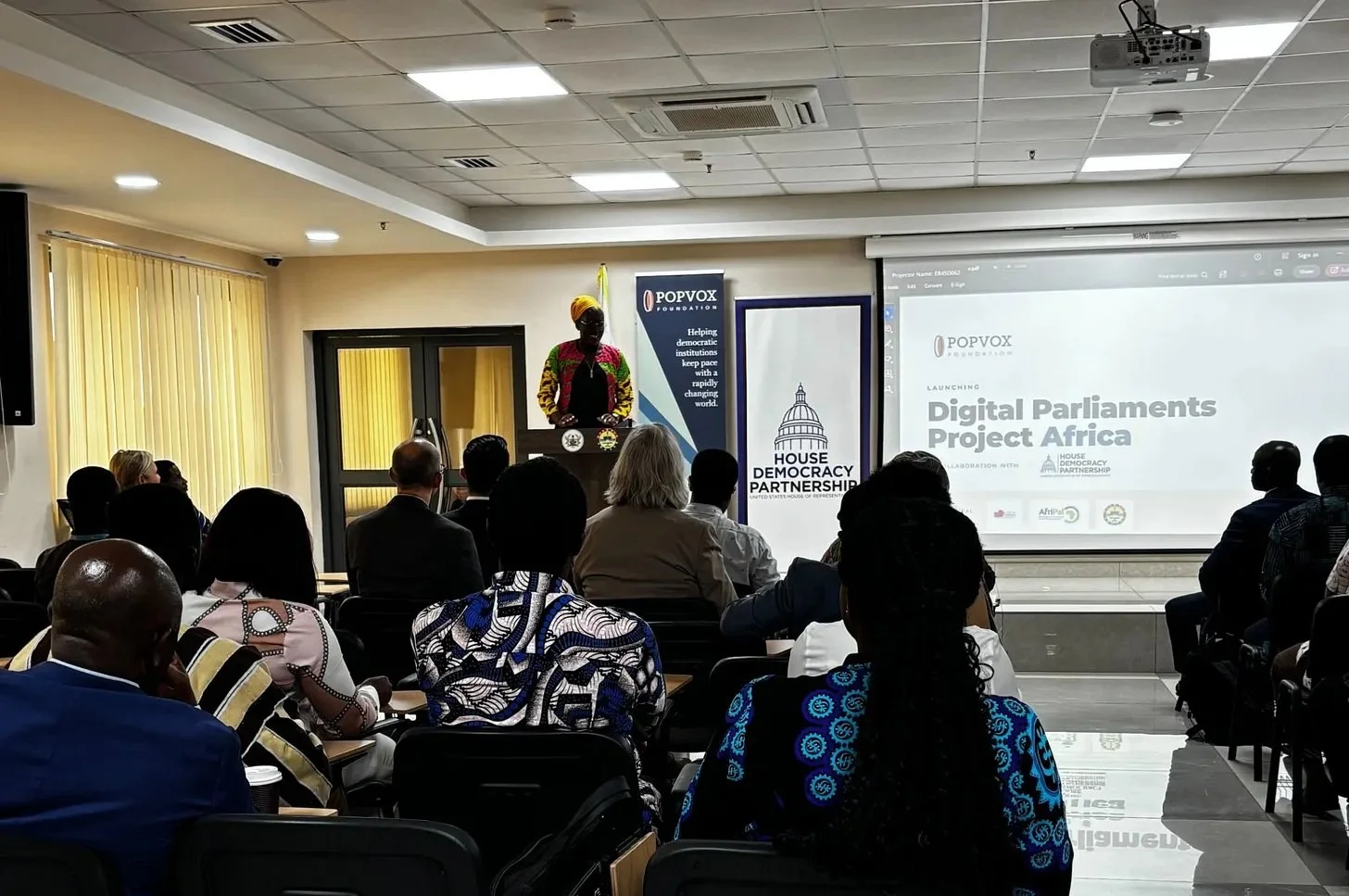
POPVOX Foundation Launches Digital Parliaments Project in Africa
The Digital Parliaments Project has expanded into Africa, with POPVOX Foundation and the House Democracy Partnership launching the initiative at a ceremony hosted by the Parliament of Ghana, uniting leaders from across the continent to advance AI-enabled tools for legislative transparency, constituent engagement, and parliamentary modernization.

Digital Parliaments Project Launches in Africa with Workshop in Accra
Parliamentary staff and institutional leaders from Ghana, Botswana, The Gambia, Senegal, South Africa, and the Pan-African Parliament gathered in Accra for the launch of the Digital Parliaments Project Africa, building skills in AI adoption, digitization, and governance modernization through hands-on training and cross-institutional knowledge sharing.
From Shadow to Institutional AI
Parliaments worldwide are adopting AI faster than they're governing it, with unsanctioned "shadow AI" tools signaling gaps in official systems. Institutional AI offers a framework separating legislative AI from consumer or enterprise tools, keeping core functions human while AI assistance scales with a decision's stakes.

AI and Legislative Modernization Workshop with Balkan and Moldovan Parliaments
POPVOX Foundation, in collaboration with the House Democracy Partnership and hosted by the Albanian Parliament, convened parliamentary staff from Albania, Kosovo, North Macedonia, Serbia, and Moldova in Tirana from July 20 to 23 for a workshop on AI and parliamentary modernization.
How Parliaments Are Learning to Live With AI
The European Parliament, Chile's Chamber of Deputies, and the US House of Representatives are testing distinct approaches to institutional AI adoption — centralizing access through a new platform, regulating disclosure and accountability, and empowering staff to build their AI tools — revealing three competing theories about legislative AI risk.
What AI Reveals About Legislative Capacity
State legislatures across the US show uneven AI adoption, with staff usage nearly doubling in a year while formal policies lag behind. Institutional knowledge often rests with single experts, and human review requires genuine source verification, not passive oversight of AI-generated output.
The Latest in Parliamentary Modernization and AI
Canada's new national AI strategy and Parliament's human-centered AI approach, IPEN's leadership transition to Sarah Moulds, and comparisons between Commonwealth Parliaments and US state legislatures on institutional culture and technology. Plus IPU's Geneva AI governance talks, Tajikistan's legislative AI training, and POPVOX Foundation's NCSL Chicago reception on parliamentary modernization.
What Two Years of ModParl Have Taught Me About AI in Parliaments
Two years of ModParl reveal what legislatures need for AI adoption: digitized information foundations, an institutional lens treating parliaments as information processors, AI literacy across staff and Members, engaged leadership, ICT-staff collaboration, governance frameworks, and incremental experimentation building toward institution-wide strategy rather than isolated pilot projects.
Modern Legislative Tools for African Parliaments
AFRIPAL, WFD, and POPVOX Foundation convened parliamentary staff and civil society from across Africa to explore digital transformation for legislatures. Topics included AI-powered tools, data standardization, cybersecurity, and ParlLink — a platform converting paper records into searchable legislative data.
AI Is an Institutional Challenge, Not an ICT Project
Annelie Lotriet, Deputy Speaker of the National Assembly of South Africa, examines why artificial intelligence readiness demands institutional leadership, not just ICT solutions. She explores Member literacy gaps, university partnerships, disinformation risks, and how AI could transform legislative oversight, research, and citizen engagement across national and provincial parliaments.
From Paper to Knowledge: How AI Is Changing the Value of Parliamentary Records
African parliaments are exploring how AI can unlock the value of digitized parliamentary records — from searching Hansards and tracking legislation to monitoring government assurances. The Digital Parliaments Project, led by POPVOX Foundation and partners, is building the data infrastructure to make that possible.
Building the Future of Parliaments, Together: Digital Parliaments Project 2026 Q2 Convening Progress Report
POPVOX Foundation's Digital Parliaments Project Q2 2026 convening covered ParlLink platform updates including bulk upload, a new data agreement, and AI prompting guides for parliamentary staff. Looking ahead: DPP launches in the Balkans and Africa, plus a Caribbean Parliamentary Modernization Summit in Miami this September.
Democracy, AI, and the Limits of Technological Pessimism
Pope Leo XIV's AI encyclical frames artificial intelligence as a civilizational threat to human dignity and democracy — but is that framing too deterministic? A nuanced look at AI's democratic risks and possibilities, situated within a longer transformation of informational life already reshaping political institutions.
Inside the NYC Council’s Policy “Primeval Soup”
How the NYC Council built a digital infrastructure to manage its legislative workflow — from an AI-powered duplicate checker that resolves sponsorship disputes, to a RAG system preserving institutional memory, to automated compliance tracking — and what it means for legislative modernization more broadly.
Modernization Without AI?
One year on, the UK House of Commons Modernization Committee has advanced coordination and institutional reform — but largely sidesteps AI and digital transformation. The gap highlights growing tension between modernization efforts and rapidly evolving technologies reshaping legislative workflows, decision-making, and institutional capacity worldwide.
Building the Future of Parliaments, Together: Digital Parliaments Project 2026 Q1 Convening Progress Report
Explore how the Digital Parliaments Project is modernizing legislatures through shared learning, open-source tools like ParlLink, and AI-powered digitization. This Q1 2026 progress report highlights global collaboration, field insights, and practical innovations helping parliaments streamline workflows, manage data, and accelerate digital transformation.
“Without Haste, but Without Pause”: How Uruguay’s Parliament Is Approaching AI
At the IPU Assembly, Rodrigo Goñi Reyes, Speaker of Uruguay’s Chamber of Deputies, outlines Uruguay’s AI strategy, emphasizing regulation as an “enabling condition” for adoption. The approach highlights sequencing, institutional trust, and global coordination, offering a model for balancing innovation, risk management, and parliamentary modernization in the AI era.
From Use Cases to Institutional Choices
At the Inter-Parliamentary Union Assembly, parliamentary leaders examined how legislatures are moving from isolated AI use cases to coordinated institutional strategies. Insights from Germany and the UK highlight challenges in governance, capacity-building, and aligning AI adoption with long-term transformation and legislative effectiveness.
Staff Remote Work in Parliaments: Uneven Starting Points
Insights from the Inter-Parliamentary Union Assembly reveal how parliaments approach remote staff work, from advanced frameworks in the UK and Canada to infrastructure constraints in developing legislatures. The debate highlights trade-offs in flexibility, cybersecurity, productivity, and institutional resilience across uneven global starting points.