
What Exactly Is AI, Anyway?
South Carolina tackles AI definitions, plus the unexpected benefits of digital accessibility for AI
State of the Art is a newsletter spotlighting innovation, technology, and institutional capacity in America’s statehouses. Learn more and subscribe at stateoftheartgov.substack.com.
Hi everyone,
Happy October! It has been a crazy few weeks in AI advancements and safety! To stay up to date on all that, I am linking our latest edition of Keeping Pace, another POPVOX Foundation newsletter that recaps advancements in AI to help legislative staffers understand the latest developments. If you are struggling to digest any of the latest news, this is a great resource to lean on!
With so much happening in AI, it is worth remembering that keeping pace with the technology is only part of the challenge for state legislatures. The time, expertise, and resources available to legislatures shape how they adopt AI, and AI itself offers opportunities to expand what those institutions can accomplish. This relationship between AI and institutional capacity is something I have returned to more than a few times in State of the Art. (And I am certainly not done yet!)
Earlier this month, I had the opportunity to discuss that relationship with some of the people navigating it firsthand. I joined NCSL’s National Association of Legislative Information Technology (NALIT) group for their Professional Development Seminar in Raleigh, North Carolina, and presented our findings from State Legislative Capacity in the AI Era. It was also a great chance to hear how legislative IT teams are making the most of their resources, finding creative solutions, and expanding what their institutions can accomplish!
And, unsurprisingly, that same relationship of AI and capacity runs through this month’s edition, particularly in our state spotlight on South Carolina, where legislators are building a working understanding of AI to make informed policy decisions about the technology. Check it out below!
As always, feel free to reach out with what you are working on or where you are seeing these dynamics in your work! I would love to hear from you (caitlin@popvox.org)!
Until next time,
Caitlin McNally
Program Associate
POPVOX Foundation
State Spotlight
South Carolina Starts with the Definition
As states grapple with how to respond to artificial intelligence, South Carolina is beginning with a foundational question: What exactly are we trying to govern?
South Carolina’s Senate Special Committee on AI held its inaugural meeting on September 16, focusing on the foundational considerations for developing statutory definitions of AI. By its own review of other states, South Carolina is a little late to the party: 33 states already have statutory definitions of AI and 34 states have created some form of task force or working group focused on AI.
But perhaps there’s an advantage to a later start: the opportunity to approach the work with greater intentionality. As the committee begins a multiyear examination of AI’s implications for government, education, and businesses, it is taking time to build its understanding of the technology before developing policy around it. Put simply, it is treating AI literacy as a prerequisite to AI policymaking.
And South Carolina has plenty of examples to learn from. Using NCSL research, Senate staff compiled statutory AI definitions, highlighting that even within the same state, multiple definitions often exist to serve different legislative purposes. A handful of states have adopted definitions for specific terms such as high-risk AI systems, companion chatbots, and frontier models. Staff cataloged other states’ AI task forces, committees, and working groups, including whether they had already released final reports or recommendations.
To help make sense of it all, the committee welcomed two University of South Carolina experts to share their perspectives: Bryant Walker Smith, a professor of law, and Homayoun Valafar, Director of the university’s AI Institute.
Smith drew on his experience developing definitions for autonomous vehicles, a process that took years and continues to require revisions. He emphasized that there is no single definition of AI that serves every legislative purpose. A law governing procurement might need a different definition from one establishing liability or identifying systems requiring oversight. The purpose of the legislation also informs which qualities lawmakers should prioritize in a definition: technical accuracy, legal clarity, enforceability, or public understanding. Smith urged lawmakers to consider the scope of their definitions, anticipating how they might apply to future technologies.
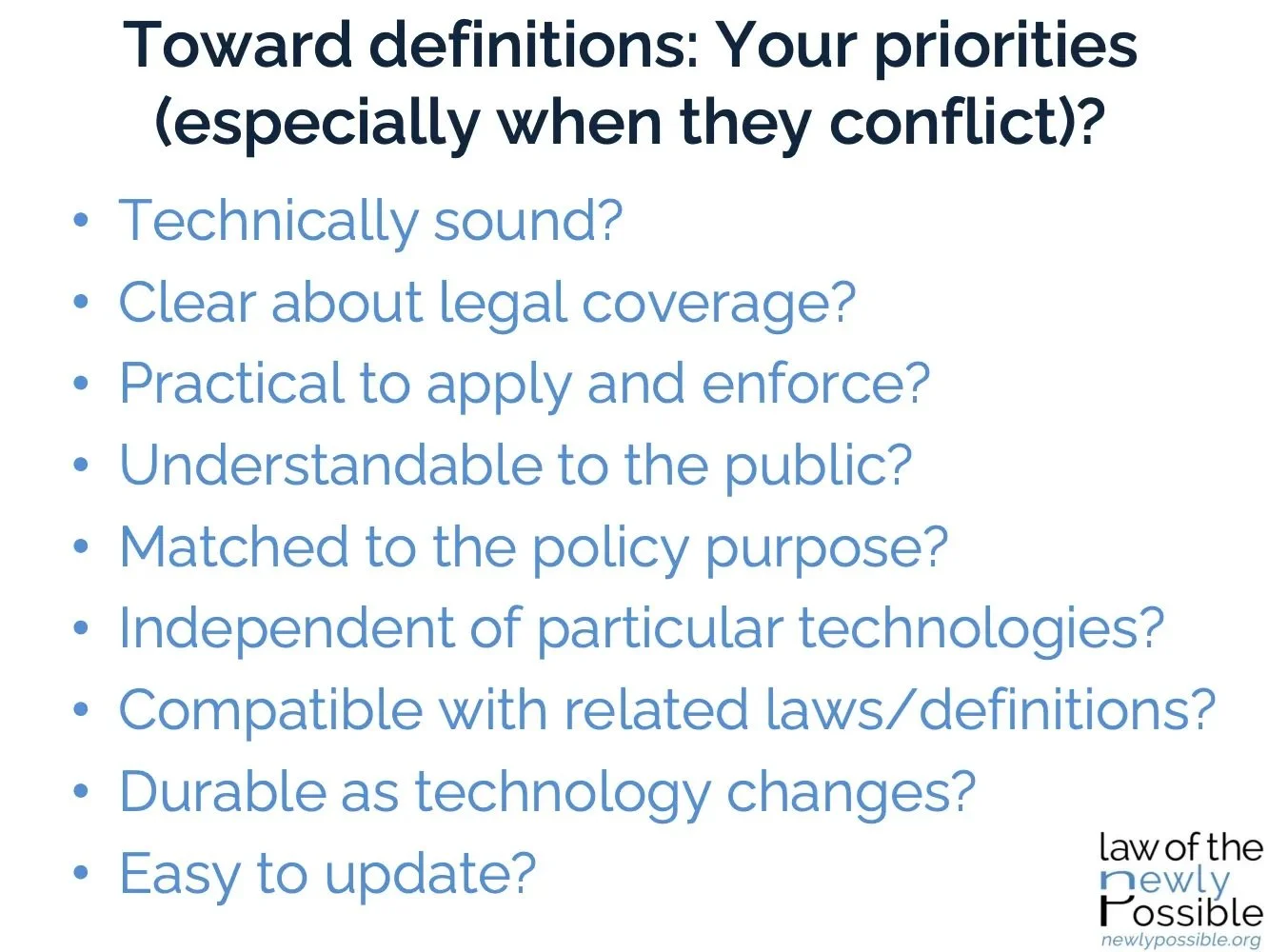
That makes the seemingly simple task of defining AI rather consequential. Getting them right is essential to developing sound, durable policy that achieves its intended purpose and remains relevant as technology evolves. Smith’s presentation offers a useful framework for other legislatures confronting these questions.
Complementing Smith’s legal perspective, Valafar provided a broader overview of AI’s capabilities and limitations, emphasizing the growing importance of AI literacy as the technology becomes more integrated into everyday work. He encouraged the Senators to continue engaging with experts, inviting them to visit the university’s nearby AI Institute.
Together, the presentations underscored that sound AI policy requires both technical understanding and thoughtful legal definitions. By studying other states’ approaches, engaging with experts, and asking fundamental questions about AI, South Carolina is making AI literacy an essential part of policymaking. South Carolina may be late to the party, but it’s making good use of its first steps.
The Adoption Tracker
These Executive branch examples offer ideas for legislative AI adoption while also highlighting emerging uses that legislatures may need to oversee:
Vermont | AI-Assisted Cybersecurity: Vermont trained approximately 100 state developers to use AI to identify vulnerabilities, test code, and secure government applications, helping patch several dozen systems.
Vermont | AI-Assisted Ballot Proofing: Vermont’s Secretary of State’s office used AI to check hundreds of ballots against candidate records, flagging potential errors for staff review and completing the process in three hours.
Kansas | Modernizing Constituent Services: Kansas’s Department of Labor is using AI in chatbots, transcription, and coding to modernize unemployment services, offering lessons for legislative constituent services and agency oversight.
Governance & Risk
Digital Accessibility and the Future of Legislative Information
Digital accessibility was a major topic at this year’s NALIT conference, as legislative IT teams prepare to meet new federal requirements under the Americans with Disabilities Act (ADA). By April 26, 2027, state legislatures must ensure their websites and digital content meet WCAG 2.1 Level AA standards, subject to certain exceptions. For legislative IT teams, compliance involves more than updating websites. It also requires examining how bills, committee materials, and other legislative documents are created, formatted, and published to ensure they are accessible to people using assistive technologies.
As highlighted in recent NCSL reporting, Minnesota is incorporating accessibility checks directly into document production workflows. These efforts also have implications for AI adoption. Consistent, well-structured documents are easier for assistive technologies to navigate and for AI tools to search, interpret, and summarize. As legislatures improve the accessibility of their public records, they may also be laying the groundwork for more effective AI-assisted research and analysis.
What We Are Watching
Two events for legislative staff:
NCSL Base Camp | October 20–21: This virtual conference for staff includes several sessions on AI in the legislative workflow.
CSG South Staff Academy for Governmental Excellence | November 15–19: A professional development program in Oklahoma City brings together state government staff for leadership training and peer learning.
And a recorded webinar to check out:
CSG South, Practical AI Adoption for Government Staff: This recorded webinar explores real-world AI applications, staff training, and strategies for introducing AI into government workflows.
And a cool tool from the public:
North Carolina, AI-Powered Legislative Explanations: Developed by student Shrenik Sridharala with support from a state senator, NCPoliSearch uses AI to generate plain-language bill summaries and arguments for and against legislation, helping the public better understand proposals before the General Assembly.