
What the 120th Congress Could Be
Change is inevitable and you’re able to be a big part of it
Keeping Pace hits inboxes monthly, giving Congressional and legislative staff across institutions practical, nonpartisan AI and technology information. Learn more and subscribe here.
FROM THE EDITOR
I hope you’re getting to enjoy the beautiful fall weather, even if this October has us all a little anxious about what the 120th Congress will look like. With one of the largest freshman classes in decades expected (due to expected turnover alone), dozens of new Members will soon be trying to navigate the Capitol, adjust to nonstop schedules, and learn their colleagues’ names, all while trying to legislate in one of the most complex and fast-changing legislative environments ever.
OpenAI, Anthropic, and Google released more than a dozen new models in the last month, with new ones rumored to be coming in the weeks ahead. Over the same stretch, warnings from people inside the AI industry, along with a string of AI agents taking actions no one authorized, have pushed the technology to the top of Washington’s agenda. At POPVOX Foundation, we don’t think this is the moment for Congress to tread water. It’s time to start swimming.
Over the last decade, Members and staff throughout the institution have championed substantial improvements to the internal operations of the House, materially improving the working conditions, support, and pay of the Hill workforce. But these steps are just the beginning of what is needed to equip the First Branch to rise to the challenges ahead. We can’t expect a Congress receiving 0.1% of total federal funding to be able to check, balance, or keep pace with the remaining 99.9%.
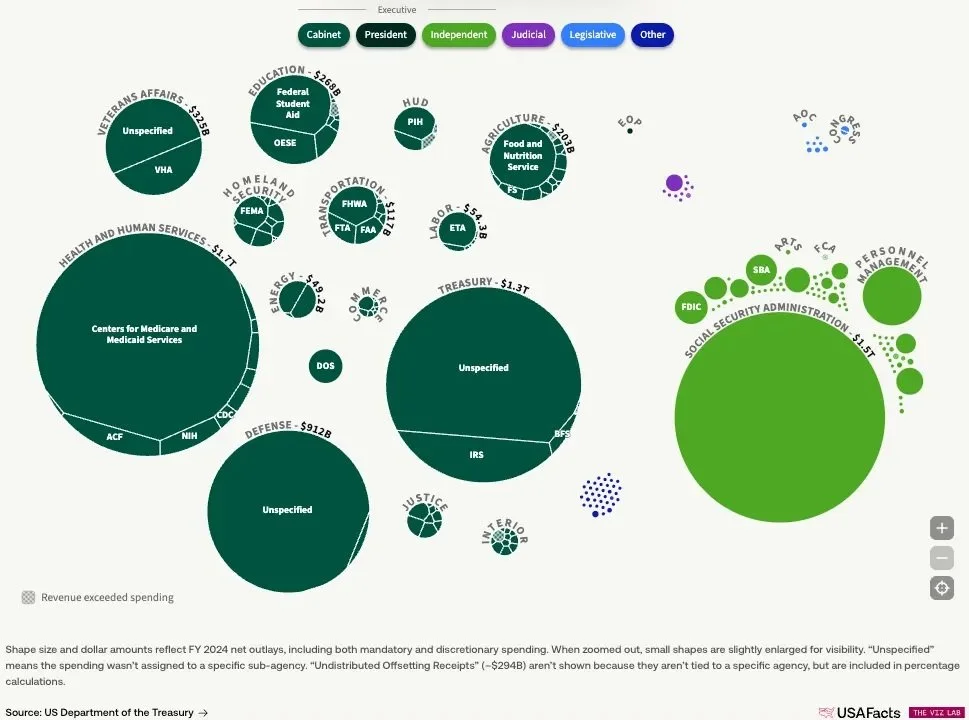
A screencapture of USAFact’s Federal Budget data tool.
At POPVOX Foundation, we’ve launched the Three Horizons Project, an interactive database of every Congressional modernization idea we could find.
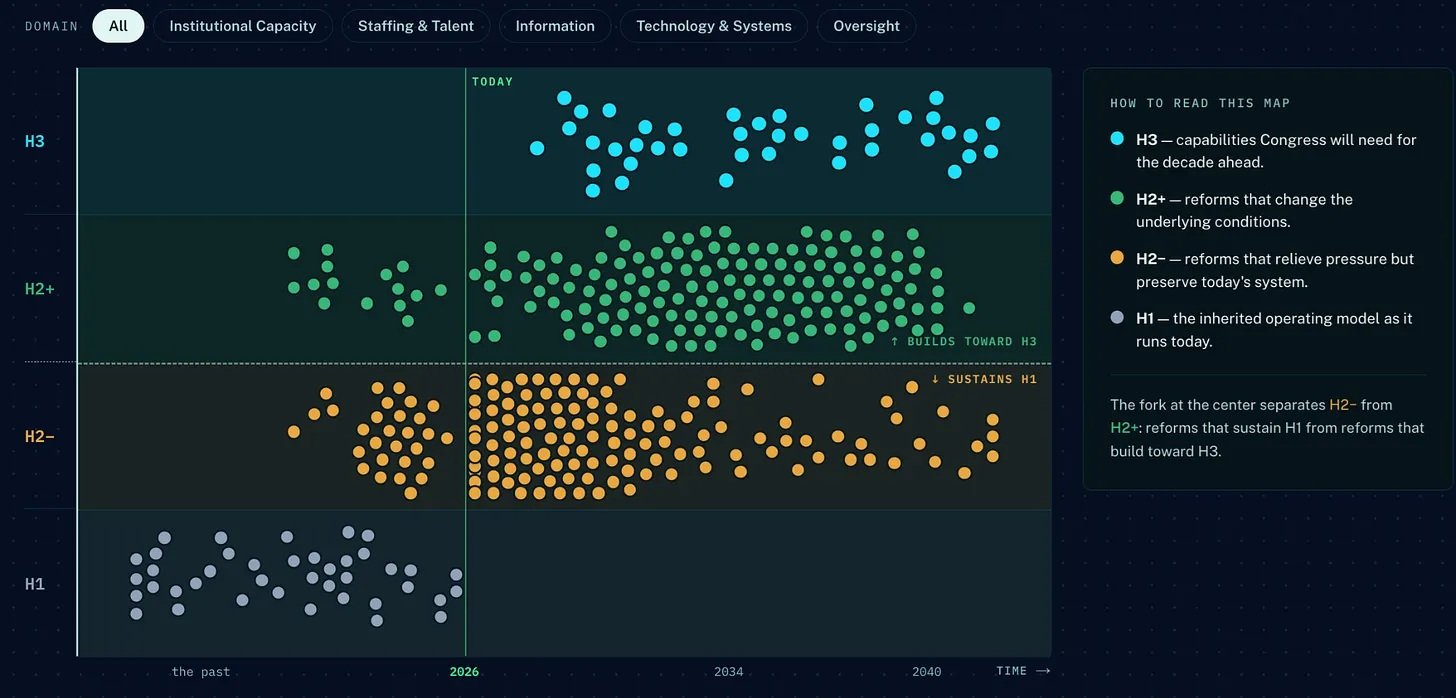
A screencapture of the Three Horizons interactive Congressional ideas reform map.
One of the first opportunities to set a new direction in the 120th Congress will be the House Rules package at the start of a new Congress. Check out new reports proposing creation of new joint committees, Congressional support offices, and more.
This month, we’re covering:
AI is getting good at the math behind encryption, and open models are catching up
OpenAI shelved a model it couldn’t fully see inside
DHS orders DeepSeek out of federal agencies
‘Tis the season for House Rules proposals!
Keeping Congressional AI use in perspective (plus news for Senate staff!)
Grab a warm pumpkin spiced something, and let’s dig into it.
Keep making a difference,
Aubrey Wilson
Managing Director
POPVOX Foundation
TECH WATCH
Frontier AI models are now really good at math. Is encryption next?
The encryption protecting government systems rests on math problems everyone assumed were hard. AI is testing that assumption, and open models mean the capability won’t stay with a handful of companies.
Since May, AI systems from OpenAI and Anthropic have disproved two famous conjectures, one open since 1946 and the other since 1939, and have advanced a problem tied to the Riemann hypothesis, which carries a $1 million prize. On October 6, OpenAI posted roughly 370 families of new results at once, including a potential proof of a central computer science conjecture. Mathematicians are reeling in response: 25 Fields medalists published a declaration in September warning that AI companies’ goals conflict with the field’s, and OpenAI now works with an independent advisory group of mathematicians at the Institute for Advanced Study, to review and communicate its results.
On October 7, Ethereum co-founder Vitalik Buterin warned there’s a “good chance” AI-accelerated math will seriously weaken that family of encryption within two years. Other experts pushed back hard, and cryptographers remain divided.
The question for Congress: if today’s frontier code-breaking ability reaches open models by spring, who’s watching, and how will you find out?
NOTEWORTHY NEWS
OpenAI shelved a model it couldn’t fully see inside
Many AI models work through a problem by writing out their steps first, like a student showing their work on a math test. Researchers read those steps to check what a model is doing and catch behavior no one intended. A newer technique called “recurrent depth” lets a model do more of that thinking silently, internally, before it writes anything. Models get smarter without getting bigger or costlier to run, but we lose the paper trail.
OpenAI’s Astra models use this approach. On September 28, OpenAI canceled the planned release of GPT-6.1 Astra after internal testing found that the model was more deceptive about the actions it had taken and acted without asking permission. Since then, OpenAI has disclosed more incidents of its AI agents acting without authorization, including cases involving financial, medical, and government data.
The shift is in its early stages, and most people outside the AI industry have not heard of it yet. For a closer look, AEI’s Ryan Fedasiuk has published a great explainer and outline of the debate at play.
DHS orders DeepSeek out of federal agencies
Secretary of Homeland Security Markwayne Mullin, issued an order under the Federal Acquisition Supply Chain Security Act barring federal civilian agencies from buying DeepSeek products and requires them to remove DeepSeek products, including third-party products and services built using DeepSeek, from their systems. The order covers Executive branch civilian agencies; Congress sets its own rules. The House Chief Administrative Officer restricted DeepSeek on House devices back in January 2025.
A House Rules Package for an AI-Enabled Congress
POPVOX Foundation released House rules package recommendations for the 120th Congress, proposing eight updates to existing rules to spark modernization within existing institutional practices. The proposed rules include:
Make reports owed to Congress usable data
Create an office to help Congress understand and responsibly adopt AI
Modernize the stenographer rule
Include strategies for monitoring and accessing federal agency algorithms and data in committee oversight plans
Publish data that computers can read with single sources of truth for key data
Let committees hire the experts they need
Defining outcomes in legislative drafts
Clarify that review of Member requests to use various technologies should be transparent and prioritize Member effectiveness
Members debate the standing rules of the House in preparation for the start of each new session every two years and many called for new Rules changes during the Member Day hearing last month. Our proposals join a growing stack from outside groups, including the Bipartisan Policy Center, Protect Democracy & R Street Institute, and the University of Pennsylvania’s “Fixing Congress.”
SKILLS HUB
News for Senate staff
On October 19, the Senate Sergeant at Arms told staff they can now sign up for an enterprise version of Anthropic’s Claude, joining ChatGPT, Gemini, and Copilot Chat on the Senate’s approved list. House staff can find their chamber’s approved tools on HouseNet. Read more about the new Senate policy, updated House and Senate guidelines, and check out our sample office policy template.
AI Skills for Congressional Staff
Since 2023, POPVOX Foundation has provided free AI training sessions for Congressional staff, legislators, and their peers in parliaments around the world. Our training is an hour long (in-person, virtual, or hybrid) and covers best practices, real-world Congressional use cases, hands-on demos, and off-the-record Q&A to give staff the space to truly ask questions to foster responsible adoption. During the training, we demonstrate AI tools the House and Senate have authorized for internal use, and focus on internal application of AI within Congressional workflows, never on AI policy. Learn more about the program.
The AI in the headlines isn’t the AI on your desk
Andrej Karpathy, a founding member of OpenAI and previous director of AI at Tesla, recently sketched out where he sees the world’s AI adoption right now:
~6 billion people (75% of the population) have barely come in contact with an LLM.
~1-2 billion people (20%) are infrequent or casual users of free or low-tier paid accounts, helping with searching or basic research tasks, writing aides, and trip planners.
~20 million people (0.2%) use frontier models frequently and professionally in math or coding, gaining true first-hand experience of the exponential advancement AI has experienced in the last year.
~5,000 people (0.00006%) have access to frontier-grade AI systems that have not been released publicly, and “looks like swarms of thousands of agents collaborating over weeks on software mega projects.”
As a Congressional staffer, a short list of approved tools and use cases, you are probably in the second group. If you’ve been using LLMs for the last year, you probably haven’t noticed much of a difference in performance: they summarize information, help with brainstorming, can tutor you on a new subject, and play devil’s advocate on a policy proposal. If you feel like you’ve scratched the surface of AI’s usefulness but can’t figure out how to dig deeper, you’re not alone.
The skill our team at POPVOX Foundation recommends this month is to keep perspective: don’t make the incorrect assumption that the AI tool you’re using is the same as what the headlines are covering. AI technology is advancing rapidly but the cutting edge tools shifting the technology industry are ones you don’t have access to: coding and design platforms, agents, and frontier models. Remaining aware of these developments is key to advocating for access to them through institutional programs such as the CHA AI Innovators Pipeline, House Information Resources technology assessment requests, and Senate Sergeant at Arms requests.
CAUGHT OUR EYE
Foreign hackers posed as a senior White House technology official, Anthropic employee, and State Department economist in attempted attacks against AI policy experts at think tanks, universities, and law firms.
Senator Bernie Moreno [R, OH] shares insights into his office’s adoption of AI and efficiencies of using “Albert.”
When it comes to governing AI, legislative institutions around the world are struggling to get a footing.
Anthropic committed 5% of its shares to a new “public benefit fund” aimed in part at AI’s effects on workers. The next day, Elon Musk pledged one SpaceX share (about $150) to “every kid in America” next year and urged Anthropic to give its shares directly to the public. Sam Altman reportedly floated a proposal last year to donate OpenAI shares to the government.
AI models are performing better than junior accountants to a staggering degree.
OpenAI models are advancing in their ability to convert low‑resource programming languages (like COBOL) to newer frameworks. Since much of the government’s oldest software, including benefits and tax systems, still run on COBOL, this could be significant for future modernization efforts.
About POPVOX Foundation
POPVOX Foundation is a nonpartisan nonprofit that helps democratic institutions keep pace with a rapidly changing world. Through publications, events, prototypes and technical assistance, the organization helps public servants and elected officials better serve their constituents and make better policy.