
The State of Congressional Casework: A Landscape Analysis
BY ANNE MEEKER

Download (PDF)
Executive Summary
Legislative constituent services, or casework, is a critical function for Congress’ ability to build trust, serve constituents, and learn from how its own laws actually land in people's lives. Member offices’ self-reported year-end data from 2025 shows that many offices work directly with thousands of constituents, and bring back millions of dollars in delayed and retroactive benefits that support their communities. Beyond those dollar figures, casework also regularly surfaces systemic problems that go on to become subjects of formal oversight or reform. A rough estimate of 15% of every Member office's staff capacity already goes to constituent service, and that number is growing as individual Member offices invest in this work.
However, years of sustained underinvestment, compounded by steadily rising pressure on the work, are bringing casework to a boiling point. What is missing is the institutional infrastructure to capture, aggregate, and route what caseworkers produce — and the cultural shift required for Members, committees, and the institution as a whole to treat casework as the policy and oversight resource it is.
Key Findings
1. Slow-moving structural governing crises are driving increasing baseline casework demand.
Federal programs and the agencies that administer them are decaying along two distinct tracks: policy decay and accumulated implementation infrastructure debt. The cumulative effect of decades of deferred action on both fronts is that more and more constituents encounter program failures that no amount of normal customer service can resolve, and the residual demand flows to Congressional offices.
2. In response to Executive-branch agency instability, legislative offices function as uncompensated surge capacity for Federal agencies.
When agencies cannot respond to constituents in moments of crisis or routine, constituents call Congress. Congressional offices end up functioning as uncompensated surge capacity for federal customer service, with the cost showing up as opportunity cost for the Legislative branch — depleting resources Congress needs to assert its Article I authority.
3. Caseworkers themselves have driven the most important professional developments for the field of the last five years.
Uniquely among Congressional staff positions, caseworkers self-organize into cross-party, chamber-wide chats that allow for coordination, mentorship, information-sharing, and — critically — institutional advocacy for professional support. That advocacy has produced real institutional responses, most notably the Senate EAP's caseworker forums and the House Chief Administrative Office (CAO) Coach Program's Casework Working Group. However, caseworkers still lack essential resources to deduplicate efforts and appropriately train and support staff to handle high-stakes cases.
4. Institutional responsiveness is important but uneven.
The House Select Committee on the Modernization of Congress and the Committee on House Administration's Subcommittee on Modernization and Innovation have paved the way for important caseworker support programs, but those supports remain fragmented and inconsistently advertised to caseworkers. The most important innovation of this period is CaseCompass, the House Digital Services casework data aggregator, which is close to launch to all House offices.
Key Recommendations
1. Launch CaseCompass and scale to the Senate.
CaseCompass does not solve the problems documented in this paper, but it creates the data infrastructure on which every other recommendation here depends. For lasting impact and maximum value from the House’s investment to date, CaseCompass will require additional funding to move from pilot to general availability across the House, and to begin building toward a Senate equivalent.
2. Establish a Casework Liaison Office, ideally bicameral.
This Office should formalize constituent service in Congress with permanent staff and programs, undertake long-term stewardship of the CaseCompass aggregator and maintenance of the underlying taxonomy, provide consistent resources and visibility for casework teams across both chambers, socialize CaseCompass data to committees in a nonpartisan way, and serve as the institutional voice for casework as a profession.
3. Codify minimum agency responsiveness standards.
Building on the GAO study now underway, Congress should formalize what agencies owe the Legislative branch when Members submit inquiries on behalf of constituents, including established criteria for response time, what information may be shared, and escalation pathways.
4. Build the agency-side infrastructure for the inter-branch feedback loop.
The Government Service Delivery Improvement Act, EO-driven CX initiatives, and the broader customer-experience reform agenda should explicitly recognize Congressional inquiries as a legitimate input into agency operations, and the feedback loop between branches as a vital area for ongoing investment and innovation. The highest-volume casework agencies — SSA, VA, USCIS, and others whose programs drive the bulk of demand — should establish independent, statutorily-empowered constituent advocate teams modeled on the Taxpayer Advocate Service as the agency-side anchor for that loop.
5. Develop opt-in baseline competence standards and certification for caseworkers.
The Casework Liaison Office (Recommendation 2) should lead the development of voluntary training and certification pathways that offices can use to credential staff handling complex, high-stakes cases. The framework should fully respect Members' authority to hire and train staff as they see fit, while recognizing both the specialized expertise required to do casework well and the potential for harm to constituents and to the institution when inexperienced staff are asked to handle high-stakes matters without adequate preparation.
Taken together, these recommendations chart a path from the current patchwork of caseworker-driven adaptation toward institutional infrastructure proportional to casework's role in Congressional service. The convergence of demand, institutional readiness, and external attention captured in this report represents an unusual window for structural investment. Congress, federal agencies, and the broader civil society field should act on that opportunity while it remains open. The cost of inaction is not stasis but further erosion of legislative capacity and constituent trust.
Table of Contents
Casework as a profession
Introduction: What has Congress done for me lately?
Most people working in Congressional capacity-building today can recite the same depressing narratives about the focus of their work like a sad catechism: over the last few decades, Congress has lost ground on staff numbers, expertise, overall productivity, and trust from the American people.
But the overriding sense of pessimism misses one of the most invisible-to-DC yet impactful areas of legislative work: constituent services, or casework.
Since 2022, POPVOX Foundation has had the unique opportunity to launch a program vertical focused on researching, documenting, and supporting legislative constituent service work. Constituent service is a critical element to Congress’ ability to address the pacing problem in multiple ways: it is a critical opportunity to build or rebuild trust with the American people by direct, collaborative problem-solving, demonstrating accountability and commitment to service; it is a vital tool for Congress to monitor Federal agency operations and maintain independent data sources on how programs are implemented; and through this work, it attracts, trains, and retains expert staff with deep local relationships, cross-agency experience and perspectives, and deep implementation expertise.
Three key observations have emerged from four years of this program:
First, casework is a massive institutional investment for a capacity-limited institution. POPVOX Foundation’s 2024 informal survey of Congressional office staff suggests that 15% to 20% of all Member office staff perform some constituent service function as part of their role.¹ When Congress allocates its scarcest resource (its limited staff) at this scale, it is making a serious statement of priorities, whether or not the institution as a whole has fully grappled with that investment. The pure staff count also does not capture the institutional resources that support casework, including but not limited to:
Member office spending on Constituent Relationship Management (CRM) tools to manage casework, in addition to other channels for constituent engagement;
Casework-dedicated programs from the House Chief Administrative Officer and Senate Education and Learning;
Staff time supporting casework and caseworkers in auxiliary institutional support organizations like the Congressional Research Service;
Congressional campus space dedicated to agency liaison offices in the House “Main Street” space, and more.
While data is sometimes difficult to come by, the trend line is clear: casework is an increasingly large proportion of legislative resources.
Second, casework delivers measurable value back to constituents. Self-reported figures from a handful of offices’ 2025 year-end reports, tracked in POPVOX Foundation’s Casework Navigator newsletter,² give a window into the scale and gravity of the matters caseworkers handle, even though these figures are not yet collected systematically or reported on a comparable basis.
Cases closed.
Money returned.
Results reported by fourteen Congressional offices.
Senate
3 OFFICESHouse
11 OFFICESThese numbers are not currently comparable in any rigorous sense: different offices count different things, report different categories, and use different methods of counting dollars returned. But across both parties and both chambers, the consistency of the pattern is clear. Casework is, in dollar terms alone, returning real money to the constituents who are directly served by the institution. In a period where the dominant narrative around Congress is institutional decay and gridlock, casework stands out as a key area where Congress can demonstrate accountability and competence, and produce real results.
In a period where the dominant narrative around Congress is institutional decay and gridlock, casework stands out as a key area where Congress can demonstrate accountability and competence, and produce real results.
Beyond closed cases and dollars returned, casework also regularly surfaces systemic problems at federal agencies that go on to become subjects of formal oversight, agency reform, or legislative action. Caseworkers documented the patterns of misconduct underlying the 2014 VA Phoenix wait-time scandal years before it reached national attention.³ Caseworkers flagged the unfolding 2022 infant formula crisis well before it became the focus of high-profile Congressional hearings.⁴ Caseworkers identified the implementation problems with the pandemic-era Employee Retention Credit that have since drawn sustained Taxpayer Advocate Service and GAO attention.⁵ Caseworkers worked on-the-ground with sources and constituents to help American citizens and Afghan allies evacuate during the 2021 Afghanistan withdrawal, as documented in American Ingenuity.⁶ In 2024, Georgia Congressional offices uncovered undisclosed USPS reorganization plans that would have substantially affected mail delivery in their districts through routine casework.⁷ Smaller-scale insights surface every day, all over the country — Rep. Marie Gluesenkamp Perez [D, WA] has publicly discussed, for example, identifying complex state daycare regulations in her district through constituent outreach and casework.⁸ These specific examples illustrate what casework already does, and what it could do at scale if its insights reached the institution as a whole.
Third, casework plays an increasingly prominent role in how Member offices talk to their constituents, and how constituents and journalists understand and evaluate Member performance. POPVOX Foundation’s Casework Navigator newsletter has documented local news coverage of casework successes and performance from across the country, demonstrating the increasing willingness of Congressional offices to pitch casework-focused stories, and increasing appetite from local media outlets to cover them. POPVOX Foundation’s own casework work has been covered or cited in the Washington Post, the Atlanta Journal-Constitution, CNBC, CQ/Roll Call, Federal News Network, FedScoop, GovExec, NextGov, Bloomberg Government, the Brookings Lawfare podcast, Lee Drutman’s Politics in Question podcast, the Highway to Hill podcast, the GovNavigators show, and academic work.⁹ ¹⁰
However, casework’s increasing prominence and success comes from a less positive set of changes in how people interact with their government in the United States: there is simply growing demand for help. Policy and administrative decay within federal agencies create a slow-moving crisis that drives casework demand to the Legislative branch. The hollowing out of social service agencies and state and local programs similarly drives demand for support even on non-federal programs to casework operations as some of the most prominent representatives of government with accessible local offices and staff. Volatility in the Executive branch policymaking apparatus under multiple administrations has created confusion and uncertainty, again creating pressure on Congressional offices to serve as translators, educators, community navigators, and advocates.
Over the last four years, the Casework Navigator program at POPVOX Foundation has worked closely with caseworkers from both chambers and both sides of the aisle, institutional offices that support casework, technology vendors who maintain the infrastructure of casework, journalists who cover casework, academic researchers who study casework, and constituents who benefit from this public service. This broad approach and perspective positions POPVOX Foundation as one of the only organizations with insight into the entire distributed network of actors who make up modern casework, and the trends and dynamics currently shaping the profession.
As POPVOX Foundation prepares to close this chapter of the Casework Navigator program, this report is designed to capture and document a moment in time for casework, along three substantive dimensions:
1. The substantive demand side of casework
What work are constituents actually bringing to Congress, why, and how is that changing?
2. The professional conditions of casework
What does it mean to be a caseworker today, how has the profession itself changed, and how is casework’s rising visibility inside and outside Congress reshaping the field?
3. Where casework should go from here?
What institutional reforms would let Congress capture the full value of its investment in casework, and who should move that work forward within the Legislative branch? How can civil society organizations dedicated to supporting Congress best encourage and facilitate these investments from the outside?
The most important question facing the casework field today is not whether casework is changing, but whether the reform work being done is building toward the future system caseworkers and the constituents they serve actually need.
Acknowledgements
This report is adapted from a presentation Casework Navigator program lead (and former House casework director) Anne Meeker was invited to give to the Senate Employee Assistance Program’s casework forum, the Senate EAP’s Casework Managers’ working group, and state-level delegations of Congressional caseworkers from Maryland and Illinois. This paper is sharpened from the questions, comments, and contributions from participants in these working groups and delegations, as well as several currently-serving caseworkers and institutional support staff who were kind enough to review the working draft before publication.
Casework Demand
Few observations have surfaced more consistently through the Casework Navigator program than the changing nature of casework itself: caseworkers and casework managers who held the same roles a decade ago would barely recognize the work today. This is not a romantic idealization of how things used to be; it is a specific, professional claim about how the demand on casework operations has changed in both degree and kind.¹¹ This section concentrates on that demand side — what work constituents are bringing to Congressional offices, why they are bringing it, and how that landscape has been reshaped.
Caseload burdens are unevenly distributed.
One of the most common questions about casework — how many cases do offices handle? — is one of the hardest to answer. Individual Congressional offices manage caseloads through individual instances of Constituent Relationship Management (CRM) programs (discussed at further length below), which are neither shared between offices nor released publicly. This means that reliable data about offices’ caseloads are difficult to come by; however, several pieces of evidence point to key aspects of casework demand.
First: demand is not distributed evenly across offices or across the country. POPVOX Foundation’s informal caseload survey in late 2024, the closest thing the field has to a recent national picture, reveals enormous ranges in what counts as a “standard” caseload, with markedly different bands between the chambers. In the House, offices reported averages of 10 to 51 new cases opened per week and 6 to 50 cases closed in the same period; in the Senate, those averages ran from 40 to 325 new cases opened and 20 to 220 closed. Goals or averages for open cases per caseworker ran from 40 to 110 in the House, with historical highs in the 200s, and 60 to 300 in the Senate. At the team level, House offices targeted between 100 and 430 open cases and Senate offices between 250 and 2,000.¹² Anecdotally in conversations with casework teams since this survey was conducted, the vast majority of offices agree that 2025 was a record year for casework demand, so these self-reported averages may be undercounts even for the past 18 months.
Congressional Caseloads
Weekly volume, per-caseworker load, and team-level targets reported across House and Senate offices.
Weekly Volume
Per Caseworker
Per Team
This variation is part of the challenge for both casework teams and the institutional support offices working with them. Managing a House team carrying 100 active cases at any given moment is fundamentally different work than managing a large Senate team carrying 2,000, and the institutional support each office needs is different as well. While Senate offices’ resources and budgets are set by a formula that takes variable population levels into account, House offices’ budgets are more or less fixed,¹³ meaning that some offices are managing caseloads four times greater than their peers with the same available resources. Advice and “best practices” that work well for a high-volume office may be overkill for a low-volume office, and vice versa.
The variation between offices is not only a difference of number, but also kind. Different parts of the country, with different demographic compositions and different relationships to federal programs, produce different case mixes: immigration-heavy in some districts, military and veterans-heavy in others, disaster-heavy in still others. POPVOX Foundation’s joint paper with Protect Democracy and New America on constituent services in multi-member districts treats this variation in some depth.¹⁴
Punctuated equilibrium
Beyond demographic and federal agency program adoption, one key driver of inconsistent caseloads stands out: disaster and crisis casework.
For the last decade and a half, casework demand has moved through a pattern of punctuated equilibrium. Every office in the country can expect (and must plan for), in any given year, to weather some kind of major casework volume event: a disaster, an international crisis, a major policy shock, a government shutdown, a federal program disruption. The intensity varies, and every district is obviously vulnerable to different shocks; however, at scale, the surges form a surprisingly consistent feature of casework today.
The major casework-driving events of the last two decades give some sense of the professional experience of casework for seasoned caseworkers — and a sense of why caseloads do not simply reset after each event ends.
| Year(s) | Event | Casework Impact |
|---|---|---|
| 2005 | Hurricane Katrina | Years of disaster and displacement casework across the Gulf states15 |
| 2008 | Financial crisis16 | Foreclosure and unemployment cases at volumes most offices had never seen; long-tail casework related to rising demand for other safety net programs including SSDI and VA Compensation and Pension |
| 2010 | Haiti earthquake | Immigration and repatriation casework, including recovery and return of the remains of deceased American citizens |
| 2017 | Hurricane Maria | Multi-year disaster and recovery casework |
| 2018-2019 | Partial government shutdown | Agency-disruption casework across the federal landscape including homeland security agencies, federal employees, etc. |
| 2020-2022 | COVID-19 pandemic | Sustained, multi-year surges across many agencies and programs simultaneously; pandemic-era relief casework still active in 2026 |
| 2021 and ongoing | Afghanistan withdrawal17 | Thousands of urgent immigration and evacuation cases; many Afghan families remain in the immigration process today |
| 2022-2023 | Post-pandemic passport surge | Enormous State Department case overflow |
| 2023 | October 7 attacks | Repatriation and immigration casework |
| 2024 | Hurricanes Helene and Milton | Active multi-state disaster and recovery casework |
| 2025 | Government shutdown | Agency-disruption casework; exacerbated by many legislative offices placing staff on furlough |
| 2025 | DOGE restructuring and program changes | Sustained federal-employee and program-disruption casework |
| 2026 | Iran war | Repatriation casework on top of ongoing immigration casework |
| Recurring | Western drought and wildfire cycles | Seasonal and recurring disaster casework |
| Recurring | Local disasters: tornadoes, flooding, plant closures, industry collapses | Varied and complex local casework, often including disaster programs as well as wayfinding and connections to local relief, liaising with state counterparts on unemployment and emergency SNAP/WIC benefits, replacing destroyed or damaged documents, etc. |
Essentially, there are few headline news events of the last two decades that have not produced some form of accompanying casework demand.
Essentially, there are few headline news events of the last two decades that have not produced some form of accompanying casework demand.
For caseworkers who have been doing this work for multiple years, these represent cumulative caseload burdens, with the aftereffects lasting multiple years or even decades. For example:
The COVID-19 pandemic added entirely new categories of programs to caseworker portfolios that have not gone away.
As of April 2026, the National Taxpayer Advocate is still publishing reminders to constituents about claim deadlines for pandemic-era relief — meaning many Congressional offices are still working with constituents to obtain refunds, credits, and benefits originating in 2020 and 2021.¹⁸
The Afghanistan withdrawal added immigration casework volume that has not yet abated; many Afghan families that Congressional offices first began working with in 2021 remain in the immigration process more than four years later, now navigating the cumulative effects of subsequent policy changes and, most recently, the fallout from the Iran war on regional travel and processing.
The DOGE restructuring is currently producing casework that will continue for years after the immediate restructuring concludes.
Programs created in response to crises are added to the roster of programs that caseworkers must master and translate to constituents.
It is worth noting separately that disaster casework, especially local disaster casework, carries a distinct mental health burden. Caseworkers handling cases for constituents in their own communities, sometimes while they themselves are personally affected by the disaster, take on a level of vicarious trauma that few other Congressional positions encounter.
Slow-moving structural pressures and capacity transfer
Beyond the punctuating crises, the last decade has seen the gradual accumulation of slow-moving structural crises that drive baseline casework demand upward, independent of any acute event. Three deserve particular attention: the cumulative effects of policy decay and implementation infrastructure debt at federal agencies; the brittleness of agency responsiveness mechanisms; and the erosion of community-level social services.
Policy decay and implementation infrastructure debt
The most foundational of these structural pressures takes two distinct but reinforcing forms.
The first is policy decay, or the impact when the underlying statutory rules and eligibility thresholds for government programs are not meaningfully updated for years or decades — therefore drifting further from the real-world conditions they were designed to address.
One clear and common example in casework is Supplemental Security Income (SSI). SSI’s income and resource limits, unchanged in nominal terms since 1989, push more disabled Americans below the program’s asset and earnings thresholds every year as inflation and minimum-wage reforms move wages up. When these limits are not changed in response to changing economic conditions, more beneficiaries run afoul of the rules, creating a cascading wave of challenges that often show up in casework, including overpayments, enrollment termination, associated program termination (e.g., when a beneficiary loses Medicaid or SNAP benefits when their Social Security benefit is terminated), appeals, and reinstatements. Decay of this kind generates casework not because anyone has made a recent decision to exclude constituents making over this threshold from benefits, but because Congress has not made a recent decision at all.¹⁹
The second is implementation infrastructure debt: the cumulative under-investment in the technology, systems, and processing capacity that agencies use to administer the programs they are responsible for. The Executive Office for Immigration Review runs case backlogs measured in years. The Veterans Affairs Compensation and Pension system continues to grapple with the legacy of decades of underinvestment in claims processing infrastructure, relative to increasing numbers of veterans from half a dozen major conflicts. The list could continue at length, across nearly every consequential federal program. Where policy decay produces failures of design, implementation infrastructure debt produces failures of execution, and the two compound on one another wherever they coexist.
The cumulative effect of decades of deferred action on both fronts is that more and more constituents encounter program failures that no amount of normal customer service can resolve, and the residual demand flows to Congressional offices.
The cumulative effect of decades of deferred action on both fronts is that more and more constituents encounter program failures that no amount of normal customer service can resolve, and the residual demand flows to Congressional offices.
Agency-side casework response capacity
The additional demand produced by modernization debt further strains the mechanisms by which Congress and the Executive branch communicate to resolve individual cases. Caseworkers report that agency responsiveness is the single greatest challenge impacting their effectiveness, and one of the most acute changes for the worse over the past decade. The pandemic was a decisive moment of inflection. Many experienced agency liaisons retired or otherwise left federal service during the pandemic years in 2020 and 2021, taking with them the knowledge of casework norms and program-specific challenges that made them effective working partners. Their departure also disrupted long-standing agency practices, including fly-in trainings for caseworkers, introductory briefings for new Congressional offices, and other relationship-building infrastructure that had operated largely on institutional memory.²⁰ The trend was exacerbated in 2025, when federal Reductions in Force (RIFs) and broader workforce reductions in many cases impacted the very staff tasked with responding to Congressional inquiries.²¹
The legal scaffolding around agency responsiveness to Congressional inquiries is, in practice, thin. Sean Kealy’s recent paper for the Administrative Conference of the United States²² documents the substantial variation in how agencies handle Congressional inquiries — some have defined standard operating procedures, others do not; some accept phone calls to check case status, others route everything through DC-based liaisons and online portals; some return responses in seven days, others in ninety or longer. Most of what “responsiveness” entails is normative and customary practice, built up over decades, and the customs are growing more brittle.
The hollowing out of liaison capacity also pushes Congressional offices toward alternative escalation pathways when the formal channels cannot move quickly enough, and many of the most reliable workarounds are political rather than institutional. A Member with strong personal relationships across the Executive branch, a senior leadership position, or majority-party access can pull a Cabinet secretary aside during a briefing or hallway encounter on Capitol Hill and surface a constituent issue directly; a newly-elected Member or a Member in the minority party generally cannot. The pattern was documented at scale in the context of the Afghanistan withdrawal, where offices with established Executive branch relationships moved cases through channels that other offices did not have access to. It surfaced again during the March 2026 Iran war: when a tour group of Utah residents was stranded in Dubai amid the closure of regional airspace, Rep. Blake Moore [R-UT] pulled Secretary of State Marco Rubio aside on Capitol Hill, worked the situation directly through Rubio and his staff, and helped secure state-chartered flights home for the stranded constituents.²³ The constituent outcomes in cases like these are significant — and seniority, existing relationships, and party have all always played a role. But the underlying pattern is one in which agency-side capacity erosion compounds the disadvantage faced by new offices, minority-party offices, and offices without senior leadership access in a function that is supposed to be available evenly across the membership.
The underlying pattern is one in which agency-side capacity erosion compounds the disadvantage faced by new offices, minority-party offices, and offices without senior leadership access in a function that is supposed to be available evenly across the membership.
This is not to say that all agency interactions with Congress are bad or worsening: on the contrary, some agencies have heavily invested in managing their relationships with Congressional offices, including in technology to help manage higher caseloads with fewer staff. The Taxpayer Advocate Service’s new online portal allows offices to see all of their open cases with TAS and re-assign or escalate cases within the portal, cutting down on the number of back-and-forth email or phone calls between caseworkers and the agency. Some TAS offices operate entirely as “Congressional-only” operations, partnering symbiotically with Congressional offices to respond to constituent demand. The Office of Personnel Management was one of the first agencies to invest in a custom-built case intake portal, and has recently migrated that portal to ZenDesk for easier internal agency tracking. Customs and Border Protection staff have also invested in internal tools that allow frequent, routine, and low-stakes cases to be more or less automated, freeing up agency staff for more complex interactions with caseworkers on higher-stakes cases. Agencies that invest in constituent-facing modernization upgrades based wholly or in part on casework as a demand signal also see appreciation and gratitude from Congressional offices, including the State Department’s overhaul of its passport processing system after the post-COVID demand surge.
Some agencies
are investing.
Not all agency interactions with Congress are bad or worsening.
What they built
The new portal lets offices view all open TAS cases and reassign or escalate them directly, reducing back-and-forth emails and calls between caseworkers and the agency. Some TAS offices operate entirely as "Congressional-only," partnering symbiotically with Congressional offices.
One of the first agencies to invest in a custom-built case intake portal, OPM has recently migrated that portal to ZenDesk for easier internal agency tracking.
Staff have invested in internal tools that allow frequent, routine, and low-stakes cases to be more or less automated, freeing up agency staff for more complex interactions with caseworkers on higher-stakes cases.
The department rebuilt its passport processing system after the post-COVID demand surge, a modernization driven in part by casework volume.
In an ironic vote of confidence in the effectiveness of casework, some experienced caseworkers even report seeing an increase in casework referred directly by staff at agencies themselves: for example, a Social Security field office referring a constituent to their Members of Congress to resolve an issue pending at a Social Security Payment Center.
However, on the whole, caseworkers express deep and ongoing frustrations with agency responsiveness, which increases caseloads: the longer cases take to resolve, the longer they sit open within Congressional offices, meaning additional time in constituent relationship management and escalation pathways where necessary. This is a challenge that no amount of better caseworker training, better internal Congressional support, or better casework technology can fully solve. The binding constraint sits on the other side of the inter-branch relationship.
This is a challenge that no amount of better caseworker training, better internal Congressional support, or better casework technology can fully solve.
The cumulative effect of these dynamics is a sustained transfer of capacity from the Legislative branch to the Executive branch through the channel of casework.²⁴ When agencies cannot respond to constituents because they are understaffed, because their technology cannot keep up, because their leadership is in transition, because policy is changing faster than administration can adapt — constituents who need help do not give up. A significant share of them call their Members of Congress. The Congressional office, finding itself the only entity providing local, on-the-ground, trusted access to the federal government across all programs and agencies at once, takes the call. In sustained crisis periods, offices reassign staff slots from policy, communications, and operations to casework simply to keep up. Congressional staff, in effect, operate as uncompensated surge capacity for federal agency customer service. This is work that does not show up on any agency’s books, but does show up as opportunity cost for the Legislative branch.
The relative size asymmetry between the branches pushes this phenomenon to absurdity. Since 1976, the Legislative branch has received at most 0.48% of federal discretionary spending; in FY2024, the entire Legislative branch — tasked with overseeing all federal spending — was funded at roughly the same level as the Food and Drug Administration.²⁵ Asking that same branch to absorb the customer-service overflow from agencies that are themselves dramatically better-resourced creates a compounding imbalance that intensifies with every crisis. The 2025–26 environment has driven the dynamic to a particularly acute pitch: Sen. Lisa Murkowski [R-AK] noted in February 2025 that the Senate switchboard was receiving 1,600 calls per minute against a normal-operations baseline of 40, with the volume knocking the switchboard off the hook entirely on several occasions.²⁶ The pattern itself predates the current administration and will continue past it until Congress acts to formalize the inter-branch relationship in casework.
Declining social services
The third slow-moving crisis driving baseline demand is the contraction of community-level social services. As public-sector and nonprofit capacity has eroded over the last two decades, constituents who would once have been served by a community organization or a state or local program increasingly land at the Congressional office instead. Mid-level institutions, like neighborhood centers, local nonprofits, libraries, and community service hubs, have eroded to the point of structural failure.²⁷ One-third of US community nonprofits lost or experienced severe disruptions to government funding in early 2025, and federal rollbacks, grant cancellations, and DOGE reviews cost 45% of surveyed nonprofits critical funding by mid-2026.²⁸ Behavioral health facilities have closed in large numbers in recent years, and decades of state hospital closures unmatched by community investment have routed vulnerable populations through homelessness, emergency rooms, and the criminal justice system.²⁹ Where services survive, they are geographically uneven: high-poverty tracts have seen net losses in local services while resources cluster in higher-income areas, and the agencies that remain frequently lack capacity to take referrals.³⁰
Many caseworkers noted that this declining support ecosystem does not result in a corresponding decrease in demand for support — rather, that demand shifts to the remaining local support structures, including Congressional offices. Constituents in need who do not know where else to turn to find support often call the most prominent representative of “the government” writ large, which is frequently their local Congressional office.
Constituents in need who do not know where else to turn to find support often call the most prominent representative of "the government" writ large, which is frequently their local Congressional office.
Caseworkers report that “miscellaneous,” “non-federal,” and “referrals” categories including mental health triage, housing and rehab placement, homelessness outreach, private-company customer service disputes, senior services, disability advocacy, mediation, and legal referrals, among others, have skyrocketed in recent years. Strictly speaking, this type of work is very much up to the discretion of the Member and their team, and the formal Ethics rules have long restricted House offices from making direct referrals to outside organizations (although offices can refer constituents to other organizations who provide referral services like 211, Community Action Programs, legal aid societies, etc.). In practice, many House offices have done so for years anyway, and the inconsistency points to uneven enforcement of ethics standards across the institution rather than any settled view of boundaries for Congressional service. The House has now caught up to what was already happening: under recently updated Ethics guidance, Member offices are explicitly permitted to cohost constituent service events with outside organizations and to publish referral resource lists on their official websites.³¹ The rule change is an acknowledgment that offices are responding to a demand the original framework did not anticipate.
These dynamics also help explain part of the variation in caseload size across Congressional offices noted earlier: districts and states with thinner local service ecosystems face a structurally different casework demand than those with more robust nonprofit infrastructure, even before differences in demographic composition, federal program intensity, and disaster exposure enter the picture.
Changing constituent attitudes
In addition to changes in quantity and types of cases, caseworkers across the country also point to subtler changes in the attitudes and dynamics constituents bring to their side of the casework equation.
Casework is, at its core, an act of collaborative problem-solving between two parties who have to trust each other in some basic way to make any progress. The caseworker has to trust that the constituent is being honest about the facts of their case and is coming to the office in good faith; the constituent has to trust that the caseworker is working hard, taking their problem seriously, and will deliver the truth even when the outcome is not in the constituent’s favor. However, constituents and caseworkers do not enter into these collaborative problem-solving relationships cold: the landscape of trust is shaped by public opinion of Congress writ large, as well as trust in the Member’s party, and then trust in the Member himself or herself.
The public’s declining trust in Congress, as demonstrated in the Gallup numbers, is an exacerbating factor for difficult casework.³² Casework is a public-facing role working with the general public, often with people who have already experienced significant frustration with an unsolvable issue at a federal agency. While these difficult circumstances routinely produce grace and selflessness from constituents in extraordinary circumstances, they also frequently provoke constituent aggression, confrontation, and abusive behavior toward caseworkers, interns, and other front-facing staff. Experienced caseworkers report that constituents are arriving less patient, less generous in their initial framing of the case, and more likely to expect drop-everything service. Constituent expectations of immediate responsiveness, including evening and weekend responses — once unusual or confined to truly emergency-level casework — are now common.
While these difficult circumstances routinely produce grace and selflessness from constituents in extraordinary circumstances, they also frequently provoke constituent aggression, confrontation, and abusive behavior toward caseworkers, interns, and other front-facing staff.
Anecdotally, caseworkers also report more constituents engaging in what caseworkers call “Member shopping,” or contacting multiple delegation Members (one Representative and two Senators) about the same case, especially after getting an unfavorable outcome from the first office they tried. This is a constituent’s right, and there are cases where switching offices opens up new approaches or competencies that produce a different outcome — due partly to the different emphases on casework or different subject-matter competencies of individual casework staff within different offices. But the rise in Member shopping appears to track with the decline in trust: constituents who do not believe that any single Member office will work hard for them spread their bets. Offices are also taking proactive steps to address this, including sharing case status with delegation colleagues with constituent consent, coordinating on complex cases, and establishing delegation-level protocols.
Safety concerns are also rising sharply for legislative offices. The escalation in threats against Members of Congress and their staff over the last several years has been documented widely in the press.³³ The risks are often more direct for district staff than for DC-based staff, especially in offices located outside government buildings with formal security installations. District and state offices are by design set up for direct constituent contact; the same accessibility that makes them effective also exposes the staff who work there. Caseworkers occupy a particularly exposed position within the office: they handle a disproportionate share of contacts from constituents who arrive already feeling wronged by the federal government, as well as those in active mental health crisis; they meet with constituents in person; and their names and contact information often spread informally through community networks. The safety dimension of casework is frequently an exacerbating challenge for caseworker mental health.
Asserting Article I Authority
The good news is that Congress has begun to act, even if modestly, to strengthen its own position on casework, especially on establishing its authority relative to Executive branch agencies. Three developments are worth marking.
CASES Act
The CASES Act of 2019 was intended to streamline Privacy Act Release Form guidance so that Congressional offices could provide casework services for constituents without requiring printed signatures — an obvious and overdue fix, especially in disasters where constituents may not have access to a printer. The Act has, in practice, not been implemented as intended. A 2022 GAO review found that agencies interpreted the law considerably differently than its original intent and have not prioritized its implementation.³⁴ Caseworkers today still report inconsistent agency responses on digital signature policies. The CASES Act stands as a cautionary example: clear Congressional intent on casework does not translate into agency behavior without follow-through, and Congress currently lacks a clear institutional stakeholder to oversee casework responsiveness writ large. However, it remains the only place where modern casework is described in law, and important precedent for future casework-related legislation.
Department of State v. Muñoz
The amicus brief filed on behalf of 35 Members of Congress in Department of State v. Muñoz marked a different kind of step. Where the CASES Act was statutory and operational, the brief was a foundational and legal assertion of Members’ institutional standing to engage on behalf of constituents in agency matters.
The case originated as casework. After the US Consulate in El Salvador denied her Salvadoran-citizen husband’s immigrant visa under a provision concerning suspected involvement in unlawful activities, Sandra Muñoz, a US citizen, sought intervention from her Member of Congress, Rep. Judy Chu [D, CA], whose office took the matter to the State Department for review. When that intervention did not produce a different outcome, litigation followed. At the Supreme Court, the central question was whether the denial of a visa to the non-citizen spouse of a US citizen infringed on a constitutionally protected interest of the citizen, and if so whether the government had properly justified its decision.³⁵
The Members’ amicus brief, prepared by WilmerHale, argued that the Executive branch’s broader pattern of withholding information from Congressional offices undermines Congress’ constitutionally prescribed role of advocating for constituents and overseeing the agencies that administer federal programs on their behalf, and urged the Court not to expand the consular nonreviewability doctrine in ways that would further erode Congress’ ability to do that work.³⁶
The Court ultimately ruled against Muñoz on the constitutional question and did not reach the Members’ arguments about Congressional standing or institutional prerogatives in casework matters.³⁷
The case is nonetheless significant for casework: it is one of the clearest recent moments in which a routine casework intervention escalated into a constitutional question, and in which a cross-partisan group of Members went on record affirming that casework is not merely a constituent service offered at Member discretion but a constitutionally-grounded activity the political branches have standing to defend in court.
GAO study on agency responsiveness to casework
An in-progress GAO study on agency responsiveness to Congressional casework inquiries is the third and most ambitious of these institutional moves. As previously noted, the FY2025 Legislative Branch Appropriations report directed GAO to undertake the study within 180 days of enactment, with explicit instruction to make recommendations on minimum response standards and the personnel and technology agencies would need to meet them. The study builds on Sean Kealy’s earlier paper on agency responsiveness for the Administrative Conference of the United States, which documented the substantial variation in how agencies handle Congressional inquiries in practice but focused on agency practices in its recommendations.³⁸ By formally examining timeliness, quality, and consistency across the federal agency landscape, the GAO study will create the record on which any future statutory effort to codify agency responsiveness standards must rest.
CaseCompass pilot
As noted above, it is difficult for internal offices as well as external entities to assess the full scale of demand for Congressional casework — which is critical both for understanding the scale of constituent dissatisfaction with federal services and the capacity that casework occupies within Congress.
One critical development in the last several years aims to address that visibility question: CaseCompass is the casework data aggregator project of House Digital Services within the CAO, prototyped following the Select Committee’s recommendation, scoped over multiple years of consultation with offices and other stakeholders, funded through several appropriations cycles, and currently close to completion and rollout to House offices. The project allows individual offices to opt in to a system that aggregates anonymized casework data across participating offices, surfacing trends and systemic issues that no single office could see from inside its own caseload. It is the first sustained institutional effort to address what American Ingenuity and the Roadmap for Casework Data identified as the central data gap in the casework field: Congress’ inability to see its own work at an institutional scale.³⁹
The capabilities the tool will unlock, and the problems it will begin to address, fall into three broad categories.
First, CaseCompass will give the institution a way to spot emerging trends and systemic issues in close to real time, surfacing problems at particular agencies, programs, or geographies before they become acute.
Second, it will give individual offices the baseline they have never had against which to make management decisions: what counts as a “normal” volume of immigration cases this week, how long a typical SSDI determination is taking, what the agency response time on a specific category of inquiry is in practice. Without that baseline, casework management is a matter of educated guesswork; with it, offices can deploy staff, set expectations, and prioritize cases on the basis of grounded evidence.
Third, and most consequential at the institutional level, CaseCompass will give Congress its own data to bring into interactions with federal agencies. Agencies cannot bluff their way through accounts of poor service when Congress can see the challenges at scale, across the country, across offices, and over time.
CaseCompass originated in Meeker’s testimony to the Select Committee in 2022, where the recommendation to build a casework data aggregator was first formally proposed. POPVOX Foundation has supported the project at every subsequent stage: consulting with the House Digital Services team on the case taxonomy that underpins the data product; advocating with appropriators for the funding that has kept the project alive; socializing the project with offices considering whether to join the pilot; and helping the media and policy world understand what the project is and why it matters.⁴⁰
CaseCompass does not solve the problems documented in this paper, but it creates the data infrastructure on which every other recommendation in this paper depends. Without CaseCompass or something like it, Congress cannot see itself; without that visibility, no statutory work on agency responsiveness, no formalization of casework standards, and no inter-branch feedback loop is possible. The fact that the project exists, is funded, and is close to general availability is the strongest available evidence that structural change in casework is achievable.
There is, however, considerable work ahead before CaseCompass realizes its full potential: socializing the tool to ensure that offices across the political spectrum understand it as a resource and join the pilot at scale; making the data coming out of it a standard input to oversight processes, rather than a niche product; determining which entity should be responsible for the tool’s long-term operation, governance, and security; and working with the broader Congressional CRM vendor ecosystem to incorporate the underlying case taxonomy into the products offices use day-to-day, so that the data feed remains sustainable across the inevitable platform transitions ahead.
These institutional steps remain modest relative to the scale of the demand-side changes documented above. But they matter, and they are the foundation for the more ambitious recommendations below.
Casework as a Profession
The substantive demand changes documented above have not only produced stress and erosion — they have also acted as catalysts. Caseworkers, confronted with the rising pressures on their work, have organized among themselves, advocated for institutional support, and laid the early scaffolding for casework as a recognized profession with shared identity, shared standards, and shared institutional voice. Institutional offices have worked hard to meet that demand, although they remain limited by ongoing capacity constraints. One of the privileges of the Casework Navigator program has been documenting the ingenuity, creativity, and dedication that caseworkers have brought to building the profession from the ground up.
Casework training and access to resources remains fragmented and inconsistent
Casework’s status as a profession without institutional infrastructure shows up most starkly in how caseworkers are hired, trained, and supported in the role. Under House and Senate rules, each Member of Congress is individually responsible for the recruitment, hiring, training, and ongoing development of their constituent services staff. There is no chamber-wide standard for what foundational competence on the job looks like, no required onboarding curriculum, and no mechanism for verifying that a person hired into a caseworker position has the working knowledge of federal programs, ethics rules, and agency interactions that the position requires.
The absence of chamber-wide requirements does not mean that no resources exist. The House Chief Administrative Officer Coach program, Congressional Staff Academy and the Senate Education and Learning offices have both invested in on-demand and live new-caseworker training; the chamber-approved CRM vendors offer onboarding curricula for their products; the House Office of the Whistleblower Ombuds offers excellent materials on handling some of the most sensitive cases; the Congressional Research Service provides supplemental training, resources, and research assistance; and civil society resources including the Casework Navigator program’s own webinars and manual chapters are widely used in the field. But each of these resources has to be specifically sought out by individual offices and individual caseworkers. There is no point in the hiring or onboarding process at which a new caseworker is automatically routed to any of them. The cumulative effect is that resources most experienced caseworkers consider foundational — like the Teams chats discussed below, the Congressional Research Service’s agency liaison contact list, the established casework manuals — remain unknown to many offices, often for years into a caseworker’s tenure.
The contrast with DC-based legislative staff is notable. Legislative directors, legislative aides, and staff assistants maintain a substantial baseline of profession-wide knowledge through sheer proximity: meeting one another in the hallways, at events, through frequent career moves between offices, through chamber-recognized staff associations, and through civil society investment in policy-oriented fellowship and skill-building programs. The result is that legislative staff build profession-wide institutional knowledge and shared expectations that are not office-specific, and that persist across individual moves and Member transitions. The lack of similar professional knowledge and practices among caseworkers contributes to more variation in casework teams’ effectiveness and therefore more variation in the constituent experience interacting with these staff.
The stakes of this inconsistency are not trivial. Caseworkers are trusted with some of the most sensitive constituent information any Congressional staffer encounters: immigration histories, medical records, criminal histories, financial hardships, personal accounts of violence and other trauma among them. An inexperienced caseworker may inadvertently exceed the permissible scope of Congressional inquiry, mishandle sensitive information, or interact with a federal agency in a way that disadvantages the very constituent the office is trying to help — for example, by triggering a review of a case the agency was about to resolve favorably, or by providing incorrect information on the constituent’s case and goals to an agency due to incomplete understanding of program rules.
The contrast with social work, an adjacent profession that handles many comparable cases on the community side, is instructive. Social work functions as a credentialed profession in the United States, with advanced degrees, state-level licensing that typically includes supervised internships, mandatory continuing education, established ethical codes, and structured training in trauma-informed practice and personal safety. None of these institutional features exist for Congressional casework, despite the sensitivity of the work and the comparable potential for harm when it is done poorly. The point is not that Congress should replicate social work’s credentialing structure, but that the absence of analogous professional scaffolding in a field where the consequences of inexperience can be significant represents a substantial institutional liability.
Casework tools and the difficulty of innovation
A similar pattern shows up in the technology infrastructure caseworkers depend on every day. Casework operations are conducted through chamber-approved Constituent Relationship Management (CRM) systems, which manage case intake, status tracking, agency and constituent correspondence, and reporting. In practice, as of the summer of 2026, House and Senate offices choose from three major CRMs: IntranetQuorum (IQ), now owned by Leidos; Fireside 21, owned by CQ; and Indigov, recently acquired by Granicus (which is not available in the Senate) — as well as a handful of tiny competitors. The House and Senate maintain stringent security requirements and lengthy, opaque approval processes for new vendors — protections that are appropriate for an institution handling sensitive constituent information, but that also create a high barrier to entry that effectively forecloses competition from new entrants.
The current vendors are a mixed bag. Several of the products lag noticeably behind private-sector equivalents, and they are surprisingly costly for what they deliver. Many caseworkers express frustration that casework appears to be an afterthought in vendor priorities: although caseworkers are some of the heaviest users of these systems, vendor sales, customer support, and product development are largely oriented toward legislative correspondence operations based in DC, leaving casework-specific needs underserved. The existing products are often unable or too unwieldy to track the most fundamental metrics of casework: “When is the response from the agency due?” And “How long have we been waiting for a response to an inquiry or a follow up?” The process of switching CRMs is so administratively painful, and so likely to result in some data loss along the way, that most offices stick with what they have even when better alternatives might exist, and many maintain separate trackers or spreadsheets outside of the CRM.
Vendors share some of the frustration. The same security and approval processes that make new entry difficult also slow down feature development for existing products, since meaningful changes typically require reapproval that can take months or longer.
The combined effect is a market with little structural incentive for innovation: a market in which caseworkers, doing some of the most information-intensive work in Congress, lose out on modern tools that could materially expand their capacity. Transcription tools of the kind now used across most major medical systems, for example, would be an obvious match for the long phone conversations caseworkers conduct with constituents every day. They are not in the existing products, and the path to getting them in is structurally unclear.
The most striking counterexample comes from inside Congress itself. The CaseCompass project, developed by House Digital Services within the CAO, has used machine learning to read the unstructured case notes caseworkers write in their CRMs and apply the right taxonomy tags automatically. This is applied machine-learning work that demonstrates exactly the kind of innovation the CRM vendors themselves could be pursuing. The lesson is not that Congress should be building competing technology, but that the institution can and does produce useful innovation for casework when the right people are pointed at the right problem. The missing ingredient is a central voice on the Congressional side that can articulate what features and tools caseworkers actually need and signal to vendors what would meaningfully accelerate adoption — a role that the Casework Liaison Office recommended later in this paper would be well positioned to take on.
Caseworkers self-organize into cross-party, chamber-wide networks
Working within these constraints, one of the most important professional developments of the last five years happened without any institutional planning at all. In the early COVID-19 pandemic and again during the Afghanistan withdrawal, caseworkers knit themselves into cross-party, chamber-wide Microsoft Teams chats. American Ingenuity documents the founding of the original House immigration chat in detail: a single caseworker, Elizabeth Peña, set up the chat and invited a few of the House caseworkers most active on the casework email listserv during the withdrawal. The response was overwhelming.⁴¹
Since the COVID-19 pandemic, these chats have proliferated and matured. Today, they serve at least four functions that further institutional investments in casework should seek to preserve and expand:
1. They support collective knowledge curation.
Caseworkers share agency rules, agency contacts, recent precedents, draft language for inquiries, and on-the-ground intelligence about which approaches are working and which are not. The collective knowledge base produced by a national group of subject-matter experts asking and answering each other’s questions in real time exceeds what any individual office could produce on its own.
2. They support mentorship and peer coaching.
New caseworkers can find experienced caseworkers who will help them troubleshoot specific cases, walk them through unfamiliar processes, and check their work. The mentorship that used to happen office-by-office, dependent on whether the new caseworker had a senior colleague able to teach them, now happens at the level of the profession.
3. They support community-building and peer mental health support.
Casework is isolating, especially in moments of crisis. The chats give caseworkers a place to articulate the emotional weight of the work, to find solidarity with peers facing similar burdens, and to share the small victories that, in the absence of any larger institutional recognition, often have to be celebrated within the profession itself.
4. They enable filtering and prioritization to take advantage of limited agency responsiveness.
When an agency holds a briefing for Congressional staff, especially in a high-volume casework episode, the chats allow caseworkers to collectively screen and prioritize questions so that briefing time is used for what no other channel can provide.
The casework Teams chats are, to date, the only Congressional staff position networked in this way at this scale. They are largely bipartisan, with some smaller side chats for party-specific or position-specific groups (including casework managers). Most of these chats remain entirely staff-driven, and the entire Senate-side chat infrastructure continues to operate this way. One House-side chat is now run by the CAO Coach Program (discussed below), but remains one node in a larger ecosystem whose largest spaces remain caseworker-led.
However, the ad-hoc and informal nature of these chats and the features of Microsoft Teams as a platform place real limits on their effectiveness. Microsoft Teams’ chat size and tenant boundaries cap how many caseworkers can participate and prevent the chats from operating as a single bicameral space. House and Senate caseworker communities are functionally separated by the platform’s architecture, leaving structural barriers to coordination between the two chambers, even on cases or crises that span them. In the staff-driven chats, the day-to-day moderation, vetting of new members, and curation of knowledge falls on a small number of individual caseworkers without recognition, formal support, or any kind of compensation; to a lesser extent there is a freeloader problem, with some offices benefiting substantially without contributing. Within the chats, the tools for managing institutional knowledge like archiving, surfacing high-value answers, or filtering by topic are limited; valuable threads scroll out of view, and reconstructing what was once known requires substantial manual effort. Finally, as noted above, there is no formal mechanism for ensuring that new caseworkers are added to most of these chats at all. Many offices, and many caseworkers, do not discover them until months or years into their tenure — meaning that, even at their best, the chats carry a substantial onboarding gap that the institution is currently not in position to close.
Caseworkers’ organizing power has nudged institutions toward support
Despite their limitations, the chats have done more than coordinate caseworkers among themselves. They have provided the organizing infrastructure through which caseworkers have collectively articulated needs to the institutional offices that exist, in theory, to serve them — and have begun to receive responses.
The clearest example is the Senate Employee Assistance Program (EAP) caseworker forums. As American Ingenuity documented, the intense experience of handling Afghanistan casework drove caseworkers to seek mental health support at scale, often through informal one-on-one outreach to EAP counselors. Rebecca Crosswaith, then a caseworker for Sen. Blumenthal [D, CT], suggested that the EAP host a group Zoom meeting for caseworkers to debrief the experience. The first session drew 75 caseworkers from across both parties.⁴² In the years since, the model has matured into a regular monthly forum led by a caseworker steering committee, with a separate manager forum, regional breakout groups, and a steady community of practice that supports caseworkers in real time. EAP staff co-facilitate the virtual meetings, lending important clinical expertise to many difficult conversations about managing the emotional aspects of the work and offering training in working with constituents; EAP has also recently launched a new page on its institutional website to host casework-specific training materials.
The EAP forums themselves provide essential support. But the structurally more important development was the process that produced them. Caseworkers identified a need, organized to articulate it institutionally, and secured an institutional response. That sequence of identification, articulation, and response is the basic mechanism by which any profession asserts itself within an institution.
The EAP forums were the first such institutional response, but they have not been the only one. A related piece of institutional infrastructure has developed on the House side through the CAO Coach Program, which absorbed casework-related training from the chamber’s Staff Academies several years ago and now operates the field’s most regular institutional convening: the monthly Casework Working Group, led by casework lead Jessica Mier. Roughly 700 caseworkers participate in the associated Teams chat, and an average of 150 join each monthly call. Every other month features a structured agency briefing with twenty minutes of presentation followed by an extended Q&A moderated by Mier. The format has produced surprisingly cordial exchanges with agency staff that other Congressional channels have struggled to make routine, and the sessions are recorded and posted to the Coach Program website or summarized into notes that circulate back through the chat. On non-agency months, the meeting becomes an open peer forum with caseworkers asking each other questions, requesting and accepting mentor relationships, and developing the shared knowledge the cross-chamber Teams chats build, here on a more structured cadence.
The Coach Program also runs a parallel Casework Leaders working group quarterly for casework managers and directors — roughly 100 participants — focused on how to support teams and run effective casework operations. The agency partnerships the Working Group has built also create room for integrated rollouts that other institutional channels struggle to achieve. When the Taxpayer Advocate Service rolled out its new online portal for casework intake, for example, TAS coordinated through the Working Group to pre-message the change and facilitate the transition.
Despite the genuine institutional progress these programs represent, both face significant capacity constraints. The EAP forums depend on the caseworker steering committee for content and direction, without a fully dedicated EAP staff line for casework; the Coach Program operates with a single staff member dedicated to casework, which limits the additional events, features, and support structures the program can develop and maintain on its own. Even the Coach team’s roughly twice-yearly email to district staff — a partial workaround for the discovery problem documented in the previous subsection — narrows rather than closes the gap for new caseworkers who do not yet know what institutional resources exist. The bottleneck across the field is staffing relative to demand, not commitment or competence.
The same is true for one of the most consistently asked-for resources in Congress: an expanded version of the Congressional Research Service’s Federal Agency Liaison directory. CRS maintains a list of agency liaisons and contact information that is the first starting point for many Congressional casework inquiries. However, the list was originally developed for DC-based policy staff seeking agency contact information for policy questions, oversight activities, and technical assistance, meaning that the list does not include many agency contacts essential for casework, such as regional offices, processing centers, and more. In response to multiple requests to do so from the House and Senate Legislative Branch Appropriations Subcommittees, CRS has consistently maintained that it does not have adequate staffing to develop and maintain such a list. In the meantime, caseworkers in each office must make do by developing these lists themselves.
Casework’s rising prominence inside and outside of Congress
The same rising visibility that has produced these gains has also produced cross-pressures. Casework is no longer easily ignored within Congressional offices, and the additional attention now arriving brings costs along with benefits.
Casework has become a communications focus. Mentions of casework in Congressional e-newsletters have skyrocketed over the last five years.⁴³
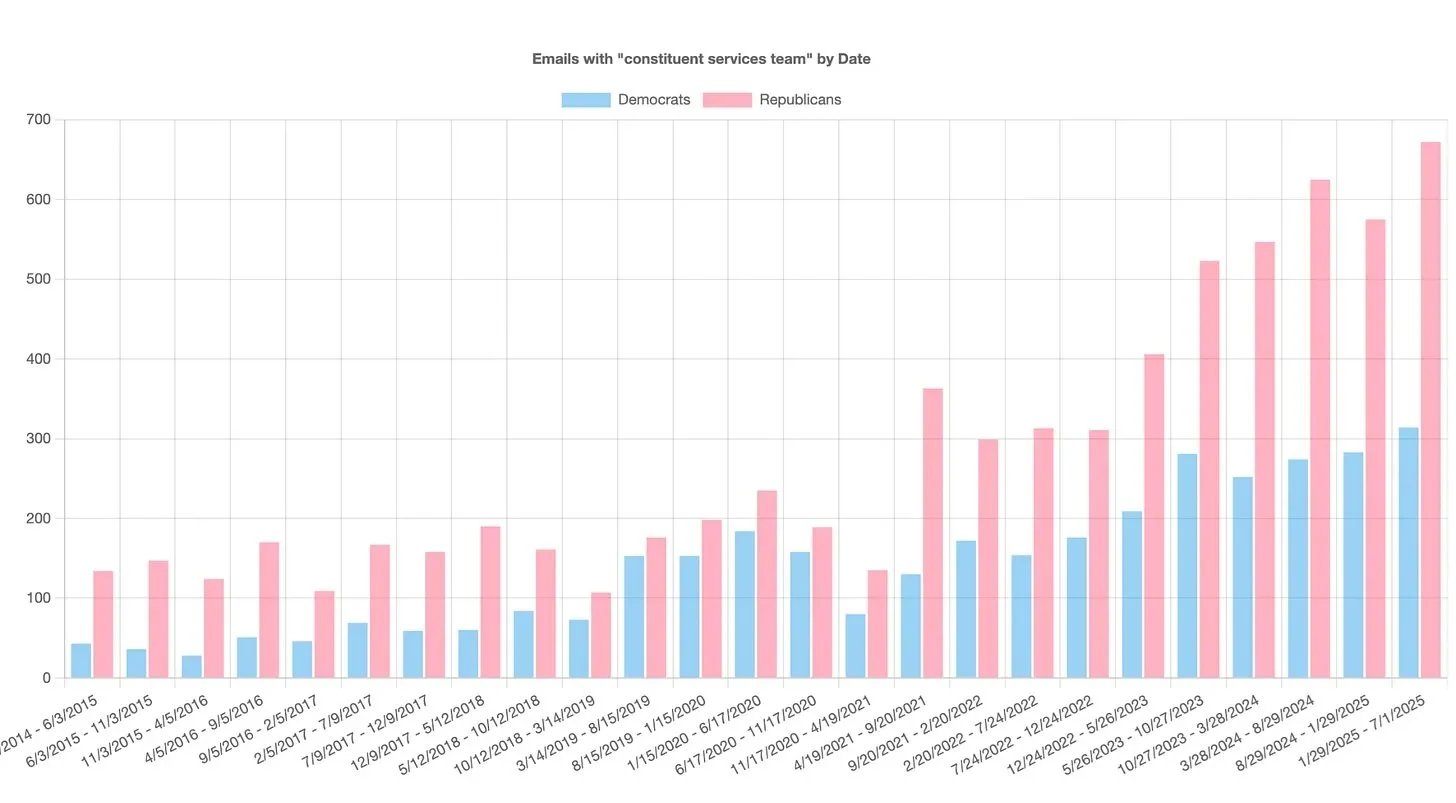
Results from DCInbox, accessed July 1, 2025
In a gridlocked legislative environment, casework is one of the few categories of work an office can point to that produces quantitative results in closed cases and dollars returned, and qualitative results in constituent quotes and casework stories. The year-end reports cited in the introduction to this paper are a clear instance of the pattern: the figures get circulated because they tell a politically usable story, even when the underlying data collection is inconsistent or uncomparable. This pressure for usable data can create internal pressure on casework operations to produce reportable outcomes, sometimes at the expense of less visible work that may have higher long-term value.
This Member-driven communications focus has been met and matched with an increasing coverage of casework in local and DC-based media outlets. The Casework Navigator newsletter has consistently documented local news stories covering casework,⁴⁴ including casework as a campaign strength or liability. Across the country, casework now has reporters who cover it as a beat, who develop sources within the casework community, and who frame casework in terms that the rest of the journalism world has begun to absorb. As more local outlets understand and cover casework, voters increasingly evaluate Members on whether their offices help.
DC-based trade coverage has also helped make the case within DC for why casework is important, and the impact it has on Congress’ overall capacity: Roll Call, under reporters Justin Papp and Nina Heller, has built the most sustained coverage. Papp’s reporting spans the Afghanistan withdrawal (the February 2024 feature previewing American Ingenuity), the Trump 2.0 environment (“Overwhelmed and Underwater,” February 2025), the 2025 shutdown (“Congressional Casework Shutdown Making Harder,” October 2025), and the Iran war (“Iran War Strains Congressional Casework,” March 2026); Heller’s reporting on staff pay, intern furloughs during the shutdown, and the broader Congressional workforce environment has consistently grounded its analysis in the constituent-facing work that depends on those workforce conditions. Federal News Network’s Terry Gerton has hosted Meeker repeatedly across the program’s three years, connecting the casework story to the broader federal management audience. CNBC, Bloomberg Government, FedScoop, GovExec, and NextGov have all run substantial coverage of casework and CaseCompass in the last twelve months, often through sources the Foundation helped connect. Podcasts including Highway to Hill, GovNavigators, Politics in Question, and the Brookings Lawfare podcast have devoted full episodes to casework.⁴⁵
While less directly accessible by Member offices, academic political science has also begun to engage with casework in sustained empirical terms for the first time since Richard Fenno’s Home Style (1978)⁴⁶ and John R. Johannes’s To Serve the People (1984)⁴⁷ anchored the field’s understanding for a generation. A growing body of new work on the latent demand for casework services that offices are not currently reaching,⁴⁸ the effects of Congressional inquiries on agency decision-making,⁴⁹ casework as a mechanism of administrative oversight,⁵⁰ the constitutional and statutory foundations of Congressional inquiry,⁵¹ and Congressional constituent communications more broadly,⁵² is producing the first sustained empirical engagement with the subject in four decades. That scholarship is giving caseworkers, advocates, and policymakers a vocabulary and an evidentiary base for understanding what Congress does, as well as further lenses to assess Congressional office performance.
This additional visibility and attention produces competitive pressure. The CAO Coach program’s highlighting of best practices and the Congressional Management Foundation’s Constituent Service Democracy Awards⁵³ have raised the standard for good casework. But they have also introduced peer-comparison dynamics that pressure offices to meet specific metrics, sometimes regardless of whether those metrics fit the office’s actual context. Benchmarking in such a wildly varied environment is challenging, if not frequently misleading.
Mobile office hours are a case in point. Anecdotally, many more offices have invested in mobile casework operations over the last three years, with several Members going further and dedicating vehicles to the work.⁵⁴ On its face, this is a textbook instance of a best practice spreading through the field. But in private conversations, many staff report ambivalence about how the practice is taking hold. Some describe pressure to hit target event numbers even in geographies where caseworkers know there is little underlying demand, or on top of an active casework surge that has already stretched the team. The temptation to prioritize visible event metrics over caseworkers’ professional judgment about what would actually serve constituents is reinforced by the competitive dynamics.
Staff turnover
All of these pressures contribute to staff turnover, which is, while on the low end for Congressional staff standards, still relatively high, around 25-30% annually.⁵⁵ Caseworkers leave Congressional service for a variety of reasons: promotion into other roles, departure from Congress entirely, burnout, frustration with structural conditions, and the pull of the private sector — but many experienced caseworkers cite especially the acute crises as precipitating events driving those decisions.
The cumulative impact of high turnover is twofold. First, the institutional knowledge that defines effective casework, including agency contacts, program rules, case patterns, office-specific practices, has to be rebuilt with each new hire, adding to the management and capacity burden on the remaining experienced staff.
Second, the lack of institutional knowledge depth at the office level prevents the casework field as a whole from developing the kind of accumulated expertise that other professional staff functions carry forward across generations. Again, the difficulty of building profession-level institutional knowledge is exacerbated by geographic distance. A DC-based legislative staffer can transfer from one Member’s office to another representing an entirely different part of the country without having to move; a caseworker — outside of the relatively rare chamber-to-chamber move — generally cannot. The consequences run in both directions: individual offices face less competitive pressure to retain or recruit experienced caseworkers, because the local talent pool is constrained; and the institutional knowledge that does build up at the district or state level is much less likely to travel between Members or chambers when a caseworker does eventually move on.
The customer service framing and casework’s place in the office hierarchy
Underneath the cross-pressures and turnover dynamics described above sits a deeper problem, one that ties the demand changes above to the professional changes of this section.
Casework still suffers from a perception that it is unskilled, entry-level customer service work — internalized by Members, by support offices, by external advisory organizations, and by caseworkers themselves. That framing matters in two ways.
Casework still suffers from a perception that it is unskilled, entry-level customer service work — internalized by Members, by support offices, by external advisory organizations, and by caseworkers themselves.
The first is the customer service framing itself. Over the last several decades, Congressional offices have been encouraged to adopt practices, language, and understandings of success from the business world, treating constituents as “customers.” It is a deeply metrics-driven approach. The goal is numbers: how many cases were closed, how many letters and phone calls were answered, how fast were the answers, what is the net promoter score. The customer service approach treats symptoms, not root causes.⁵⁶ A constituent calls about a delayed passport, the office helps with the individual case, the constituent’s case closes and is logged for year-end metrics. The pattern that could inform oversight of State Department processing delays rarely gets flagged. The framing has obscured the deeper value of constituent insights — the systematic pattern detection that casework is uniquely positioned to produce, but that the customer service frame does not prioritize.
The second is the typical Congressional office hierarchy. The typical structure of a Congressional office makes constituent-facing work the lowest-status position.⁵⁷ For young, idealistic, rising Congressional staffers, the reward for moving up in the hierarchy of political jobs is talking to the public less. The legislative correspondent who spends the majority of their time on mail and phones wants to be the legislative aide who might spend an hour on form letters per week. The staff assistant managing the intern program to keep the phones answered wants to be the field representative meeting with stakeholders. And the caseworker — explicitly tasked with one-on-one work with constituents to identify and solve complex administrative problems — is in a bind where the substance of their work is culturally coded to more junior positions, even as it requires the experience, maturity, and professionalism of more senior ones.
Together, the customer-service framing and the status hierarchy produce the same outcome: casework concerns are often isolated outside of the policymaking process. Caseworkers are the staff most steeped in what it means and what it feels like when government fails people — in the millions of small indignities and betrayals that drive part of the alienation animating contemporary American politics. A Congressional culture that took casework seriously as a profession would treat caseworkers as the natural resources and leverage points for top-to-bottom reform of how government works. The culture as currently constructed does the opposite: it suppresses their insight at the very moment Congress most needs it.
Where casework goes from here
The picture this paper has drawn pulls in multiple directions at once. The substantive demand on casework is intensifying along multiple vectors. The capacity transfer from the Legislative to the Executive branch is escalating, not abating. The professional infrastructure of the casework profession has improved in significant ways, largely because caseworkers themselves have made it improve — but it remains dependent on uncompensated self-organization rather than on institutional support. And the wider world is finally catching up to what caseworkers have always known, further increasing pressure on casework teams to produce results — even as the institutional frameworks for translating caseworker knowledge into Congressional decision-making remain absent.
And the wider world is finally catching up to what caseworkers have always known, further increasing pressure on casework teams to produce results — even as the institutional frameworks for translating caseworker knowledge into Congressional decision-making remain absent.
Taken together, these pressures suggest that casework is approaching a true breaking point. Demand keeps rising. Agencies have not received sustained investment from either party to truly address that demand. The mechanisms for resolving casework are brittle and fragile. And the profession itself is inconsistently supported in ways that make it difficult to take caseworker knowledge and expertise — some of the richest real-time data Congress has access to on how its own laws are actually experienced by Americans — and put that knowledge to work in service of the policy process. Each of these is a structural problem. Each has a structural fix available. But without action, the current operating model is approaching unsustainability.
Casework as part of Congress’ information apparatus
The most important shift required is conceptual and cultural. Casework is not a constituent service function that exists alongside Congress' "real" work of legislation and oversight. It is one of the institution's most underused information-gathering and oversight tools: a function akin to and related to formal oversight, and one that also fulfills Congress’ Constitutional role as the most directly accessible, accountable branch of government.
Caseworkers, every day, generate the kind of data that committees and oversight investigators spend significant resources to produce: how a federal program is actually being administered, where it breaks down, who falls through the cracks, what implementation guidance is failing, what agency responsiveness looks like in practice. That stream of evidence is currently captured almost entirely at the office level, where its value is local rather than institutional. The future of casework as Congress’ information apparatus depends on closing that gap: building the institutional infrastructure to aggregate, surface, and act on what caseworkers already know.
What this could look like
Consider an authorizing committee taking up reauthorization of a major federal program — for example, Social Security Disability Insurance.
In the current model, the committee draws on academic research, support from legislative information agencies like CRS and GAO, agency-provided data, advocacy testimony, the personal experience of Members and their staff, and completed oversight investigations. Caseworker insight enters the conversation only sporadically, depending on whether a Member happens to surface a case in their office that connects to the broader policy question.
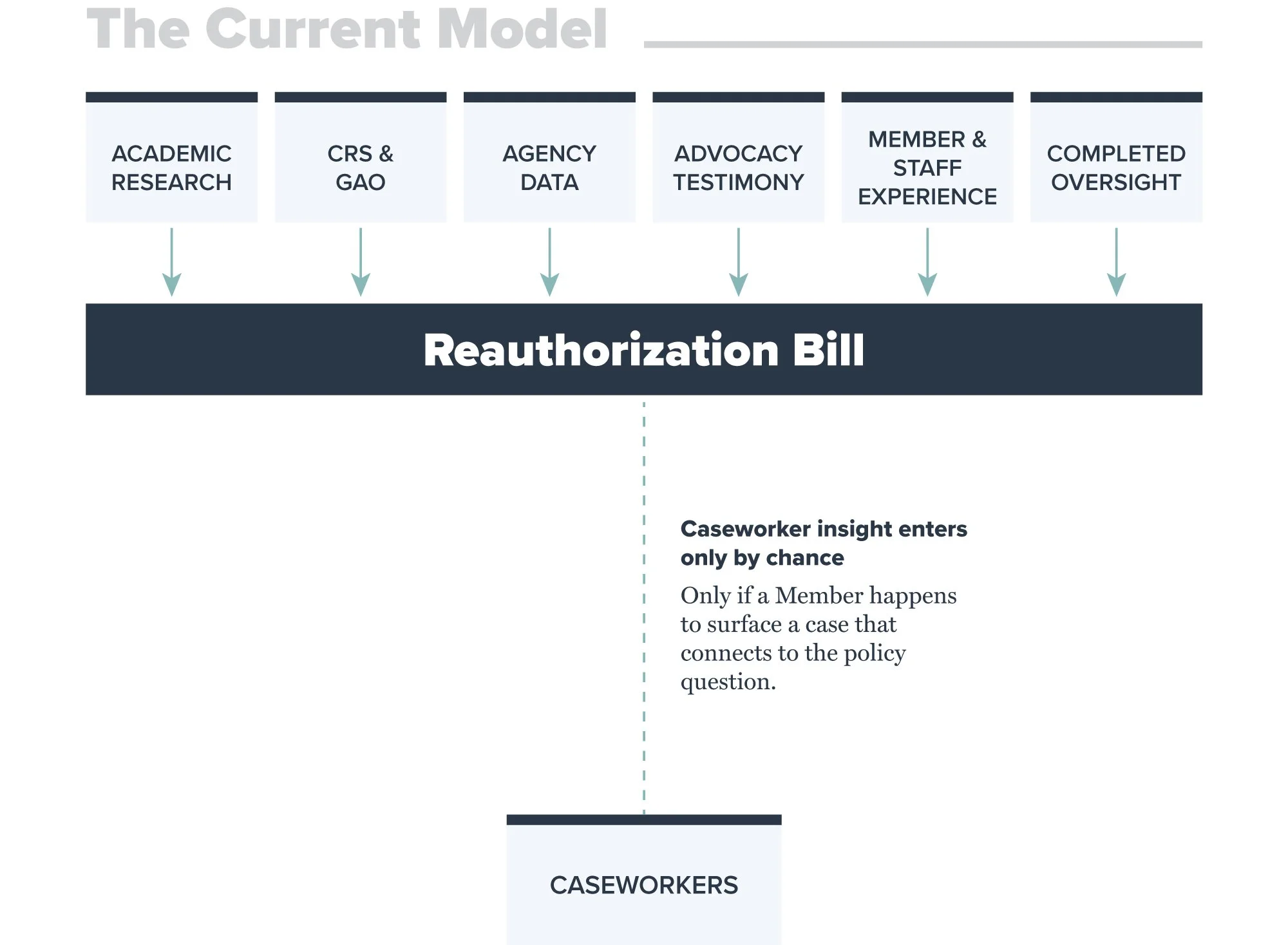
In a future model, the committee opens its reauthorization process with the dataset CaseCompass would generate: state-by-state trends in SSDI casework volume, patterns of agency responsiveness across regional Office of Hearings Operations geographies, processing delays that can be correlated to specific Disability Determination Services and Administrative Law Judge hiring backlogs, and the case-level texture of where the program is functioning well and where it is failing. This data is independent of agency-provided datasets, which is critical when there is suspicion that agencies may be manipulating their data.⁵⁸ From the same data, the committee identifies offices with high-volume SSDI portfolios and reaches out through Member offices to caseworkers with deep expertise in the program.
The committee also runs a structured constituent input process: through the same Member offices, constituents who have navigated SSDI are asked what they would change through a series of dedicated town halls and an accessible public input portal. AI-enabled tools, modeled on the Foundation’s Departure Dialogues pilot,⁵⁹ help committee staff sort through the resulting qualitative input to surface common themes, points of frustration, and concrete suggestions. The process gives Members a substantive opening to invite constituents to participate in a process where they will be able to see transformative results, increasing their credibility and trust.
Because many caseworkers who handle SSDI also handle adjacent federal disability programs like the VA Compensation and Pension system, the Department of Labor’s Office of Workers’ Compensation Programs, sometimes Medicaid and SSI in parallel, the committee also draws on caseworkers who handle those portfolios to identify points where the programs collide, conflict, or duplicate burdens that no single agency would design or sanction on its own.⁶⁰ That cross-portfolio view, available to caseworkers because of the breadth of their daily work, is otherwise invisible from inside any one agency. The committee uses what those caseworkers know to develop best practices for the SSDI determination process that can be standardized across the disability programs, and to surface coordination questions for the affected agencies that no single program review would catch.
A caseworker advisory task force, convened for the duration of the reauthorization, brings that combined expertise into the committee’s deliberations directly. Committee detail positions — caseworkers temporarily seconded to committee staff for the reauthorization — provide a structural pathway for casework expertise to enter the policy process and a meaningful career step for experienced caseworkers who currently have few advancement options that retain their connection to the work.
The reauthorization that emerges is grounded in implementation reality rather than legislative imagination. The constituents who have lived the program have shaped its next iteration. The caseworkers who navigate it daily have helped redesign it. The agency receives a clearer set of expectations — and a partner across the inter-branch relationship — than the typical reauthorization produces. Finally, the output of this process is stored and accessible to future committees and academic researchers
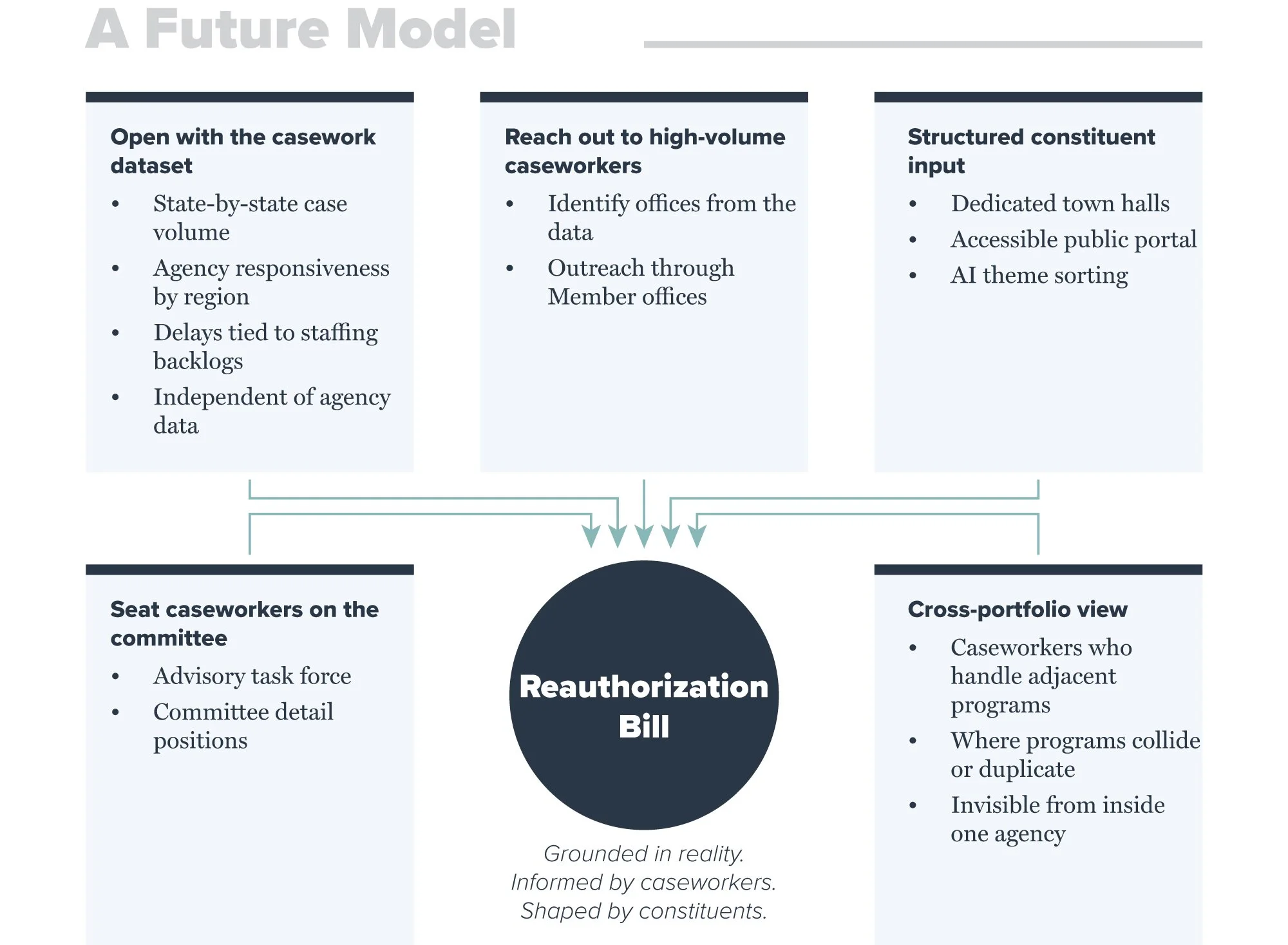
What this would take
The investment required is not enormous, relative to Congress’ existing commitment to casework. 15% to 20% of every Member office’s staff capacity already goes to constituent service. What is missing is the institutional infrastructure to capture, aggregate, and route what caseworkers produce — and the cultural shift required for Members, committees, and the institution as a whole to treat casework as the policy and oversight resource it is.
That culture-shifting is substantial. It requires Members to understand casework as more than district-office activity. It requires committees to treat casework data as a legitimate and valuable empirical input, alongside agency reports and academic studies. It requires the Congressional staff hierarchy to recognize casework as a profession with expertise that belongs in the policy process — not a constituent service function pigeonholed outside the main lane. And it requires sustained civil society work to keep that shift moving until it becomes self-sustaining.
The groundwork already laid
The good news is that this future is more reachable than it might appear.
CaseCompass is the first and most important piece — the first sustained institutional effort to make casework data legible to the institution. Without it, the rest of this vision is impossible. With it, the rest becomes a matter of will and follow-through. The CASES Act, however imperfectly implemented, established casework’s first formal statutory footing. The Muñoz amicus brief established its constitutional standing. The in-progress GAO study on agency responsiveness is producing the empirical record on which formal codification of responsiveness standards must rest. The Senate EAP forums, the CAO Coach program, and the chamber-wide Teams chats have built the early professional infrastructure that the institution’s eventual support framework can absorb and expand. The recent updates to House Ethics guidance permitting cohosted constituent events and published referral resource lists are a small but meaningful institutional acknowledgment that the demand landscape has changed faster than the formal framework has.
Each of these is a structural achievement of the last several years. None of them is the destination. But together they represent the first time in modern Congressional history that the institutional building blocks for casework-as-information-apparatus exist at all.
Recommendations
What follows are the moves that would translate the existing groundwork into the future described above. They are presented in order of priority — not because the later ones are less important, but because the institutional infrastructure recommendations enable the substantive reforms that follow.
1. Complete and scale CaseCompass.
CaseCompass does not solve the problems documented in this paper, but it creates the data infrastructure on which every other recommendation here depends. For lasting impact and maximum value from the House’s investment, CaseCompass will require additional funding to move from pilot to general availability across the House, and to begin building toward a Senate equivalent. Work to cement and scale CaseCompass may also include working with additional CRM providers to standardize casework data fields to align with the CaseCompass taxonomy, and developing an ongoing mechanism to review and update case tags for accuracy, and building research tools to allow committee and policy staff to interact with the CaseCompass data corpus in a way that is secure and flexible. Everything else in this section depends on CaseCompass existing as durable infrastructure rather than a one-time pilot, and the difference between those two outcomes is precisely the kind of institutional commitment that easily gets deferred.⁶¹
2. Establish a Casework Liaison Office, ideally bicameral.
This Office should formalize constituent service in Congress with permanent staff and programs, undertake long-term stewardship of the CaseCompass aggregator and maintenance of the underlying taxonomy, provide consistent resources and visibility for casework teams across both chambers, socialize CaseCompass data to committees in a nonpartisan way, and serve as the institutional voice for casework as a profession, and serve as the institutional voice for the profession.
The Office is also a critical element for the House to reap the benefit of its previous investment in CaseCompass, landing years of sustained appropriations support and institutional investment in a permanent organizational home with the staff and authority to maintain it, develop it, and integrate it into Congressional decision-making over the long term. Tools without homes degrade. The investment Congress has already made in CaseCompass will go nowhere without an institutional steward, and the Casework Liaison Office is the natural place for that stewardship to live.
A bicameral structure — or paired offices in the House and Senate with explicit coordination mandates — would also begin to address the structural barrier discussed earlier in this paper: the difficulty of building shared casework infrastructure across the platform and tenant boundaries that currently keep House and Senate caseworker communities operationally separated.⁶²
3. Codify minimum agency responsiveness standards.
Building on the findings of the in-progress GAO study, Congress should formalize what agencies owe Congressional inquiries on behalf of constituents — and what constituents themselves can expect from agencies. This is the statutory work that gives caseworkers a leg to stand on in the present moment, while the longer-horizon infrastructure matures. It is also the foundation of every subsequent recommendation.⁶³
4. Build the agency-side infrastructure for the inter-branch feedback loop.
The Government Service Delivery Improvement Act, EO-driven CX initiatives, and the broader customer-experience reform agenda should explicitly recognize Congressional inquiries as a legitimate input into agency operations, and the feedback loop between branches as a vital area for ongoing investment and innovation. At the highest-volume casework agencies — SSA, VA, USCIS, and others whose programs drive the bulk of demand — independent, statutorily-empowered constituent advocate teams modeled on the Taxpayer Advocate Service should be established as the agency-side anchor for that loop. At smaller agencies, lighter-weight versions of the same model — designated CX leadership with formal Congressional responsiveness responsibilities — should be developed and standardized. The full vision of working feedback loops at every consequential federal agency is out of scope for this paper, but casework should be recognized as a critical element of any serious version of it.
5. Develop opt-in baseline competence standards and certification for caseworkers.
The Casework Liaison Office (Recommendation 2) should lead the development of voluntary training and certification pathways that offices can use to credential staff handling complex, high-stakes cases. The framework should fully respect Members’ authority to hire and train staff as they see fit, while recognizing both the specialized expertise required to do casework well and the potential for harm — to constituents and to the institution — when inexperienced staff are asked to handle high-stakes matters without adequate preparation.
Casework belongs in the broader reform conversation
Underneath the specific recommendations sits a broader point. Casework belongs in the ongoing conversations about state capacity, government modernization, service delivery reform, and the restoration of public trust in federal institutions that are taking shape across the ideological spectrum. It is not a niche concern, and it is not a constituent-service curiosity. It is one of the most direct and ongoing relationships American citizens have with the federal government, and the only one in which the Legislative branch participates at scale.
The cross-ideological coalition that has begun to take this seriously is real, and it is the kind of coalition that can sustain institutional change across shifts in political control. Casework genuinely matters from a progressive perspective focused on state capacity, equity, and restored trust in democratic institutions, and from a conservative perspective focused on efficiency, accountability, and the assertion of Article I authority over the Executive branch. The recommendations in this paper work for both framings, which is what gives them their political durability.
Conclusion: Reflecting on the Casework Navigator Program
Over the last several years, POPVOX Foundation has had the unusual opportunity to stand back and see the full picture of constituent services through the launch of the Casework Navigator program, even as that picture has changed rapidly.
In 2022, POPVOX Foundation Director of Strategic Initiatives Anne Meeker was invited to testify to the House Select Committee on the Modernization of Congress on "Improving Congress' Customer Service," or strengthening casework, and offered recommendations directly from her experience as a former Director of Constituent Services in the House.⁶⁴ In December of that year, POPVOX Foundation convened caseworkers with civil society organizations for a virtual summit on the Future of Casework, building on those recommendations to imagine a vision for reinvigorated casework as a central component of Congress' oversight capacity and constituent engagement.⁶⁵ In Spring 2023, the POPVOX Foundation team launched the Casework Navigator program, intended to complement resources for caseworkers provided by institutional support offices, and shed light on the role and scope of casework in wider Congressional modernization efforts.
Over the next three years, the program grew to include:
Institutional advocacy for casework
Building on recommendations to the Select Committee on the Modernization of Congress, the program engaged in sustained nonpartisan advocacy with appropriators and committee staff. The FY2025 Legislative Branch Appropriations report alone directed four casework-relevant actions — a study toward a centrally-managed Congressional staff directory, an expanded CRS agency liaison contact list, the GAO study on agency responsiveness to Congressional inquiries (now underway), and $7 million for Senate intern compensation that supports casework operations — three of which have continued through the FY2026 and FY2027 cycles.⁶⁶ The program has also been a consistent advocate for the multi-year appropriations that have kept the CaseCompass pilot on track for general availability.⁶⁷
The Casework Navigator newsletter⁶⁸ and Case Notes blog⁶⁹
A regular, casework-focused information product rounding up agency-side developments that affect casework operations, including program changes, leadership transitions, processing delays, regulatory updates, and policy shifts. This newsletter was the only sustained, dedicated information product of its kind in the field, giving caseworkers a single channel for tracking what is changing across the agencies that drive their portfolios.
The Casework Avengers working group
An informal working group of technology vendors, academics, and institutional support staff, bringing together the broader ecosystem of organizations whose work touches casework, including Congressional CRM vendors, academic researchers, institutional support offices, and external civil society organizations. The working group provided a forum to surface cross-cutting issues, coordinate on shared priorities, and build common language around the field's most pressing challenges.
The Casework for Journalists training program⁷⁰
Structured training for reporters covering Congress, designed to give journalists the substantive grounding to cover casework as a recognized beat rather than as occasional human-interest material.
Flagship research reports
A series of in-depth research products that have established casework as a serious subject for empirical and policy attention:
The Roadmap for Congressional Casework Data (July 2023)⁷¹ made the analytical case for institutional casework data infrastructure and laid the groundwork for CaseCompass.
American Ingenuity: Congressional Casework in the Afghanistan Withdrawal (February 2024)⁷² documented the role of Congressional offices in the 2021 evacuation and the founding of the cross-chamber caseworker Teams chats.
Disaster Casework: Recommendations for Reform (November 2024)⁷³ mapped the cumulative impact of repeated regional disasters on casework operations and the distinctive mental health burden of local disaster work.
Constituent Services in American Multi-Member Districts: How Would It Work? (April 2025),⁷⁴ a joint paper with Protect Democracy treating casework as a central component of any serious electoral reform proposal.
Informal advising, speaking, and mentorship across the field
Direct engagement with caseworkers, casework managers, and Congressional offices through presentations and standing relationships, including the Senate Employee Assistance Program (EAP) caseworker forum and Casework Managers forum, presentations to individual delegations (Maryland and Illinois among them), the Democratic district directors fly-in, and a casework-focused session for state legislative staff convened by the Council of State Governments.
Recognition as a casework resource by institutional offices
Casework Navigator program materials are listed as casework resources on both the Congressional Research Service and the Senate Employee Assistance Program sites.
The last four years of the Casework Navigator program have added perspective on which elements of this strategy are most effective, and what conditions must be present for this kind of institutional torch-passing to succeed. Three lessons stand out.
First, connecting and communicating within legislative institutions is work that is often easier to do from the outside. One of the clearest things the Casework Navigator program accomplished was bringing together people within Congress whose work affected one another but who were not aware of each other's efforts — including connecting DC-based institutional offices directly to the caseworkers they serve. An external organization, unbound by any single office's mandate or jurisdiction, is frequently better positioned to make those introductions than any internal actor.
Second, district and state offices remain significantly under-leveraged. It is startling how little DC-based staff, civil society organizations, and journalists know about casework, or how rarely they see the value in building relationships with district and state staff. These staff are critical to a healthy and functioning Congress, and they consistently send clear demand signals for additional support, resourcing, and recognition as heavy users of institutional and civil-society hosted programs. District and state offices remain an untapped area for both internal and external investment in the institution.
Third, casework offers a rare opportunity to make the "what have you done for me lately" case for institutional investment directly to the public and to Members themselves. The Congressional reform and modernization field has long lamented that Member support for institutional investment is scarce, because there is no public constituency for a better Congress. The Casework Navigator program points toward a promising resolution: institutional investment in casework gives Congress concrete results to bring home — demonstrations of effectiveness, accountability, and rebuilt trust that bear directly on Member performance and, by extension, on how parties build and hold majorities. A fuller development of that argument is beyond the scope of this paper, but it is fertile ground for the organizations that take up this work next.
The Work Continues
POPVOX Foundation's operating model is built to end in a handoff. The organization pilots or prototypes a change it believes would strengthen the institution, refines that pilot while building internal buy-in, and — when the institution is ready — hands over the materials, resources, and learnings as turnkey as possible. But the model does not end at the handoff. Its final stage is to continue to champion, cheerlead, and support the institutional staff who carry the change forward.
That final stage is where much of the lasting value is realized. A pilot without a steward degrades, and a handoff without a champion stalls. The Casework Navigator program has shown how much of casework's institutional progress over the last five years — the CaseCompass pilot, the Senate EAP forums, the CAO Coach Program's working groups, the cross-chamber caseworker networks — depended on sustained external support to reach the point it has. That support does not become unnecessary as the work matures. If anything, the convergence of conditions documented in this paper makes it more essential than at any point in the program's history.
The structural pressures on casework have rarely been more acute. The institutional readiness for reform — CaseCompass, the GAO study, the new Ethics guidance on referrals, and the professional infrastructure caseworkers themselves have built — has rarely been more developed. The external attention from journalism, academia, think tanks, and civil society has rarely been more sustained or more cross-ideological. The window for structural investment in casework is open now, and it will not stay open indefinitely. The cost of inaction is not stasis but further erosion — of caseworker capacity, of constituent trust, and of Congress' own ability to know how the laws it passes actually land in the lives of the people it represents.
The Casework Navigator program's first chapter closes here. But the work it began — supporting caseworkers, elevating their expertise, and building toward the institutional infrastructure that casework's role in Congressional service demands — is more necessary now than when the program started. Casework is too important, to the constituents it serves, to the Members and offices who do it every day, to Congress as an institution, and to the broader American democratic project, to leave on the margins any longer. That work does not end. It continues — and it deserves a dedicated champion equal to the moment.
References
“Addressing Patients’ Unmet Social Needs: Disparities in Access to Social Services in the United States from 1990 to 2014, a National Time Series Study,” BMC Health Services Research (March 2022)
“Assessing the Capacity of Local Social Services Agencies to Respond to Referrals from Health Care Providers,” Health Affairs (April 2020)
Megan Blackwood, Annelise Russell, and Ken Docekal, “Stuck in the System: Casework Services as Administrative Representation” (forthcoming, 2026)
Megan Brenan, “Disapproval of Congress Ties Record High at 86%,” Gallup (April 22, 2026)
“Brief of Amici Curiae Members of Congress in Support of Respondent, Department of State v. Muñoz” (amicus brief), Supreme Court of the United States (March 2024)
Ida A. Brudnick, “R40962: Members’ Representational Allowance: History and Usage,” Congressional Research Service (January 10, 2025)
Ida A. Brudnick, “R43397: Legislative Branch Appropriations: Frequently Asked Questions,” Congressional Research Service (2024)
Marisol Cruz Cain, “GAO-23-105562: CASES Act Implementation,” Government Accountability Office (GAO) (December 20, 2022)
“CARES Van and Constituent Casework,” Office of Rep. Pat Ryan (n.d.)
“Carolina Cruiser,” Office of Rep. Chuck Edwards (n.d.)
“Case Notes,” POPVOX Foundation (n.d.)
“Casework History: How Did We Get Here?” (webinar), POPVOX Foundation (2024)
“Casework Navigator” (newsletter), POPVOX Foundation (n.d.)
Center for Effective Philanthropy, “A Sector in Crisis: How U.S. Nonprofits and Foundations Are Responding to Threats,” Center for Effective Philanthropy (January 2026)
“Committee Approves FY27 Legislative Branch Appropriations Act,” House Committee on Appropriations (May 20, 2026)
“Constituent Services: Building a More Customer-Friendly Congress” (hearing), House Select Committee on the Modernization of Congress (July 14, 2022)
“Constituent Services Representative/Caseworker,” HillClimbers (accessed May 2026)
DCinbox (database) (accessed May 2025)
“Democracy Awards,” Congressional Management Foundation (n.d.)
“Department of State v. Muñoz,” Oyez (2024)
Department of Veterans Affairs, Office of Inspector General, “14-02603-267: Review of Alleged Patient Deaths, Patient Wait Times, and Scheduling Practices at the Phoenix VA Health Care System” (August 26, 2014)
“Departure Dialogues Project,” POPVOX Foundation (May 2026)
“Fiscal Year 2027 Justification of Estimates for Appropriations Committees,” US Food and Drug Administration (2026)
Lee Drutman, “What’s the Future of Casework?” (podcast), Politics in Question (July 23, 2025)
“The ERC Claim Period Has Closed,” Taxpayer Advocate Service (May 2025)
Richard F. Fenno Jr., Home Style: House Members in Their Districts (Boston: Little, Brown, 1978)
“Future Casework Virtual Summit,” POPVOX Foundation (December 14, 2022)
Lindsey Gailmard, Daniel E. Ho, and Mark S. Krass, “Congressional Intervention in Agency Adjudication: The Case of Veterans’ Appeals,” Yale Law Journal (2025)
Terry Gerton, “Americans Seeking a Way Out of the Middle East Are Once Again Turning to Congressional Caseworkers,” Federal News Network, The Federal Drive (March 12, 2026)
Karyn Greer, “‘It’s Bad Management’: Georgia Congressman Wants Answers Over Postal Delays, Alleged Fraud,” WSB-TV (April 11, 2024)
Marci Harris and Zach Graves, “The Supreme Court Is About to Make Congress Reinvent Itself,” Newsweek (May 29, 2024)
Nina Heller, “Iran War Puts Further Strain on Congressional Casework,” Roll Call (March 24, 2026)
“House Lawmakers Hold Hearing on Supply of Infant Formula” (hearing), PBS NewsHour (May 19, 2022)
Charlie Hunt and SoRelle Gaynor, “Does Calling Your Member of Congress Actually Do Anything?” (podcast), Highway to Hill (2026)
“‘I Hope They Blow Your Head Off’: Violent Threats Pour Into Congressional Offices, and It’s Getting Worse,” The Boston Globe (April 2026)
John R. Johannes, To Serve the People: Congress and Constituency Service (Lincoln: University of Nebraska Press, 1984)
“A Journalist’s Guide to Covering Congressional Casework,” POPVOX Foundation (2025)
Sean J. Kealy, “Congressional Constituent Service Inquiries,” Administrative Conference of the United States (June 5, 2024)
Eric Klinenberg, Palaces for the People: How Social Infrastructure Can Help Fight Inequality, Polarization, and the Decline of Civic Life (New York: Crown, 2018)
Yuval Levin, The Fractured Republic: Renewing America’s Social Contract in the Age of Individualism (New York: Basic Books, 2016)
Katherine Long, “Canaries in the Coal Mine: Casework Lessons from the 2008 Crisis,” POPVOX Foundation (April 27, 2023)
Jessica Lucas-Judy, “GAO-26-107456: COVID-19 Relief: IRS Can Use Lessons Learned to Address and Prevent Improper Payments in Future Tax Programs,” Government Accountability Office (GAO) (February 10, 2026)
“Measuring Civic Experience,” POPVOX Foundation (n.d.)
Anne Meeker, “American Ingenuity: Congressional Casework in the Afghanistan Withdrawal,” POPVOX Foundation (February 2024)
Anne Meeker and Lee Drutman, “Constituent Services in American Multi-Member Districts: How Would It Work?,” Protect Democracy (April 2025)
Anne Meeker, “Casework Navigator: 2026 Is Off to a Running Start,” POPVOX Foundation (January 23, 2026)
Anne Meeker, “Constituent Services in Permanent Crisis,” Voice/Mail (February 12, 2025)
Anne Meeker, “Disaster Casework: Recommendations for Reform,” POPVOX Foundation (November 2024)
Anne Meeker, “How Legislative Office Structure Creates Bad Politics,” Voice/Mail (August 27, 2025)
Anne Meeker, “Newsletter: Taking Care of Yourselves in 2025,” POPVOX Foundation (December 4, 2024)
Anne Meeker, “Public Witness Testimony on Strengthening Congressional Casework to House Appropriations Legislative Branch Subcommittee for FY25,” POPVOX Foundation (April 2024)
Anne Meeker, “Roadmap for Congressional Casework Data,” POPVOX Foundation (July 2023)
Anne Meeker, “The Long Road to Change: How Caseworkers Helped Build the Future of Congressional Data,” POPVOX Foundation (September 9, 2025)
Anne Meeker, “Who Does Casework for Congress? An Unscientific Survey,” POPVOX Foundation (May 2024)
Cami Mondeaux, “How Utah’s Congressional Delegation Rescued Utahns Stranded in Dubai Amid Iran Strikes,” Deseret News (March 8, 2026)
“Moylan Launches Congressional Mobile Office to Expand Access to Federal Services Across Guam,” Office of Rep. James Moylan (May 11, 2026)
Sean Newhouse, “‘Bounce-Back Emails and No-Replies’: IRS and Social Security Workforce Reductions Are Hurting Constituent Service, House Democrats Argue,” Government Executive (July 2025)
Sean Michael Newhouse, “A Developing Database of Constituent Complaints to Congress Could Help Agencies Find Systemic Issues in Their Public Services,” Government Executive (September 26, 2025)
Caroline Nihill and Madison Alder, “Bug Bounties, Constituent Casework Automation Among Ideas Touted at Congressional Hackathon,” FedScoop (September 15, 2023)
Natalie Orpett, “How Congressional Staffers Helped Our Afghan Allies” (podcast), The Lawfare Podcast (April 5, 2024)
Shira Ovide, “Lawmakers Are Getting Flooded with Calls About Elon Musk and DOGE,” The Washington Post (February 7, 2025)
Shira Ovide, “This App Is Turbocharging Calls to Congress About Trump’s Policies,” The Washington Post (February 11, 2025)
Jennifer Pahlka, “Stop Telling Constituents They’re Wrong,” Eating Policy (November 22, 2024)
Justin Papp, “Afghanistan Withdrawal Caused ‘Doom Loop’ for Caseworkers, Report Says,” Roll Call (February 1, 2024)
Justin Papp, “‘Overwhelmed and Underwater’: Congressional Staffers Feel the Brunt of Trump 2.0,” Roll Call (February 26, 2025)
PolicyEngine, “Cliffwatch” (n.d.)
“POPVOX Foundation Appropriations Requests FY27,” POPVOX Foundation (2025)
David Rapallo, “Mapping Minority Investigative Powers in Congress,” SSRN (January 28, 2026)
Megan Rickman-Blackwood, “A Theory of Proactive Casework at the State Level as a Means of Bridging Access Gaps in the Provision of Constituent Services,” Levin Center for Oversight and Democracy (2024)
Chris Riotta, “Civic Hackers Explore Ways to Streamline Government Operations,” Nextgov/FCW (September 15, 2023)
Annelise Russell, Tweeting Scared: Congress’s Crisis of Communication (New York: Oxford University Press, 2024)
Taylor J. Swift and Anne Meeker, “Casework Wins in FY 2025 Appropriations Bill,” POPVOX Foundation (August 1, 2024)
“Tens of Millions of Taxpayers May Be Eligible for Significant Tax Refunds – If They Act by July 10 (Part I),” Taxpayer Advocate Service (April 2026)
“Threats Against Congress Spiked in 2025 and Rose for Third Year in a Row, Capitol Police Say,” NBC News (January 28, 2026)
Urban Institute and Independent Sector, “Nonprofits Squeezed: Growing Community Need, Fewer Resources,” Independent Sector (2025)
“U.S. House Members May Now Officially Co-Sponsor Certain Events with Private Entities,” Wiley Rein LLP (June 5, 2024)
Rylee Wilson, “18 Behavioral Health Closures in 2025,” Becker’s Behavioral Health (June 25, 2025)
Footnotes
1 Anne Meeker, “Who Does Casework for Congress? An Unscientific Survey,” POPVOX Foundation (May 2024)
2 Anne Meeker, “Casework Navigator: 2026 Is Off to a Running Start,” POPVOX Foundation (January 23, 2026)
3 “14-02603-267: Review of Alleged Patient Deaths, Patient Wait Times, and Scheduling Practices at the Phoenix VA Health Care System,” Department of Veterans Affairs, Office of Inspector General (August 26, 2014)
4 “House Lawmakers Hold Hearing on Supply of Infant Formula” (hearing), PBS NewsHour (May 19, 2022)
5 “The ERC Claim Period Has Closed,” Taxpayer Advocate Service (May 2025); Jessica Lucas-Judy, “GAO-26-107456: COVID-19 Relief: IRS Can Use Lessons Learned to Address and Prevent Improper Payments in Future Tax Programs,” Government Accountability Office (GAO) (February 10, 2026)
6 Anne Meeker, “American Ingenuity: Congressional Casework in the Afghanistan Withdrawal,” POPVOX Foundation (February 2024)
7 Karyn Greer, “‘It’s Bad Management’: Georgia Congressman Wants Answers Over Postal Delays, Alleged Fraud,” WSB-TV (April 11, 2024)
8 Jennifer Pahlka, “Stop Telling Constituents They’re Wrong,” Eating Policy (November 22, 2024)
9 Shira Ovide, “This App Is Turbocharging Calls to Congress About Trump’s Policies,” The Washington Post (February 11, 2025); Justin Papp, “‘Overwhelmed and Underwater’: Congressional Staffers Feel the Brunt of Trump 2.0,” Roll Call (February 26, 2025); Justin Papp, “Afghanistan Withdrawal Caused ‘Doom Loop’ for Caseworkers, Report Says,” Roll Call (February 1, 2024); Nina Heller, “Iran War Puts Further Strain on Congressional Casework,” Roll Call (March 24, 2026); Terry Gerton, “Americans Seeking a Way Out of the Middle East Are Once Again Turning to Congressional Caseworkers,” Federal News Network, The Federal Drive (March 12, 2026); Caroline Nihill and Madison Alder, “Bug Bounties, Constituent Casework Automation Among Ideas Touted at Congressional Hackathon,” FedScoop (September 15, 2023); Sean Michael Newhouse, “A Developing Database of Constituent Complaints to Congress Could Help Agencies Find Systemic Issues in Their Public Services,” Government Executive (September 26, 2025); Chris Riotta, “Civic Hackers Explore Ways to Streamline Government Operations,” Nextgov/FCW (September 15, 2023); Natalie Orpett, “How Congressional Staffers Helped Our Afghan Allies” (podcast), The Lawfare Podcast (April 5, 2024); Lee Drutman, “What’s the Future of Casework?” (podcast), Politics in Question (July 23, 2025); Charlie Hunt and SoRelle Gaynor, “Does Calling Your Member of Congress Actually Do Anything?” (podcast), Highway to Hill (2026)
10 Lindsey Gailmard, Daniel E. Ho, and Mark S. Krass, “Congressional Intervention in Agency Adjudication: The Case of Veterans’ Appeals,” Yale Law Journal (2025)
11 And not for the first time in American history — Senate Associate Historian Daniel Holt has documented significant shifts in casework practices over the last two hundred years. “Casework History: How Did We Get Here?” (webinar), POPVOX Foundation (2024)
12 Anne Meeker, “Newsletter: Taking Care of Yourselves in 2025,” POPVOX Foundation (December 4, 2024)
13 Ida A. Brudnick, “R40962: Members’ Representational Allowance: History and Usage,” Congressional Research Service (January 10, 2025)
14 Anne Meeker and Lee Drutman, “Constituent Services in American Multi-Member Districts: How Would It Work?,” Protect Democracy (April 2025)
15 Anne Meeker, “Disaster Casework: Recommendations for Reform,” POPVOX Foundation (November 2024)
16 Katherine Long, “Canaries in the Coal Mine: Casework Lessons from the 2008 Crisis,” POPVOX Foundation (April 27, 2023)
17 Anne Meeker, “American Ingenuity: Congressional Casework in the Afghanistan Withdrawal,” POPVOX Foundation (February 2024)
18 “Tens of Millions of Taxpayers May Be Eligible for Significant Tax Refunds – If They Act by July 10 (Part I),” Taxpayer Advocate Service (April 2026)
19 PolicyEngine’s “Cliffwatch” tool documents similar program interactions where an increase to one benefit or a small increase in wages may cause a disproportionate decrease in another program.
20 Anne Meeker, “American Ingenuity: Congressional Casework in the Afghanistan Withdrawal,” POPVOX Foundation (February 2024)
21 Sean Newhouse, “‘Bounce-Back Emails and No-Replies’: IRS and Social Security Workforce Reductions Are Hurting Constituent Service, House Democrats Argue,” Government Executive (July 2025)
22 Sean J. Kealy, “Congressional Constituent Service Inquiries,” Administrative Conference of the United States (June 5, 2024)
23 Cami Mondeaux, “How Utah’s Congressional Delegation Rescued Utahns Stranded in Dubai Amid Iran Strikes,” Deseret News (March 8, 2026)
24 Anne Meeker, “Constituent Services in Permanent Crisis,” Voice/Mail (February 12, 2025)
25 “Fiscal Year 2027 Justification of Estimates for Appropriations Committees,” US Food and Drug Administration (2026); “Committee Approves FY27 Legislative Branch Appropriations Act,” House Committee on Appropriations (May 20, 2026)
26 Shira Ovide, “Lawmakers Are Getting Flooded with Calls About Elon Musk and DOGE,” The Washington Post (February 7, 2025)
27 Eric Klinenberg, Palaces for the People: How Social Infrastructure Can Help Fight Inequality, Polarization, and the Decline of Civic Life (New York: Crown, 2018); Yuval Levin, The Fractured Republic: Renewing America’s Social Contract in the Age of Individualism (New York: Basic Books, 2016)
28 Urban Institute and Independent Sector, “Nonprofits Squeezed: Growing Community Need, Fewer Resources,” Independent Sector (2025); Center for Effective Philanthropy, “A Sector in Crisis: How U.S. Nonprofits and Foundations Are Responding to Threats,” Center for Effective Philanthropy (January 2026)
29 Rylee Wilson, “18 Behavioral Health Closures in 2025,” Becker’s Behavioral Health (June 25, 2025)
30 “Addressing Patients’ Unmet Social Needs: Disparities in Access to Social Services in the United States from 1990 to 2014, a National Time Series Study,” BMC Health Services Research (March 2022); “Assessing the Capacity of Local Social Services Agencies to Respond to Referrals from Health Care Providers,” Health Affairs (April 2020)
31 “U.S. House Members May Now Officially Co-Sponsor Certain Events with Private Entities,” Wiley Rein LLP (June 5, 2024)
32 Megan Brenan, “Disapproval of Congress Ties Record High at 86%,” Gallup (April 22, 2026)
33 “‘I Hope They Blow Your Head Off’: Violent Threats Pour Into Congressional Offices, and It’s Getting Worse,” The Boston Globe (April 2026); “Threats Against Congress Spiked in 2025 and Rose for Third Year in a Row, Capitol Police Say,” NBC News (January 28, 2026)
34 Marisol Cruz Cain, “GAO-23-105562: CASES Act Implementation,” Government Accountability Office (GAO) (December 20, 2022)
35 “Department of State v. Muñoz,” Oyez (2024)
36 “Brief of Amici Curiae Members of Congress in Support of Respondent, Department of State v. Muñoz” (amicus brief), Supreme Court of the United States (March 2024)
37 “Department of State v. Muñoz,” Oyez (2024)
38 Sean J. Kealy, “Congressional Constituent Service Inquiries,” Administrative Conference of the United States (June 5, 2024)
39 Anne Meeker, “Roadmap for Congressional Casework Data,” POPVOX Foundation (July 2023); Anne Meeker, “American Ingenuity: Congressional Casework in the Afghanistan Withdrawal,” POPVOX Foundation (February 2024)
40 Anne Meeker, “The Long Road to Change: How Caseworkers Helped Build the Future of Congressional Data,” POPVOX Foundation (September 9, 2025)
41 Anne Meeker, “American Ingenuity: Congressional Casework in the Afghanistan Withdrawal,” POPVOX Foundation (February 2024)
42 Anne Meeker, “American Ingenuity: Congressional Casework in the Afghanistan Withdrawal,” POPVOX Foundation (February 2024)
43 “DCinbox search for “constituent services team,” December 31, 2014–July 1, 2025 (accessed September 1, 2025).
44 Casework news roundups in the Casework Navigator newsletter, POPVOX Foundation (2023–2026)
45 Natalie Orpett, “How Congressional Staffers Helped Our Afghan Allies” (podcast), The Lawfare Podcast (April 5, 2024); Lee Drutman, “What’s the Future of Casework?” (podcast), Politics in Question (July 23, 2025); Charlie Hunt and SoRelle Gaynor, “Does Calling Your Member of Congress Actually Do Anything?” (podcast), Highway to Hill (2026)
46 Richard F. Fenno Jr., Home Style: House Members in Their Districts (Boston: Little, Brown, 1978)
47 John R. Johannes, To Serve the People: Congress and Constituency Service (Lincoln: University of Nebraska Press, 1984)
48 Megan Rickman-Blackwood, “A Theory of Proactive Casework at the State Level as a Means of Bridging Access Gaps in the Provision of Constituent Services,” Levin Center for Oversight and Democracy (2024)
49 Lindsey Gailmard, Daniel E. Ho, and Mark S. Krass, “Congressional Intervention in Agency Adjudication: The Case of Veterans’ Appeals,” Yale Law Journal (2025)
50 Megan Blackwood, Annelise Russell, and Ken Docekal, “Stuck in the System: Casework Services as Administrative Representation” (forthcoming, 2026)
51 David Rapallo, “Mapping Minority Investigative Powers in Congress,” SSRN (January 28, 2026)
52 Annelise Russell, Tweeting Scared: Congress’s Crisis of Communication (New York: Oxford University Press, 2024)
53 “Democracy Awards,” Congressional Management Foundation (n.d.)
54 CARES Van and Constituent Casework (Rep. Pat Ryan [D, NY]); Carolina Cruiser (Rep. Chuck Edwards [R, NC]); Moylan Launches Congressional Mobile Office (Rep. James Moylan [R, Guam])
55 “Constituent Services Representative/Caseworker,” HillClimbers (n.d.)
56 “Measuring Civic Experience,” POPVOX Foundation (n.d.)
57 Anne Meeker, “How Legislative Office Structure Creates Bad Politics,” Voice/Mail (August 27, 2025)
58 For example, the VA’s manipulation of reported data on wait times for veteran medical appointments: “14-02603-267: Review of Alleged Patient Deaths, Patient Wait Times, and Scheduling Practices at the Phoenix VA Health Care System,” Department of Veterans Affairs, Office of Inspector General (August 26, 2014)
59 “Departure Dialogues Project,” POPVOX Foundation (n.d.)
60 For recent work on cross-agency interoperability, see Christopher Whitaker and Arabella Crawford, “Standard Definitions: Reducing Administrative Burden by Ensuring Interoperability.” Searchlight Institute, July 27, 2026.
61 “Constituent Services: Building a More Customer-Friendly Congress” (hearing), House Select Committee on the Modernization of Congress (July 14, 2022); Anne Meeker, “Roadmap for Congressional Casework Data,” POPVOX Foundation (July 2023); Anne Meeker, “American Ingenuity: Congressional Casework in the Afghanistan Withdrawal,” POPVOX Foundation (February 2024)
62 Anne Meeker, “Disaster Casework: Recommendations for Reform,” POPVOX Foundation (November 2024); Anne Meeker, “American Ingenuity: Congressional Casework in the Afghanistan Withdrawal,” POPVOX Foundation (February 2024)
63 Anne Meeker, “American Ingenuity: Congressional Casework in the Afghanistan Withdrawal,” POPVOX Foundation (February 2024); Anne Meeker, “Public Witness Testimony on Strengthening Congressional Casework to House Appropriations Legislative Branch Subcommittee for FY25,” POPVOX Foundation (April 2024)
64 “Constituent Services: Building a More Customer-Friendly Congress” (hearing), House Select Committee on the Modernization of Congress (July 14, 2022)
65 “Future Casework Virtual Summit,” POPVOX Foundation (December 14, 2022)
66 Taylor J. Swift and Anne Meeker, “Casework Wins in FY 2025 Appropriations Bill,” POPVOX Foundation (August 1, 2024); “POPVOX Foundation Appropriations Requests FY27,” POPVOX Foundation (2025)
67 Anne Meeker, “The Long Road to Change: How Caseworkers Helped Build the Future of Congressional Data,” POPVOX Foundation (September 9, 2025)
68 “Casework Navigator” (newsletter), POPVOX Foundation (n.d.)
69 “Case Notes,” POPVOX Foundation (n.d.)
70 “A Journalist’s Guide to Covering Congressional Casework,” POPVOX Foundation (2025)
71 Anne Meeker, “Roadmap for Congressional Casework Data,” POPVOX Foundation (July 2023)
72 Anne Meeker, “American Ingenuity: Congressional Casework in the Afghanistan Withdrawal,” POPVOX Foundation (February 2024)
73 Anne Meeker, “Disaster Casework: Recommendations for Reform,” POPVOX Foundation (November 2024)
74 Anne Meeker and Lee Drutman, “Constituent Services in American Multi-Member Districts: How Would It Work?,” Protect Democracy (April 2025)