After the Bill Passes
California’s first year of Outcomes Reviews, plus new NCSL numbers on legislative AI use
State of the Art is a newsletter spotlighting innovation, technology, and institutional capacity in America’s statehouses. Learn more and subscribe at stateoftheartgov.substack.com.
Hi everyone,
Welcome back to State of the Art!
It was so nice meeting many of you at the NCSL Legislative Summit! If you did not get a chance to stop by our booth or catch our Executive Director Marci Harris’ session on “When AI Joins the Staff,” you can check out our recap, which includes her slides.
This was my first NCSL Summit and I was so pleased to talk with so many people thinking deeply about how to strengthen their institutions and how AI might factor into that equation.
Also this month: NCSL released the results of its Legislative Use of Artificial Intelligence 2026 Survey, giving us a much clearer year-over-year picture of how legislative AI use is changing. The California Outcomes Reviews program announced the conclusion of its pilot year, and I had the chance to learn a bit more about the program from staff working on it, making it our State Spotlight this month!
As always, feel free to reach out with what you are working on! I would love to hear from you.
Until next time,
Caitlin McNally
Program Associate
POPVOX Foundation
State Spotlight
Inside California’s Outcomes Review Process
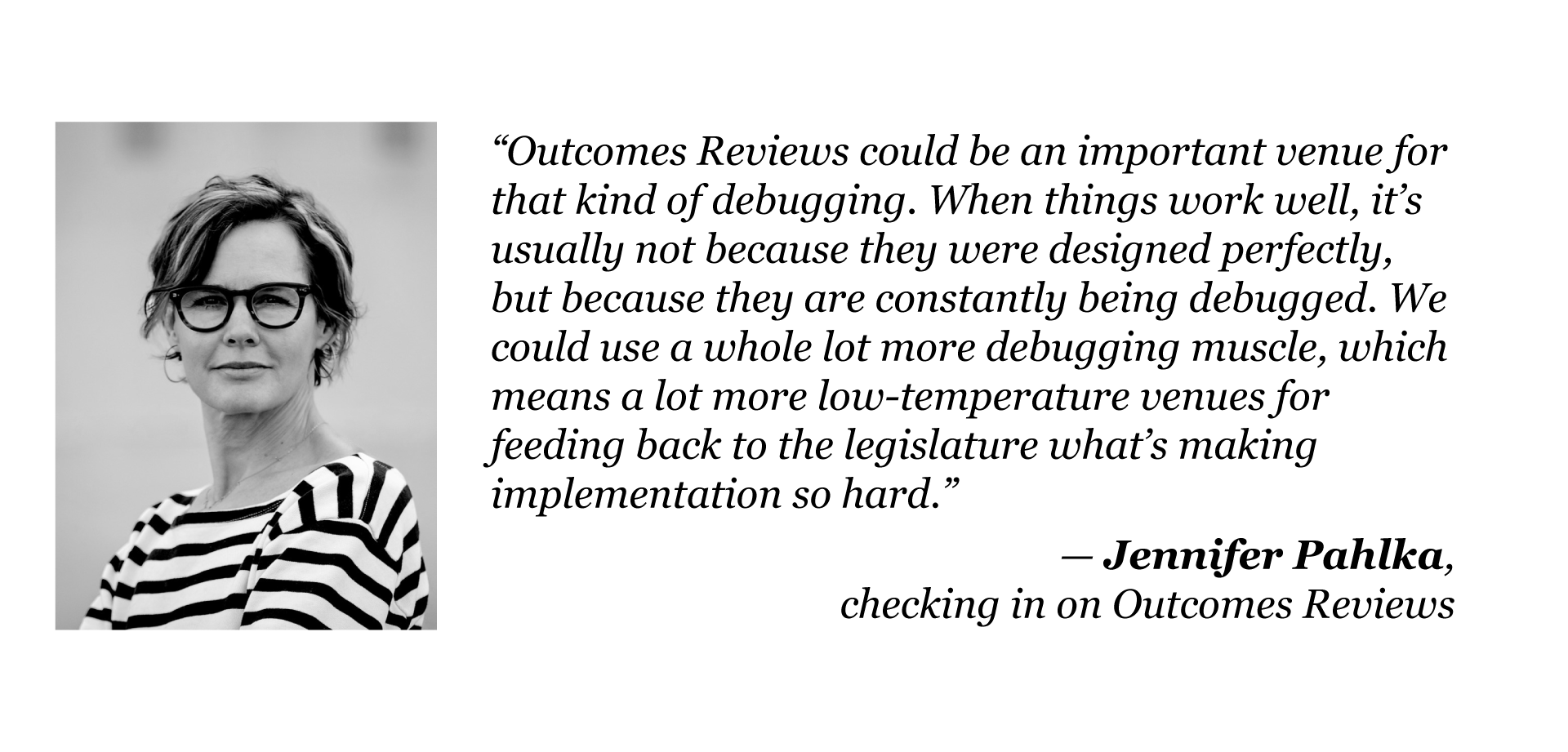
Legislatures have extensive processes for developing and passing legislation, but almost never a routine for examining whether laws actually have their intended effect. California’s new Outcomes Review program tries to change that. Some may have first heard about the program through Jennifer Pahlka’s recent piece, in which she highlights a community solar law that fell short in implementation. She argues that Outcomes Reviews provided a lower stakes venue for “debugging” this legislation, giving lawmakers the opportunity to check in on implementation and propose changes if things are not on track. With California now through its first pilot year, there are several useful lessons for other statehouses considering similar work.
The California version of Outcomes Reviews, championed by Assembly Speaker Robert Rivas, allows Members to work with the relevant policy committee on a law they authored, gather information on how it is working, and publicly report what they learn. In the pilot year, 15 Assemblymembers reviewed 14 laws covering housing, health care, energy, worker protections, foster care, and wildfire recovery.
One of the reviews focused on AB 238, a 2025 law passed after the Eaton and Palisades fires to provide mortgage-forbearance protections for homeowners facing financial hardship. Months after passage, Assemblymember John Harabedian and the Assembly Banking and Finance Committee returned to Pasadena to hear directly from fire survivors about how that relief was working in practice.
Many homeowners successfully received forbearance, but the hearing showed how difficult the process could be. One survivor described spending several days trying to reach someone at her bank who understood the program, only to receive guidance that conflicted with the law’s protections, including that her family could face a lump-sum repayment or a loan modification that increased their monthly payments. Another homeowner testified that he secured a 90-day forbearance but never received written confirmation, resulting in continued past-due notices. After that, he had to repeat the process every 90 days. Harabedian said that while some banks complied, “many delayed and denied consumers the relief they are owed.”
The review also surfaced broader problems with how the law worked in practice, including inconsistent lender implementation and confusion over what repayment options borrowers could face after forbearance. Those findings helped inform two bills that have since passed the legislature and await action by the governor, one to extend forbearance protections and another to create a permanent statewide framework for mortgage relief after future disasters.
Assemblymember Rebecca Bauer-Kahan’s review of California’s 988 Suicide and Crisis Lifeline surfaced a different implementation problem. The committee found that while California had built basic connections between 988 and 911, many crisis centers still could not directly dispatch mobile crisis teams, and text and chat response rates could fall as low as 35%. The review also highlighted delays in the technology meant to more seamlessly connect 988 and 911. NBC Bay Area later reported on those findings, including that the 988 technology project was already two years overdue. The review helped shape proposed changes around oversight, coordination, and crisis-response standards.
California is not the only state testing the model. Oregon House Majority Leader Ben Bowman launched an Outcomes Reviews effort this year after helping lead a bipartisan Legislative Oversight, Effectiveness, and Accountability Workgroup. Participating lawmakers will revisit laws they sponsored, work with policy staff and stakeholders, hold roundtables, and report what they learn about implementation during next week’s September Legislative Days.
I spoke with a member of Speaker Rivas’ team working on the California project and asked what other legislatures should consider if they are interested in trying something similar. One of the clearest takeaways was that the model works best when Members see oversight as an important part of their responsibilities and the leaders are interested in giving them room to focus on it.
Timing is a big part of that. California lowered the number of bills each Assemblymember can introduce to 35 for the 2025–2026 session. The staff member I spoke with credited that change with helping create more capacity for oversight work. Other states may have different openings. In part-time legislatures, the interim could be a natural place for this work.
Scale is also important. California completed 14 reviews while Oregon is starting with roughly six. States should size a program to their own capacity rather than try to replicate another legislature’s model exactly.
The California team also emphasized the importance of clear timelines and staff roles. During the pilot, the Speaker’s office made sure participating offices had the support and resources they needed to navigate the process, with the expectation that less guidance will be necessary as the model becomes more familiar. Setting expectations early about what committee staff, personal-office staff, and institutional staff will each handle can help keep the process manageable and sustainable.
Oversight remains an essential, albeit often underemphasized, part of legislative work. California’s pilot serves as a good model for how states can create more structure to analyze implementation and improve the effectiveness of existing legislation.
The Adoption Tracker
NCSL Releases Its 2026 Data on AI Usage
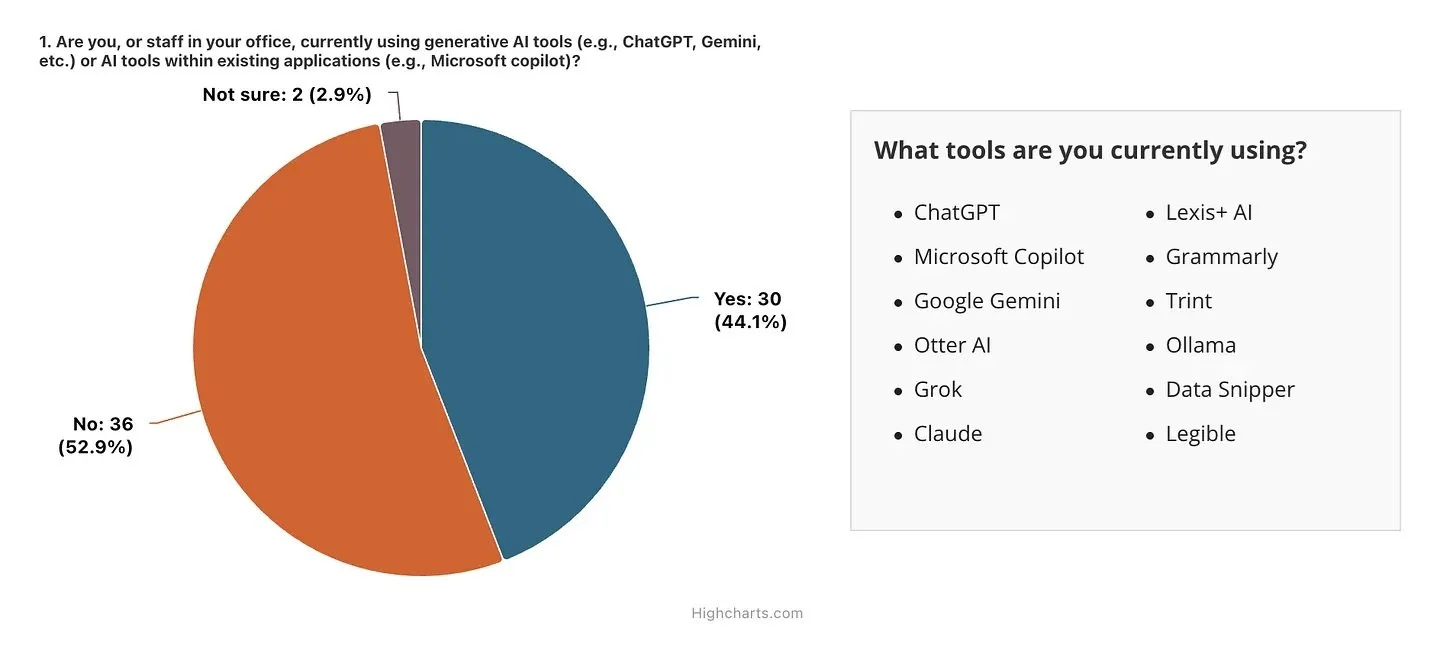
Source: National Conference of State Legislatures. “Legislative Use of Artificial Intelligence: 2026 Survey.” 2026.
NCSL’s 2026 survey gives us the clearest picture yet of how quickly AI use is becoming part of legislative work.
AI use keeps climbing. 56% of 2026 respondents report using generative AI for legislative work, up from 44% in 2025 and about 23% in 2024.
It is becoming more visible across legislatures. Nearly 70% now know of AI use in other offices, compared with 43% in 2025 and roughly 19% in 2024.
Governance is catching up. Nearly half now report an AI-use policy, about double last year’s share.
The capacity story is getting more complicated. Some staff say AI saves time, while others report added review and verification work.
Governance & Risk
AI and Downstream Bottlenecks
NCSL’s 2026 survey confirms a pattern we also found in our state report: AI can save time in one part of a legislative workflow while creating more work somewhere else. Several survey respondents said AI outputs required substantial review and verification, while others pointed to a growing need for legislative AI training.
That can happen for different reasons. Staff using AI earlier in the process may need better training to avoid sending weak or inaccurate work downstream, while staff later in the process may need more capacity and better tools to handle a higher volume of work.
Recent reporting from Congress shows a similar tension occurring at the federal level. The House Office of Legislative Counsel is seeing more proposals come through, including AI-generated drafts that can require additional review and correction. To call this simply an “AI slop” problem would miss the institutional issue. AI can expand capacity in one part of the process and, consequently, shift the bottleneck downstream, increasing the burden on reviewers. As a result, legislatures should treat capacity as dynamic, tracking where demands are shifting across the workflow and adjusting staffing, training, and tools where new pressure points emerge.
Legislators and staff should think about where these dynamics may already be showing up in their own workflows. Legislative leaders in particular should watch for new bottlenecks and whether staff have the training and capacity to manage them. One encouraging example comes from Idaho’s Legislative Services Office. As highlighted in a previous edition of State of the Art, the office has been offering ongoing AI training to help staff adapt their workflows, identify bottlenecks, and build capacity as use expands.
What We Are Watching
A few other state-focused AI efforts are also worth keeping an eye on:
Oklahoma’s new BEACON platform includes an AI tool that helps policymakers review administrative rules and identify opportunities for simplification.
Stanford researchers are using AI to scan state statutes for outdated reporting requirements and other “policy sludge,” with the work already informing legislative and regulatory cleanup efforts.
And a flag for upcoming events:
NALIT: NCSL’s National Association of Legislative Information Technology connects legislative IT staff across states around system modernization, cybersecurity, emerging technology, and practical peer learning. Their 2026 Professional Development Seminar runs Sept. 30–Oct. 3 in Raleigh.
RELACS: NCSL’s Research, Editorial, Legal and Committee Staff association brings together the staff who handle research, bill drafting, legal work, editing, committee support, and related functions. The 2026 seminar will be held jointly with Legislative Research Librarians Oct. 11–14 in Salt Lake City.