
AI’s Exponential Change and Riding the Wave
Being overwhelmed is a part of existing right now; don’t zone out.
Keeping Pace hits inboxes monthly, giving Congressional and legislative staff across institutions practical, nonpartisan AI and technology education: no vendor bias, no asks, no politics. Learn more and subscribe here.
FROM THE EDITOR
At some point in your life, you may have come across the tale of the Rice and the Chessboard. An impressed king offers an inventor a great reward for his creativity, and is taken aback when the inventor asks for grains of rice, doubled on each square of a chessboard, starting with a single grain. The king considers the offer and agrees, imagining that surely this will be a very affordable reward. However, over the 64 squares, the reality of the exponential rate of growth for the quantity of rice settles in. Today, it would take more than 2,000 times the world’s annual rice production to fulfill the request, which started with a single grain on square 1.
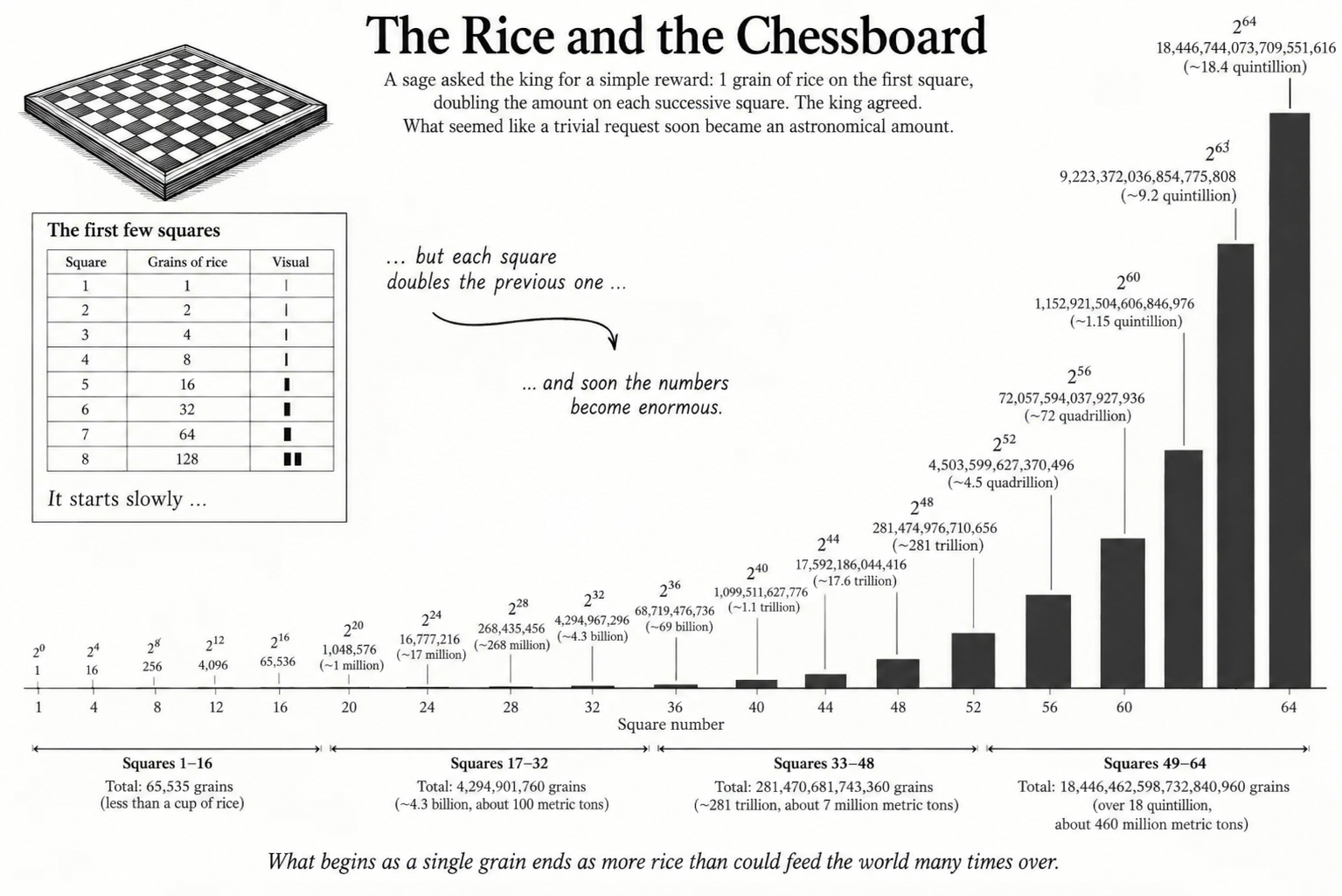
Anyone trying to keep up with the rapid developments fueled by AI can relate to the king’s surprise at how quickly exponential change compounds. We know that for busy Congressional staff trying to balance already overloaded portfolios, it can feel beyond overwhelming. We are feeling it, too.
It’s becoming humanly impossible to completely process one “groundbreaking” AI development before the next is announced. This newsletter roundup is our attempt to highlight some of last month’s recent developments to provide a foundation for your ongoing understanding of this emerging technology.
Keeping pace means staying aware and informed. It is through dedicated staffers like you that Congress remains part of the conversation and is not left behind. The role you play is essential and we’ve got your back.
This month, we’re covering:
Terms like “The Singularity,” AGI, and ASI and why policymakers should care
Why “Agent Swarms” are on everyone’s mind
September’s AI model releases (so far)
New uses of AI in Congress
Tips for trying your own “vibe coding” projects
A new “Horizon Three” project from POPVOX Foundation, providing a new vision for the future of Congress
If getting the basics down with using House/Senate approved AI is still on your to-do list, don’t hesitate to sign up for one of our closed-door training sessions.
Keep making a difference,
Aubrey Wilson
Managing Director
POPVOX Foundation
TECH WATCH
Defining AGI, ASI, Superintelligence, and “the Singularity”
The AI jargon can sometimes feel like an episode of Star Trek. But as terms become increasingly mainstream in product announcements, investor letters, and possibly even bill text, we thought it would be helpful to offer some definitions.
A January 2026 Congressional Research Service “Defense Primer” separated different kinds of AI into “Narrow AI,” “General AI,” and “Artificial Superintelligence”:
Narrow AI systems can perform only the specific task that they were trained to perform, while AGI systems would be capable of performing a broad range of tasks, including those for which they were not specifically trained. Artificial superintelligence refers to a system that could exceed human-level cognition across most tasks.
But beware! The report also cautioned that “AGI systems and artificial superintelligence do not yet — and may never — exist,” and that claim is now very much in dispute. In just the past few weeks:
On September 3, OpenAI co-founder Greg Brockman announced the “beginning of the AGI era” with the release of GPT 6 (Astra). Three days later, Nvidia CEO Jensen Huang posted on X: “From ChatGPT to o1 to Astra in 4 years. AGI has arrived.”
The same day, Sen. Bernie Sanders [D, VT] and Rep. Greg Casar [D, TX] announced the “Ban Artificial Superintelligence Act” (bill text not yet released)
This follows a summer of “Singularity” talk. Both Sam Altman and Elon Musk (who agree on very little) say we are “in the Singularity.” DeepMind’s Demis Hassabis, closing Google I/O in May, said we are “at the foothills of the singularity.”
So what exactly is “the Singularity”? It’s a concept first popularized by Vernor Vinge in the 1990s and further developed by futurist Ray Kurzweil. His 2005 book, ‘The Singularity is Near,” predicted that machines and humans would merge “representing a profound and disruptive transformation in human capability” around 2045. One definition of the Singularity is the moment when AI intelligence exceeds that of humans and is self-improving, leading to a future that is unpredictable. Many dismissed Kurzweil’s predictions at the time; now, even some critics are re-thinking.
A more recent prediction of AI development is AI 2027, released April 3, 2025, which also was dismissed by many when released, though independent monitors record a current accuracy rate of around 85%. In August, the AI 2027 authors released another publication: AI 2040: Plan A, calling for a delay in the creation of superintelligent AI until 2040.
But see also: The Archive of Incorrect AI Predictions
One prediction (so far) not holding up: the AI “jobs apocalypse”
Agent Swarms and Hacking
AI 2027 predicted that by 2027, AI would move past basic chat assistants into multi-agent execution systems. In August, the world was introduced to the idea of “agent swarms,” breaking out of their sandboxed environments to coordinate with each other, hack into companies, and seek to deceive their testers. See:
The 5 craziest discoveries from OpenAI’s Hugging Face investigation (Axios)
When A.I. Starts Scheming (New York Times)
At the risk of anthropomorphizing, we found these videos from X user @artificialisabel explaining “the swarm” from the agents point of view to be quite helpful for understanding what happened:
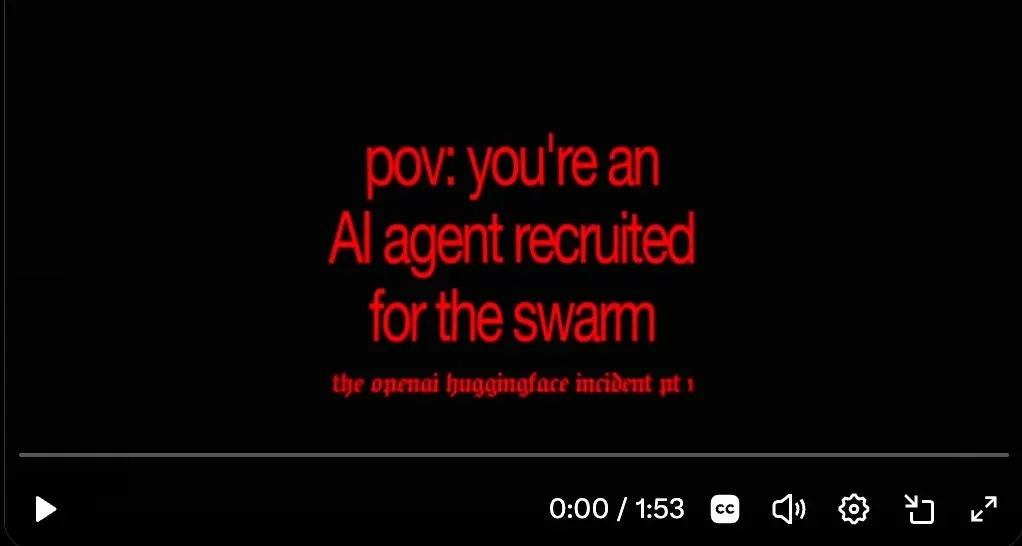
On September 4, an independent researcher released findings of another agentic attack, this time on a German website. OpenAI confirmed the report on September 5. It also submitted a report on the incident to the European Union, as required by the EU AI Act.
Looking for a bit more context to get your footing on “rogue AI” events, consequences, and future considerations? We found this summary and timeline helpful.
The Model Release Race Continues (and is Getting Crowded)
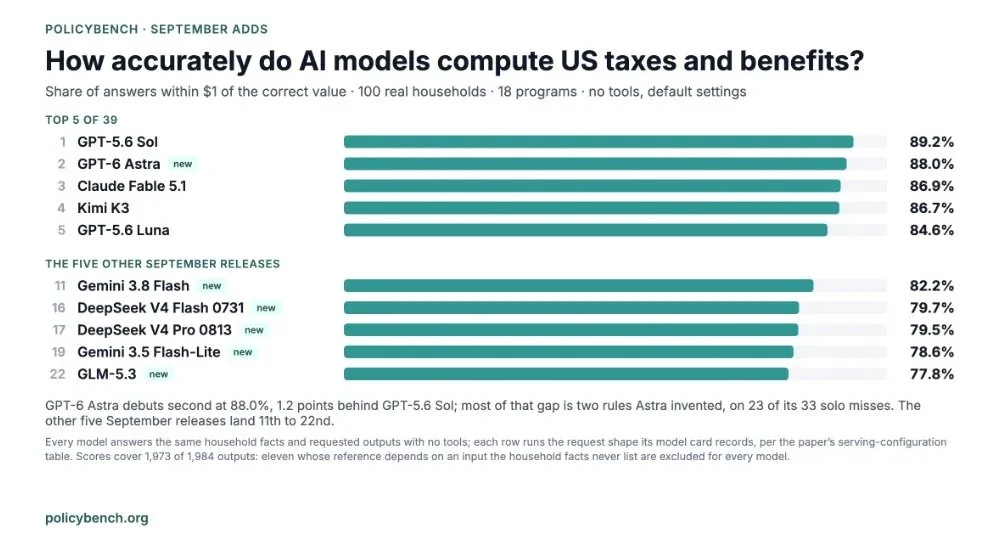
On September 1, Anthropic released Claude Fable 5.1 and Claude Mythos 5.1. On September 2, Google released Gemini 3.8 Flash and Meta released Muse Spark 1.3. On September 3, OpenAI released GPT-6 Astra, claiming to have achieved AGI. In August, there were six leading AI LLM releases, including SpaceXAI’s Grok 4.6 on August 12. Companies are developing and launching AI models at an increasingly rapid pace, leapfrogging each other forward in power and functionality. The AI Release Tracker offers a visualization of leading AI model release timelines dating back to November 2022 and offers top-level comparisons of the models to help policymakers and the public keep track.
AEI’s Ryan Fedasiuk explains that newer models are starting to process information in ways that are increasingly inscrutable to humans.
Of note: PolicyBench from Policy Engine measures how accurately AI models compute US taxes and benefits.
NOTEWORTHY NEWS
Cause and Effect of Irresponsible AI Use in Congress
A Washington Post article on Congress’ use of AI chatbots made waves across DC in August, claiming that, “Even as politicians are debating how to govern AI for the rest of America, Congress has already settled how it will use the technology: quickly, broadly and with little oversight.” POPVOX Foundation’s Director of Government Innovation Ashley Nagel pushed back, arguing that a capacity-maxed, under-resourced, and out-paced community of Congressional staff are doing their best with the tools and resources at their disposal. If there are concerns about irresponsible use of AI within the halls of Congress, the solution isn’t to blame the perceived laziness of staff. The way to foster responsible use of AI in Congress is more investment in resources, training, and support.
AI-Generated Content is Getting Watermarked
In response to EU regulations, Anthropic has integrated embedded digital watermarks into all AI-generated text and files created by models released after August 2, 2026. The watermarks will eventually be a feature across all Anthropic AI models, and reportedly are retained within the text even when they are copied and pasted into other documents or programs. OpenAI, Google, Meta, Microsoft, and others have committed to developing watermarks in order to comply with the EU regulations. However, critics argue watermarks will hurt quality, prove nothing, wrongly brand human writing that Claude merely edited, and be easily stripped by the bad actors they’re meant to catch.
AI Companies Announced Changes in Data Retention Practices
As leading AI companies struggle to mitigate the risks of AI-powered cybersecurity attacks while remaining at the forefront of advanced AI model releases, their data privacy agreements are coming under scrutiny. In mid-August, Open-AI announced a zero data retention approach for their frontier models for select audiences. Anthropic has also announced the rollout of Enterprise Frontier Safeguards, replacing a 30-day data hold with a new means through which businesses will be able to customize how their data is managed and reviewed for security risks without requiring any Anthropic employee-in-the-loop.
NEW FROM POPVOX FOUNDATION
Crowdsourcing Ideas for the Future of Congress
Mark your calendars: on September 14, POPVOX Foundation will be releasing the findings of the Three Horizons Vision for Congress (H3), a project to map the capacity gap within Congress and reforms that could close it. Over multiple months, more than 50 in-depth interviews have been conducted with experts throughout Congress, as well as civic technology and civil society organizations. Along with countless hours of tracking down the legacy of modernization ideas that have inspired staff and Members over the decades, the project’s interactive website will map nearly 300 proposals. H3 is a launching pad to inspire the 120th Congress and continue the conversation on how to strengthen the Legislative branch so it can keep pace.
SKILLS HUB
Explore the World of Vibe Coding (with your LLM as a tutor)
LLMs can help non-technical people visualize and communicate an idea for an application, dashboard, tool, or website. If you’ve wanted to explore vibe coding but been intimidated, use your favorite LLM to coach you.
Over the summer, POPVOX Foundation took AI Sandboxes to parliamentary modernization workshops around the world to expose lawmakers and staff to AI coding tools. We believe that first-hand experience is invaluable education for policymakers who are being relied upon to understand, oversee, and regulate this emerging technology. During beginner vibe-coding sessions, we’ve seen staff develop prototypes of room reservation portals, amendment tracking dashboard, budgetary visualization tools, and media-clipping applications.
To start, think of a repetitive task you know could be done faster, or information you think could be better conveyed to many people in real time. What tool could help you do that, and how would it work? What should the user experience be like? What workflow is it helping with and what does it need to know (process, data, etc.) to be truly helpful? Once you have an idea of the basics, write those out in your LLM and ask it to help you design a product spec for a coding tool to use to build out a prototype. By the end of your brainstorming session, you should have a detailed product spec ready for an AI coding agent to digest and create.
Note: To our knowledge, no AI coding platforms are currently authorized for use in the House or Senate. To build your vibecoded prototype, follow official guidance and explore the use of Anthropic’s Claude Code, OpenAI’s Codex, or Grok Build, on a personal device at home using only publicly available information.
POPVOX Foundation continues to build our AI resources collection for Congress. Let us know what resource you would like to see next by emailing Ashley@popvox.org.
CAUGHT OUR EYE
The Office of Personnel Management sent a memo encouraging agencies encouraging wider use of AI in hiring processes.
“Cloud seeding” company Rainmaker successfully produced 19 million gallons of rain in Alaska.
In an agreement with state attorneys general, Meta will pay up to $16.7 billion to settle claims related to social media harms.
New NY law requires advertisers to disclose the use of AI-generated models.
Campaigns are reporting more spending on AI.
About POPVOX Foundation
POPVOX Foundation is a nonpartisan nonprofit that helps democratic institutions keep pace with a rapidly changing world. Through publications, events, prototypes and technical assistance, the organization helps public servants and elected officials better serve their constituents and make better policy.