
AI Is an Institutional Challenge, Not an ICT Project
Annelie Lotriet, Deputy Speaker of the National Assembly of South Africa, discusses why AI literacy among MPs and leaders, and parliamentary collaboration, are key to building an AI-ready legislature.
BY BEATRIZ REY
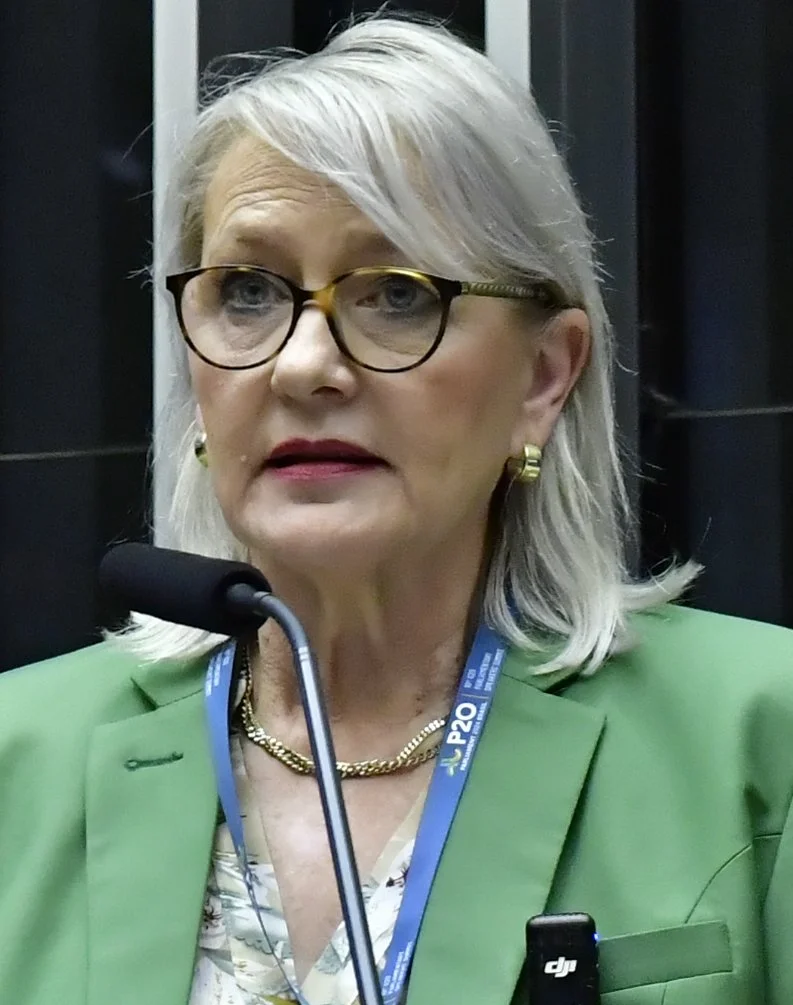
In June, Annelie Lotriet, Deputy Speaker of the National Assembly of South Africa, published a LinkedIn post that began with a simple but important question: “Are we ready?” Reflecting on Parliament’s role in an age of artificial intelligence, she argued that AI is not merely a technical issue for ICT departments but an institutional challenge that will affect every aspect of parliamentary work — from legislation and oversight to representation and citizen engagement.
I first heard Lotriet discuss these questions during the Inter-Parliamentary Union’s conference The Role of Parliament in Shaping the Future of Responsible AI, held in Kuala Lumpur in late 2025. Her remarks stood out because they focused not only on technology itself, but on the people who will ultimately determine whether parliaments succeed or fail in adapting to it. For Lotriet, the starting point is not software or infrastructure, but capacity. Parliament’s ability to navigate the AI era depends on whether Members understand the technology, its opportunities, and its limitations.
That emphasis on literacy runs throughout this conversation. Lotriet argues that most parliamentarians are aware of AI without fully understanding how it works, why its outputs require scrutiny, or how it can be used responsibly in legislative work. Building AI literacy among Members, she suggests, is now as important as more traditional forms of parliamentary training.
Her remarks also highlight a second theme: leadership. Technological change does not automatically transform institutions. Someone must create the space for learning, bring together parliamentary staff and elected representatives, and build support for change across the organization. Drawing on her experience leading Member-capacity initiatives in South Africa’s Parliament, Lotriet explains why leadership is essential if legislatures are to move from discussing AI to preparing for it in practice.
In our conversation, she reflects on lessons from Kuala Lumpur, South Africa’s efforts to train Members and staff on AI, the growing importance of partnerships with universities and civil society, and her vision of what an AI-ready parliament might look like in the years ahead.
Beatriz: On LinkedIn, you argued that AI is an institutional matter rather than an issue confined to ICT departments. What led you to that conclusion, and what do you think it means in practice for parliaments?
Annelie: When you look at a parliament, you have the administrative side and the Members. One of the things we discovered — quite strongly, in fact — at the AI Congress held in Kuala Lumpur last year was the disconnect between those two groups.
That congress was the first time I had attended an event where parliamentary staff and Members shared the same platform and engaged in discussion. What we found was similar to what happened in the past with ICT. Staff plan and design systems, while Members are rarely part of the process. They are largely on the receiving end.
The same thing is happening with AI. Members have very specific needs, and they operate with varying levels of knowledge, skills, and experience. You cannot develop systems in the ICT world without taking those differences into account.
That is why we believe the two sides must work together. Neither side should make decisions without the other. Politicians have specific ideas about how things should work and about their own needs. That is why AI is an institutional matter and should not be confined to ICT departments.
Beatriz: So the convening in Kuala Lumpur was a key moment for you, as I understand it. Was it the first event of its kind that you attended?
Annelie: Yes. As parliamentarians, we had not really been confronted with this issue before. We had attended conferences where AI might appear as one topic among many, but it was never the sole focus. Kuala Lumpur was different. It was a conference where you really had to think about these issues and were exposed to the more technical side of AI rather than simply to the political discussions around legislation and governance. It was a real turning point for me.
Beatriz: In the same post, you mentioned the webinar series with Stellenbosch University’s Policy Innovation Lab. Could you tell me a little about what motivated this initiative and what the most important lessons were?
Annelie: We were looking at which universities had been working in this field, particularly in relation to governance. Stellenbosch University, through its Center for Innovation and Information Development, offered relevant courses.
One of my staff members, Dr. Loxton LaBrant, attended one of those courses and came back very impressed. We then engaged with the university, and they developed a two-day program that was highly informative and largely tailored to the parliamentary environment.
The course covered the foundations of AI: what it can and cannot do, its opportunities, risks, and limitations. We also discussed practical applications and many of the issues we have been talking about today.
Another important topic was disinformation and misinformation, and the role AI can play in both. We will be offering a follow-up course in partnership with the Konrad Adenauer Stiftung that focuses specifically on those issues. In an election year, they become particularly important and potentially dangerous.
The course was an introductory course designed to orient Members and staff. We talk about AI all the time, but my experience is that around 80% of our Members know that AI exists without really understanding what it is. The next step will be to offer more advanced courses.
Beatriz: Just to clarify, Members themselves participated in the course?
Annelie: Yes. It was open to both Members and staff. The majority of participants were staff members, primarily due to their schedules and the demands of parliamentary work. We are about to enter a recess at the end of June, so we intend to repeat the course when Members have more time to attend.
Beatriz: The figure you mentioned — 80% of Members not really understanding AI — is striking.
Annelie: It is. People think they know, but they often do not. To be honest, I thought I understood AI before I started engaging with it more seriously, but I didn’t.
Beatriz: I feel the same way. At least for me, the only way to really understand it has been through courses and hands-on experimentation.
Annelie: Exactly. You have to use it. You have to understand what it actually is.
Beatriz: And what its limitations are. You mentioned that part of the course focused on misinformation and disinformation. Do you see AI as a double-edged sword? On the one hand, you’ve described how it can free up Members’ time, but on the other hand, there are also clear risks.
Annelie: Absolutely. Just look at hallucinations. You have to be very careful. At the end of the day, whatever AI produces must still be reviewed and edited by a person. There has to be what people call a “human in the loop.” That is one of the main messages we are trying to convey. In fact, we are already seeing examples in Parliament where speeches have clearly been generated using AI but not properly edited. As a result, the factual accuracy is not always there.
Beatriz: You’re trying to teach both sides of the equation — the opportunities and the risks. The mention of the university course made me think about something else. You have said that Parliament should not navigate these questions alone. What role do universities, civil society organizations, and external experts play in helping legislatures prepare for the age of AI?
Annelie: Their role is critical. I do not think any institution has all the knowledge, expertise, or experience required. This is an area where collaboration is essential.
We have already started working with universities. The course I mentioned, and the one we are planning with the Konrad Adenauer Stiftung, both rely on university lecturers and researchers. This is their field. They are conducting research and developing expertise that Parliament can benefit from.
But collaboration should not stop there. We also need to work with civil society and the private sector. Companies are doing a tremendous amount of work in AI and often bring different perspectives to the discussion.
That is why I am trying to keep our training programs as open as possible. We need to learn from a wide range of actors.
Beatriz: It’s interesting that you mention universities because I am a researcher myself and work at the University of Lisbon. Many of my colleagues worry that universities may eventually become obsolete because of AI. Yet what you’re describing points in the opposite direction — that universities are becoming even more important.
Annelie: Universities should conduct research, and they play a vital role in educating the next generation of people who will work with, study, and improve AI. We cannot leave that responsibility entirely to the private sector.
More importantly, AI can be used effectively only when grounded in deep knowledge of a particular field. The human role in the process depends on expertise and judgment. That expertise has to come from somewhere, and universities are central to that.
I do not see universities disappearing. Their format may change. The traditional model of exclusively campus-based education may evolve, and teaching methods will certainly adapt. But that is simply part of how institutions respond to broader changes in society.
I say that as someone who was also a university professor. I am very fond of universities and university campuses. But change is inevitable, and institutions must evolve with the world around them.
Beatriz: What does it mean, in your context, to prioritize AI and digital literacy as part of strengthening Members’ capacity?
Annelie: It’s critical, and that is exactly what we are doing. We recently reviewed all the training offered to Members of Parliament. Previously, ICT training was largely limited to tools of the trade — what kind of laptop or device Members used — but there was very little focus on how the technology actually works or how to use it effectively.
Training was mostly confined to technical basics: switching devices on and off, using applications, and similar tasks. We never really focused on AI.
As a result, we have redesigned our entire training offering for Members, with a strong emphasis on AI. We are also conducting a maturity assessment for both the ICT side and the Members themselves. It is taking longer than I would have liked, but it is important because it will help us identify where we are, what our gaps are, and what we need to do next. We can then tailor our training accordingly.
Today, alongside the traditional skills that politicians need, AI has become one of our main priorities. It is changing the entire landscape of how we deal with information, petitions, parliamentary questions, constituencies, and even speechwriting. AI will play an increasingly important role in all of these areas.
Beatriz: You mentioned the future. Do you have a vision of how parliaments — or, if you prefer, the role of Members — might look five years from now as AI continues to develop?
Annelie: I think Members will have much more time to spend on the ground and to represent their constituencies. They will no longer have to spend hours reviewing annual performance reports, working through hundreds of pages of budgets, making comparisons, and carrying out other time-consuming tasks.
AI can help with that work. It will not eliminate those responsibilities, but it will make them much easier. Preparation for committee and portfolio committee meetings will change dramatically.
At the moment, Members are often overwhelmed with information. Departments provide enormous volumes of documentation, and it is simply impossible to work through all of it. AI can highlight key issues, summarize content, and identify the most important points in seconds. That will free Members to think more politically about issues rather than being bogged down by administrative work.
Beatriz: Does that mean Members will be doing more politics?
Annelie: Yes. If you look at the amount of documentation we receive, it is enormous. You are expected to prepare for meetings using stacks of reports and documents that often arrive only a day or two beforehand. There is simply no way to read everything. With AI, Members will be able to identify the most important issues much more quickly and ask far more relevant and informed questions.
Beatriz: I hope that also means they get to do better politics.
Annelie: We certainly hope so.
Beatriz: When I asked how AI might change Members’ work, much of your answer focused on legislation. Do you also see implications for oversight and representation?
Annelie: Speaking from the South African context, a great deal of our oversight work takes place in constituencies. We conduct oversight visits, public hearings, and consultations. We receive petitions and submissions from citizens and community organizations. All of that generates enormous amounts of information. Until now, much of that information has had to be processed manually. Let me give you an example. During discussions around a proposed constitutional amendment, we received almost half a million public submissions.
Beatriz: Wow.
Annelie: Exactly. How do you process that volume of information? This is where AI can make an enormous difference. If submissions, petitions, and other forms of participation are collected digitally, AI can help organize, group, tag, and analyze them. It becomes much easier to identify patterns, themes, and public concerns. That makes the process more effective and allows Members to be more responsive. Too often, citizens submit petitions or comments and then feel as though those contributions disappear into a void. AI has the potential to help legislators engage with that information much more systematically and meaningfully.
Beatriz: Fundamentally, you think AI will transform how politicians work with information inside parliaments.
Annelie: Yes. It will also transform how Members conduct their own research. At the moment, research often depends on what information people happen to find and how much time they have available. AI changes that completely. I am genuinely excited about the possibilities. My only concern is making sure everyone can come along on the journey.
Beatriz: You hold a leadership position in Parliament. Why do you think leadership matters in shaping how legislatures respond to AI?
Annelie: Someone has to take the lead. Someone has to take the initiative.
I am fortunate because one of my delegated responsibilities is capacity building for Members of Parliament. Given my academic background, it was a natural fit. When we reviewed the training available to Members, it became clear that we needed to think beyond traditional forms of capacity building and consider where the world is heading.
Leadership matters because it takes initiative to make these things happen. In a parliamentary environment, you need political support to get projects off the ground. Individual Members can pursue training on their own, and many courses are available. But if you want to transform the parliamentary system as a whole, you need institutional commitment.
That is why I have emphasized the importance of working closely with the ICT division — and not only with ICT, but with the administration more broadly. We need a coordinated approach to information management, legislation, tracking systems, and all the processes that make Parliament function effectively.
Beatriz: Looking ahead, what would success look like? If you and I were having this conversation again in five years, what would an AI-ready South African Parliament look like in practice?
Annelie: I would hope to see a Parliament where AI systems are fully integrated into the institution.
At the moment, we are still trying to encourage Members to use tools such as ChatGPT. Five years from now, I would like to see Members who understand AI, know how to use it effectively, and can apply it in ways that benefit both themselves and the citizens they represent.
I would also like to see an administrative system that is fully equipped to work with AI — whether for information management, documentation, workflow systems, or parliamentary tracking mechanisms.
Most importantly, I would like to see everyone working from the same foundation and sharing a common understanding of how AI can support the institution.
Parliaments have traditionally been slow to adapt to broader developments in society. Processes can be extremely time-consuming. Legislation often takes two or three years to pass.
My hope is that, in an environment where AI is properly understood and supported by the right systems, Parliament can become a more effective institution and deliver better outcomes for citizens. I envision a Parliament that is more focused, more responsive, and ultimately more effective.
Beatriz: We have seen major technological shifts before — the rise of the internet, for example, or social media. I have been studying parliaments for a long time, and in some ways, this feels like a familiar conversation. Yet many of the Members and parliamentary leaders I speak with seem to view AI differently. Do you agree? And if so, why do you think parliaments might be more willing to adapt in the age of AI?
Annelie: People approach these questions differently and bring different perspectives to them.
In my case, I believe my position gives me an opportunity to help drive the conversation. In South Africa, we have the National Parliament as well as nine provincial legislatures. One of the responsibilities I see for myself is helping to promote awareness and understanding across all of these institutions.
International organizations such as the Inter-Parliamentary Union and the Commonwealth Parliamentary Association have also played an important role in increasing awareness and encouraging discussion. Their work makes it easier for parliaments to learn from one another.
For me, however, the immediate priority is ensuring that both the National Parliament and the provincial legislatures are as informed and prepared as possible.
We have structures such as the Speakers’ Forum and the legislative sector through which we work with the provincial legislatures. One of the challenges I see is bringing the national and provincial institutions together around a common vision for AI and a shared path forward.
That requires training, education, and sustained engagement. People need opportunities to learn about AI, understand its implications, and become comfortable using it.
This is not something that will happen overnight.
Modern Parliament (“ModParl”) is a newsletter from POPVOX Foundation that provides insights into the evolution of legislative institutions worldwide. Learn more and subscribe at modparl.substack.com.