
Lessons Being Learned with Fable
Keeping Pace is POPVOX Foundation’s monthly newsletter helping the Congressional workforce learn and adopt modern technology so every staffer is empowered to innovate. Each issue delivers practical, nonpartisan AI and technology education with no vendor bias, no policy asks, and no partisan agenda. Learn more and subscribe here.
A just-in-time technology explainer to address cutting-edge AI news that we believe legislators and staff should be aware of
On June 9, Anthropic released Fable 5, a general-use version of its most powerful AI frontier model, Mythos. By June 12, it was removed from public access due to reports of testers being able to jailbreak the model’s guardrails.
Prior to Fable 5’s release, the Mythos model was only made available to a small group of vetted organizations through Project Glasswing due to its high success rate at identifying and taking advantage of cybersecurity vulnerabilities. (We provide background on Mythos and frontier models in our May and June newsletters.)
Days after Fable 5’s release, Amazon researchers reported they had found a way to bypass Fable’s safety guardrails, accessing capabilities that could potentially enable AI-assisted cyberattacks. Amazon relayed that finding to senior administration officials Thursday evening and by the following evening, the Commerce Department sent Anthropic a letter placing Fable 5 and Mythos 5 under export controls. This restricted any foreign government, company, or individual from accessing the model. To comply, Anthropic cut off all customer access (foreign and domestic) to both models.
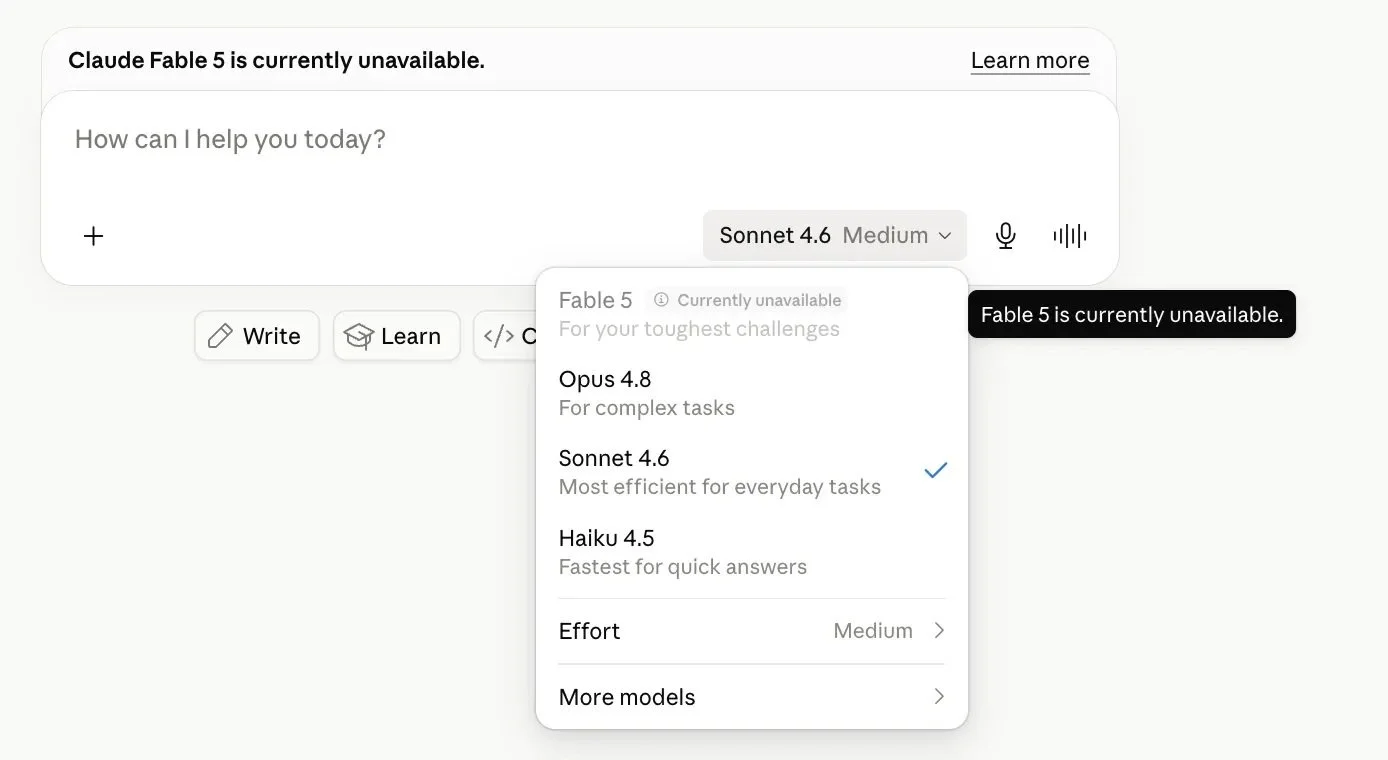
A June 15 screenshot of Anthropic’s Claude interface, showing announcements that Fable 5 is unavailable.
In an open letter with over 40 signatories, some of the country’s most prominent cybersecurity leaders argued that Fable’s capabilities that alarmed the administration, such as using AI to identify software vulnerabilities, is what defenders need. They claim that similar capabilities already exist in other widely available models, including OpenAI’s GPT-5.5, Anthropic’s Opus and Sonnet models, and Chinese model Kimi 2.7. Signatories warn that restricting Fable weakens US cyber defenders without meaningfully constraining adversaries.
The restriction also raised alarm globally. With the Commerce Department’s use of export controls to respond to the potential threat of Fable, the US government played out a scenario foreign countries have feared about over-reliance on the American tech stack — specifically that the US government has a “kill switch” to turn off access to both allies’ and adversaries’ use of frontier models.
The episode raises a number of questions regarding Congress’ role in oversight of this type of government action, but Legislative branch involvement requires awareness of Fable and the events that transpired over the last week. The Administration’s response to reports of this frontier AI model’s functionality was made rapidly with consequences for a major US company and its users worldwide. Congressional understanding of the situation and oversight of the Administration’s response is a concrete example of the pacing problem in action.
About POPVOX Foundation
POPVOX Foundation is a nonpartisan nonprofit that helps democratic institutions keep pace with a rapidly changing world. Through publications, events, prototypes and technical assistance, the organization helps public servants and elected officials better serve their constituents and make better policy.