
Modernization Without AI?
Coordination, institutional change, and the missing question in the UK House of Commons Modernization Committee
BY BEATRIZ REY
One year after the creation of the UK House of Commons Modernization Committee, a striking gap stands out: none of its 18 recommendations explicitly address artificial intelligence or digital transformation. Based on the Committee’s published work, AI appears only indirectly in the Commons’ formal modernization agenda, embedded within broader concerns such as accessibility, communication, and service delivery.
This absence is not trivial. It comes at a moment when parliaments around the world are actively grappling with how new technologies are reshaping information flows, decision-making, and institutional capacity.
This does not mean that AI is absent from parliament. As indicated in a previous ModParl post, discussions about its potential are well underway within the institution, but they seem to be unfolding along parallel tracks rather than within the Committee’s remit. The available evidence suggests a division of labor: modernization focuses on internal coordination and processes, while technological transformation develops elsewhere.
This creates a clear tension. As technological change begins to reshape the informational environment of legislatures, the body formally tasked with modernization engages with these questions only indirectly. Whether this reflects sequencing, institutional boundaries, or the early stages of a broader shift remains unclear.
What the Committee is doing
On July 24, 2024, the UK House of Commons formally authorized the creation of a new Commons Modernization Committee to consider reforms to its procedures, standards, and working practices. The Labour Party committed to creating the Committee in its manifesto, giving it a clear political grounding from the outset. Over the course of 2025, the Committee conducted its first inquiry, culminating in a report published in December with 18 recommendations spanning infrastructure, procedural redesign, and cultural or organizational change.
The House of Commons Administration¹ responded on March 2, 2026, suggesting a relatively high level of institutional receptiveness: five recommendations have been fully taken up with clear implementation commitments, while a further eight have been incorporated into ongoing work or existing structures. The remaining proposals were either modified or deferred, particularly those touching on parliamentary procedure or requiring coordination with political actors (see figure below).
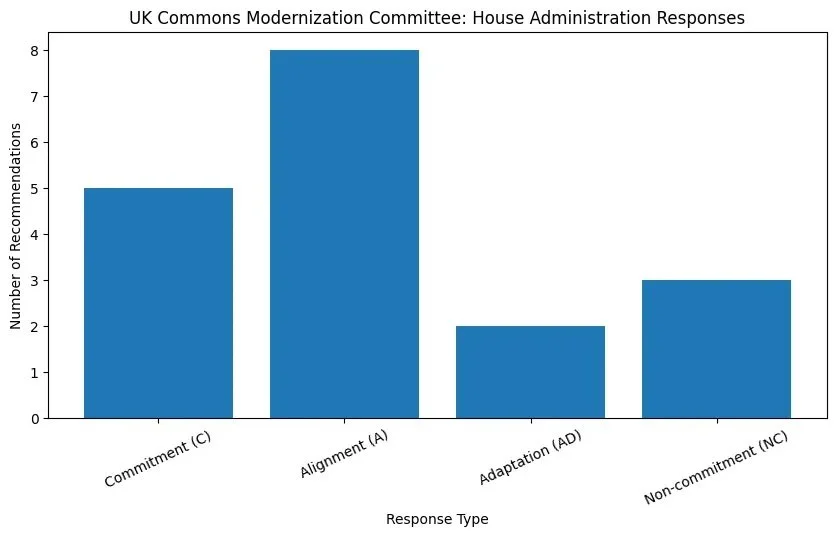
Note: Responses were coded into four categories: Commitment (clear acceptance with implementation pathway and timeline), Alignment (agreement incorporated into existing practices or ongoing work), Adaptation (acceptance of the objective but modification of the proposed mechanism), and Non-commitment (deferral to other actors or limitation to review without concrete action).
The distribution of responses, shown in the figure, helps clarify how the Committee operates in practice. Most recommendations fall into the category of Alignment, meaning they are absorbed into ongoing processes rather than implemented as discrete reforms. A smaller but still significant share reflects Commitment, where the Administration agrees to concrete implementation. By contrast, relatively few recommendations fall into Adaptation or Non-commitment, and these tend to cluster around issues that require coordination beyond the Administration, particularly procedural changes involving MPs or the Chamber itself.
This pattern reinforces a broader point: the Committee’s effectiveness does not lie primarily in producing standalone reforms, but in shaping and accelerating changes that are already institutionally viable. It operates less as a disruptive actor and more as a coordinating mechanism that aligns existing initiatives and gives them political backing.
How the Committee works
The current Committee builds on an earlier institutional model used during the Labour governments of the late 1990s and 2000s, while expanding its scope. Like its predecessor, it is chaired by the Leader of the House, an unusual feature for a select committee. This is not merely symbolic. Because the Leader of the House controls parliamentary business and can table motions on the floor, this arrangement strengthens the Committee’s ability to translate recommendations into procedural change.
At the same time, the Committee’s remit is broader than in previous iterations. Rather than focusing primarily on legislative procedure, it explicitly includes standards, culture, and working practices. This reflects a shift in how modernization is understood, from improving legislative efficiency to addressing how Parliament functions as a workplace and as a political environment.
The way the Committee sets its agenda reinforces this broader approach. Instead of starting with predefined reforms, it conducted a wide consultation across MPs, staff, and external stakeholders. Rather than selecting individual proposals, it used these submissions to identify recurring themes and structure its work program. In that sense, consultation functions not just as input, but as a mechanism for agenda construction.
This process helps explain both the substance and sequencing of its work. Accessibility emerged as the first inquiry because it cut across multiple aspects of parliamentary activity. The Committee has since moved toward questions about how time is used in the House of Commons. Notably, the concern is not primarily about how long Parliament sits, but how predictable its time is. For MPs, the challenge lies in navigating an inherently uncertain legislative environment while maintaining some degree of planning. This points to a deeper coordination problem at the core of parliamentary work.
The Committee also operates within a crowded institutional landscape. Responsibilities related to procedure and administration already sit with other bodies, particularly the Procedure Committee and the Administration Committee. As a result, modernization is not centralized but distributed. Much of the Committee’s work involves coordination across existing actors, ensuring that proposals align with ongoing processes and that stakeholders are brought into the process early.
Like other select committees, it gathers written evidence, holds oral hearings, and produces reports with recommendations. The key difference is that these recommendations are directed internally, primarily to the House of Commons Administration. This places the Committee in a hybrid position. It does not make public policy, but it does shape the internal functioning of Parliament.
Its influence, therefore, lies not only in what it recommends, but in what it enables. By articulating priorities and generating political backing, it creates the conditions for administrative change.
A Comparative Look
If AI currently sits outside the Committee’s core agenda, its approach to learning more broadly is outward-looking. From the outset, the Committee has drawn on examples from other parliaments, particularly in its work on how time is organized. The aim is not replication, but adaptation: identifying workable approaches and translating them into the Commons context.
At the same time, this exchange is not one-directional. The Committee understands its own work as potentially informative for other legislatures. Modernization, in this sense, operates as a process of cross-learning across parliamentary systems.
But comparison also highlights differences. Placed alongside the experience of the US House Select Committee on the Modernization of Congress, the contrast is clear. In the United States, modernization has taken the form of a large-scale, bipartisan effort, producing over 200 recommendations and focusing heavily on expanding institutional capacity, particularly in staffing, technology, and data, alongside a structured pathway for implementation.
In the UK, the approach is more embedded within the institution itself. Rather than expanding capacity at scale, it works by coordinating existing actors, aligning incentives, and generating the political backing needed to move reforms forward. These two models reflect different theories of institutional change. One builds new capacity to meet emerging demands. The other seeks to reorganize and better use what already exists.
As parliaments confront increasingly complex informational and political environments, including the growing role of AI, the challenge may not be to choose between these approaches, but to understand how elements of both can be brought together.
¹ The House of Commons Administration refers to the non-partisan body of officials responsible for the day-to-day operations of the House of Commons, including services such as procedural support, information and research, digital infrastructure, and the management of the Parliamentary Estate.
Modern Parliament (“ModParl”) is a newsletter from POPVOX Foundation that provides insights into the evolution of legislative institutions worldwide. Learn more and subscribe at modparl.substack.com.