
How legislatures are building institutional capacity to think beyond electoral cycles and anticipate long-term change
BY BEATRIZ REY
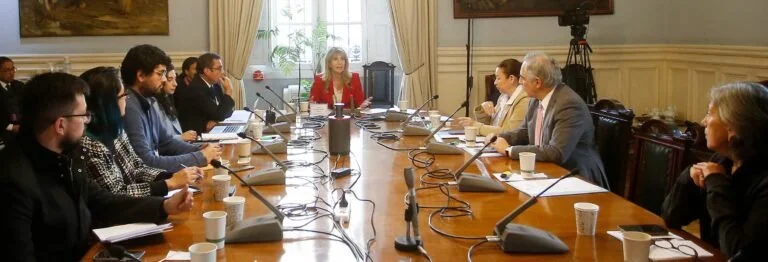
Chile’s Senate Committee on Future Challenges in session, part of an effort that brings legislators into sustained dialogue with scientists and specialists on emerging technologies.
Those who follow my work know how keen I am on all issues related to reimagination in politics. I recently came across the concept of foresight, which I think is deeply connected to reimagining and opens important possibilities for those working in parliaments.
Foresight refers to a structured way of exploring possible future pathways in order to inform present decision-making. It is not about prediction or forecasting what will happen. Instead, it integrates evidence-based methods — such as literature reviews, surveys, and trend analysis — with the imaginative construction of possible futures, often developed through expert input and scenario-building. It helps policymakers reflect on the strategic choices they face today and how those choices may shape the political, economic, and institutional landscape years or even decades ahead.
For parliaments, this matters enormously. Legislatures operate within short electoral cycles, yet they must make decisions on topics like technology, security, and economic transformation with consequences that unfold over much longer time horizons. Policy foresight provides a way to bridge this temporal mismatch. It allows parliamentary actors to step back from immediate political pressures and consider how current policy paths might influence the future – not in a deterministic sense, but by clarifying the range of plausible scenarios and the strategic choices embedded in today’s decisions
Where is Foresight in Parliaments?
Across different political systems, parliaments are beginning to institutionalize policy foresight in practical ways to build capacity to think systematically about long-term change.
In the European Union, one of the most notable examples of foresight applied to policymaking is the European Strategy and Policy Analysis System (ESPAS). Initiated by the European Parliament in 2009, ESPAS was designed as a mechanism to encourage longer-term thinking within the EU’s policy process by bringing together multiple institutions (the Parliament, the European Commission, the Council, and the External Action Service) to jointly analyze global trends and their implications for Europe. Rather than proposing policies, ESPAS focuses on identifying medium- and long-term developments and producing shared analyses that can inform strategic decision-making across institutional boundaries. It also promotes collaboration among the research units of these bodies and engages with academics, think tanks, and external partners to broaden the perspectives feeding into its work.
Also worth noting in the European Union context is the Policy Foresight Unit, part of the Directorate for Impact Assessment and Foresight within the European Parliamentary Research Service (EPRS), which has conducted strategic foresight since 2015 to assist Members of the European Parliament in anticipating future trends.
Finland offers one of the most developed parliamentary models. Since 1993, the Finnish Parliament has maintained a standing Committee for the Future composed of MPs who engage directly with long-term societal challenges. Each parliamentary term, the government submits a report on future developments, and the Committee prepares Parliament’s response. This creates an ongoing dialogue between legislature and executive on emerging risks and opportunities at a stage when policy paths are still open. Crucially, the Committee also sets its own agenda, allowing parliamentarians themselves to explore future-oriented issues rather than merely reacting to them.
Estonia offers a particularly interesting model through the creation of a dedicated foresight think tank within parliament itself. The Estonian Parliament’s Foresight Centre functions as an institutional bridge between long-term societal change and legislative decision-making. Rather than focusing on immediate policy debates, the Centre analyses structural developments, identifies emerging trends, and develops alternative future scenarios — typically looking ahead to 2030. Its work brings together domestic and international experts and systematically maps possible development pathways before outlining the strategic decisions policymakers are likely to face. In this way, the Centre equips parliament not with predictions, but with a structured understanding of plausible futures, allowing legislators to deliberate with greater awareness of how present choices may shape long-term outcomes.
Other parliaments have applied foresight through targeted initiatives. Chile’s Senate Committee on Future Challenges has worked with hundreds of experts on emerging issues such as AI and neurotechnology — contributing, for instance, to the early constitutional recognition of “neurorights.” In Germany, a parliamentary commission on artificial intelligence brought together MPs, experts, and citizens to examine AI’s long-term societal implications. Austria, meanwhile, has strengthened legislative decision-making by partnering with external foresight and technology assessment institutions that provide regular monitoring of future developments.
A Concrete Example from ESPAS
A recent example from ESPAS illustrates how policy foresight works in practice through what is now being called augmented foresight, that is, the integration of human expertise with generative AI to explore future developments in more systematic and creative ways.
In its analysis on the transformative potential of generative AI, ESPAS examines how large language models can support foresight by identifying emerging trends, detecting weak signals of change, and helping build plausible future scenarios. Rather than replacing human judgment, these tools expand the analytical capacity of foresight teams by processing large volumes of information and generating structured scenario narratives at speed and scale. This enables analysts to move beyond simply describing trends toward constructing alternative pathways for how technology, governance, and society might evolve.
For instance, AI-assisted horizon scanning can help detect early developments that might otherwise go unnoticed – such as technological innovations or shifts in social behavior – by continuously analyzing academic literature, patents, or media sources. Scenario planning can then use these signals to generate different plausible futures and explore their policy implications. In one illustrative exercise, ESPAS analysts used AI-generated personas grounded in a future scenario to simulate how citizens might experience the long-term consequences of policy choices, making abstract futures more tangible and relatable for decision-makers.
What this type of foresight does, fundamentally, is shift the focus from prediction to preparedness. It does not claim to know which future will occur. Instead, it outlines multiple plausible futures and highlights the strategic choices policymakers may face across them. By doing so, it allows legislators to consider risks, opportunities, and unintended consequences before they fully materialize.
For MPs and parliamentary staff, this kind of material can be valuable as it equips parliamentarians with structured ways of thinking about uncertainty: What if this trend accelerates? What if governance lags behind innovation? What decisions today could close off or open up future options?
In this sense, foresight analysis becomes less about forecasting the future and more about enabling legislatures to proactively engage with it. And this is precisely where it connects to the broader task of reimagining politics. If reimagining politics requires moving beyond inherited mental maps and institutional reflexes, foresight offers a structured way to do so: it creates space for legislators to step outside immediate constraints and consider alternative pathways, different priorities, and new relationships between technology, society, and governance.
By opening up multiple plausible futures, foresight supports the kind of imaginative, collective reflection that democratic institutions increasingly need – not to predict what will come, but to expand what is politically thinkable.
Modern Parliament (“ModParl”) is a newsletter from POPVOX Foundation that provides insights into the evolution of legislative institutions worldwide. Learn more and subscribe at modparl.substack.com.