
Staff Remote Work in Parliaments: Uneven Starting Points
Notes on whether and how parliaments are undertaking remote staff work from the Association of Secretaries General of Parliaments debate at the 152nd Inter-Parliamentary Union Assembly in Turkey
BY BEATRIZ REY
I’m in Istanbul, Turkey, for the 152nd Inter-Parliamentary Union (IPU) Assembly, and over the past few days, I’ve been spending my time with legislators, parliamentary staff, clerks, and others working closely with legislative institutions (in other words, fully in my element).
One of the bodies linked to the IPU is the Association of Secretaries General of Parliaments (ASGP), a consultative network that brings together senior parliamentary officials. Established in Oslo in 1939, the ASGP exists to facilitate exchange among those responsible for the internal functioning of parliaments — often a less visible but critical layer of legislative capacity.
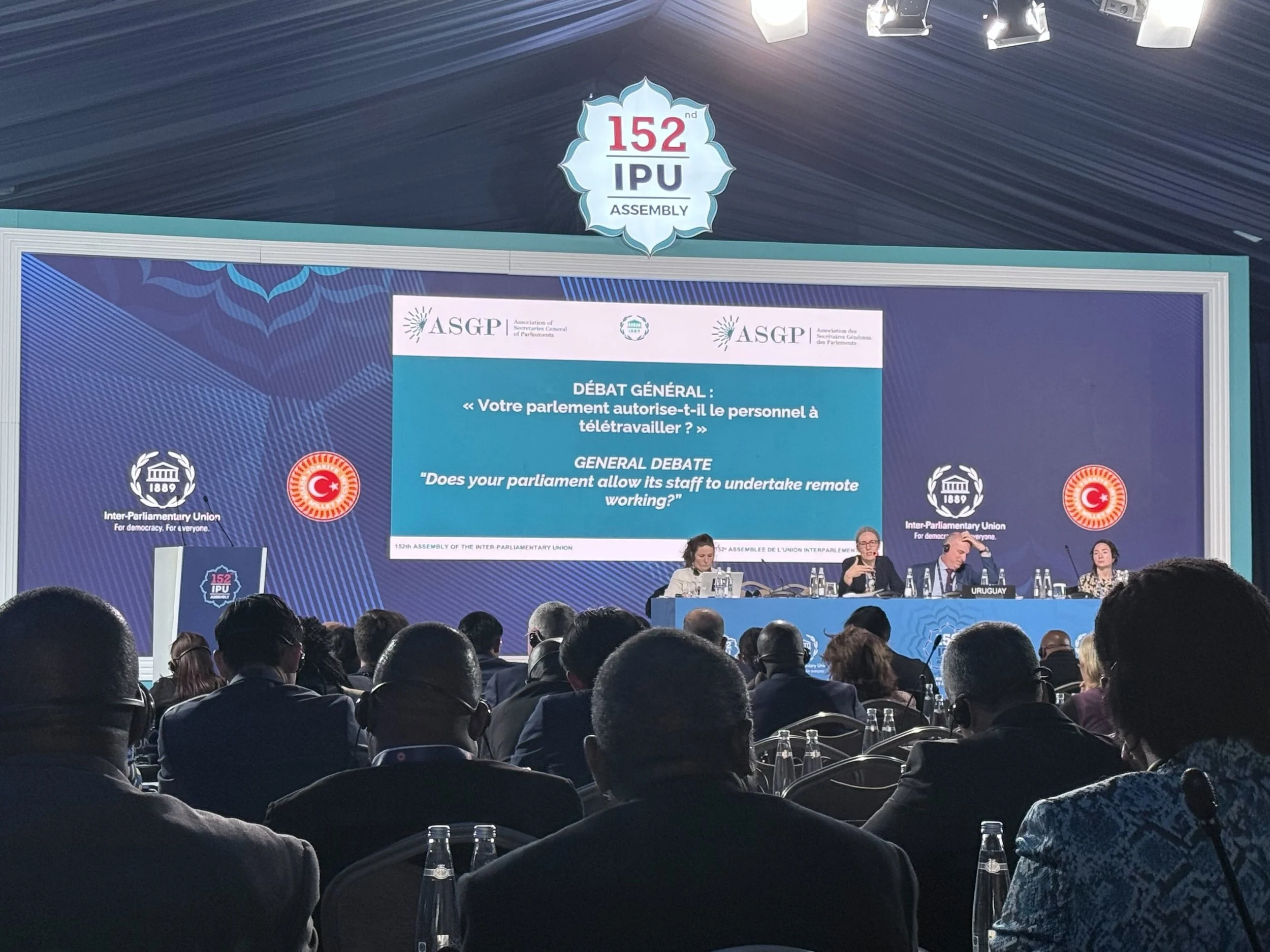
On April 18, the ASGP held a debate on whether parliaments should allow their staff to work remotely. Moderated by Chloe Mawson, Clerk Assistant in the UK House of Lords, the discussion was structured around three questions:
whether remote work benefits parliamentary institutions and what risks it entails,
what regulatory frameworks exist (including requirements for in-person presence), and
how parliaments manage roles that cannot be performed remotely, particularly in terms of inequality across staff.
What stood out to me is how uneven the starting point is across countries. Before questions of policy design or organizational culture, there is a more basic constraint: infrastructure. And by infrastructure, I mean something as fundamental as reliable high-speed internet. The gap across parliaments is striking — and this is before we even get to digitization, which is typically the entry point for conversations about AI and legislative modernization.
Some delegations made this explicit. Representatives from Timor-Leste and the Democratic Republic of Congo raised the question of how remote work can even be considered in the absence of basic technological capacity. At the same time, parliaments in countries such as the UK, France, Canada, Thailand, and Chile have adopted relatively advanced frameworks governing remote work for staff.
Staff Remote Work: Examples and Trade-Offs
In the UK, Mawson noted that the two Houses — the House of Commons and the House of Lords — operate under distinct arrangements. The Commons requires staff to spend a minimum of 40% of their time on-site, while the Lords allows for more variation across departments. The rationale for enabling remote work is partly competitive: as private-sector employers expand flexible arrangements, parliaments face pressure to do the same to attract and retain staff.
The Canadian Parliament reported a broadly similar approach, with an additional layer: Members themselves are allowed to work remotely, reflecting the reality that they spend a significant portion of the year in their constituencies. In Thailand, remote work proved particularly valuable during the 2026 energy crisis, triggered by disruptions in global fuel supply linked to conflict in the Middle East, which led the government to actively encourage and, in some cases, mandate work-from-home arrangements to reduce energy consumption. This points to a less frequently discussed benefit: beyond flexibility, remote work can enhance institutional resilience, allowing parliaments to function during disruptions such as energy shortages, natural disasters, or the COVID-19 pandemic.
There are, of course, trade-offs. Cybersecurity and data protection were repeatedly cited as key concerns. Participants also raised issues related to diminished in-person interaction, the risk of overwork and digital fatigue among staff, and the difficulty of monitoring productivity in remote settings.
The Case of Chile
I’m always glad to run into Miguel Landeros, the Secretary General of Chile’s Chamber of Deputies, at events like the IPU Assembly. This time, he gave me an additional reason to be glad: he mentioned that he regularly reads ModParl and saves issues for future reference.
His intervention began with a story I always find compelling. By the late 1990s, Chile had already digitized most of its legislative processes — not as part of a modernization agenda, but out of necessity. Although both chambers of the National Congress of Chile are located in Valparaíso, the need to coordinate legislative work across institutions and with actors based in Santiago encouraged early investment in digital workflows, even as digitization was far from a global priority. More recently, this institutional capacity proved advantageous: during the Constitutional Convention (2021–2022), Congress was able to support and adapt to new hybrid and remote work arrangements without major disruption.
In our conversation, Landeros explained that, in general, Chamber staff work four days in person and one to two days remotely, depending on the legislative calendar. He also noted that productivity is easier to monitor in some functions than in others. For example, staff responsible for reviewing AI-generated transcripts of committee proceedings have their work directly logged into the final document, since the system tracks all edits made to the initial version.
Another key element of the Chamber’s policy is the right to disconnect. After an eight-hour workday, staff are expected to disengage, and if they continue working, they are compensated with time off in subsequent weeks. This is one institutional response to the psychological concerns raised repeatedly during the debate. As Landeros put it, “productivity is not tied to sitting in a chair.” This view, however, was not universally shared. Representatives from the Swedish Parliament, for instance, expressed more skepticism, particularly regarding the challenges of monitoring productivity in remote settings.
What emerges from these conversations is not a single model of remote work in parliaments, but a spectrum shaped by institutional capacity, technological infrastructure, and underlying assumptions about what parliamentary work requires. In some contexts, the question is how to regulate flexibility; in others, it is whether flexibility is even feasible. More broadly, the debate suggests that remote work is not just a question of location, but of how parliaments define presence, accountability, and performance. Those definitions, much like the institutions themselves, remain uneven and very much in flux.
More to come soon on how parliaments are thinking about artificial intelligence and a conversation with Rodrigo Goñi Reyes, Speaker of Uruguay’s Chamber of Deputies.
Modern Parliament (“ModParl”) is a newsletter from POPVOX Foundation that provides insights into the evolution of legislative institutions worldwide. Learn more and subscribe at modparl.substack.com.