
3. The State of AI Adoption in State Legislatures
BY CAITLIN MCNALLY, ANNE MEEKER, AND AUBREY WILSON
3A — Where State Legislatures Sit on the Representative Bodies Adoption Phases
The most pressing finding of this research is that state legislatures are simultaneously ahead of and behind the trajectory Representative Bodies anticipated, depending on which dimension is measured. Representative Bodies’ framework for assessing international parliaments’ AI adoption — four approaches ranging from off-the-shelf tools to institutional models, and four phases from early experimentation to long-term transformation — applies just as much at the state level. Different legislatures, and often different offices within the same chamber, sit at different points across that entire framework at once.
An Idaho Legislative Service Office staff member described adoption within his own office as a bell curve with a small group using AI daily, a small group refusing to engage at all, and a large hesitant middle that could move with better training and policy clarity:
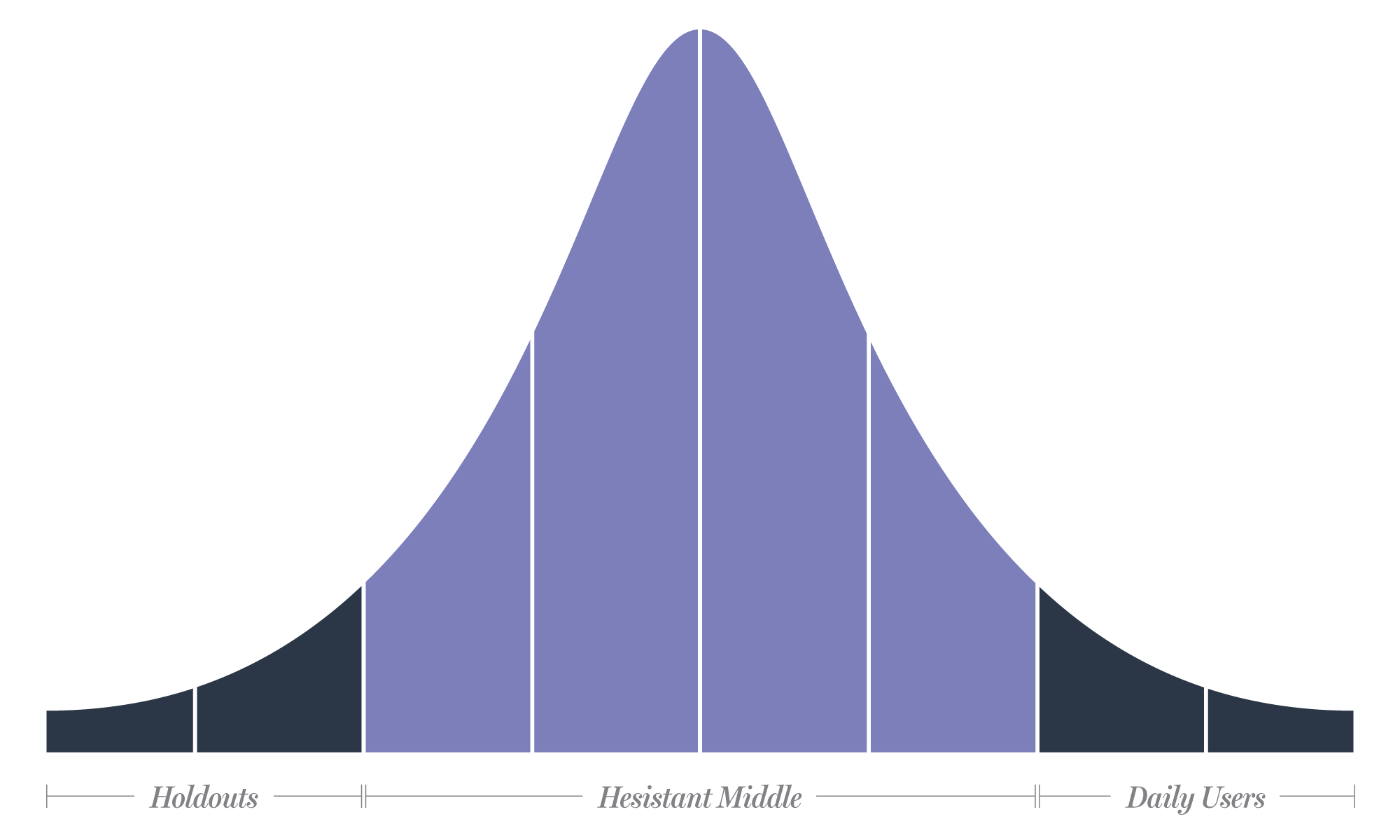
That local description holds up as an accurate model of adoption across the states represented in this research more broadly, and it maps cleanly onto Representative Bodies’ phasing. The right-end group operates in medium-term territory, integrated, domain-constrained tools embedded in actual workflows: for example, Iowa’s Legible platform, Arizona’s Skywolf, multiple states’ use of Westlaw AI Co-Counsel, and Idaho’s institution-wide AI guide all represent what Representative Bodies framed as medium-term integration goals. Yet in most states represented here, formal institutional support for AI experimentation, Representative Bodies’ immediate-term recommendation, does not exist at scale. The hesitant middle remains in the immediate or short-term phase, where the priority is experimentation and basic literacy rather than integration. The left-end group has not entered Representative Bodies’ phasing at all.
NCSL’s annual survey work offers the clearest scope-of-adoption picture available. Its 2024 survey found roughly 20% of responding legislative staff using generative AI tools for legislative work; by 2025 that figure had jumped to 44%, with ChatGPT and Microsoft Copilot the most commonly used tools in both years.¹⁶ Adoption of formal AI-use policies has not kept pace: the 2025 survey found no material change in the number of responding offices with a policy in place.¹⁷ The interviews conducted for this report add texture to that picture, showing how staff actually use these tools and where capacity challenges hinder progress.
Use-cases in Section 3b catalog specific AI-related initiatives, pilots, and workflows documented across this research. Entries are organized in relation to the four implementation timelines and technology adoption approaches described in Section 1c, with each entry’s corresponding Representative Bodies approach and adoption phase.
3B — Use Case Inventory
In the interviews conducted across 22 states, we confirmed the following use cases were in use by Members and legislative staff. The research suggests a pattern across state legislatures of little institutional investment to address the pacing problem, resulting in independently initiated Member and staff experimentation. A handful of legislative support agencies have adopted their own use policies, but this research identified only one legislature-wide policy.
Use cases are categorized along four timelines (described in Section 1c), from low-complexity commercially-available tool use to more involved use cases requiring more technical knowledge to implement.
3C — What Adoption Is Already Producing: New Pressures and Risks
AI adoption among constituents, advocates, vendors, Executive branches, and Members themselves is already producing a second-order set of pressures and governance risks that most legislatures have no infrastructure for addressing. These are not growing pains of adoption; they are new problems related to the adoption itself.
Demand-Side Pressure
The volume and complexity of work entering state legislative offices is rising, and several interviewees attributed at least part of that rise to AI tools now in widespread use among constituents, advocates, lobbyists, and Members themselves.
State legislative bill counts have risen over recent sessions in many states,¹⁹ but attributing that rise specifically to AI requires more analysis than is currently available. A staffer in Washington’s state Senate, with over two decades of experience, was not confident in AI’s specific role in her state, attributing observed increases in bill introductions primarily to an influx of younger, activist-background legislators. However, a staffer at Idaho’s LSO reported that bill drafting requests have increased noticeably, a trend partly attributable to AI tools making it easier for Members to generate initial ideas and move them forward for formal drafting. Alongside higher volume, drafting staff also contend with a shift in the quality of incoming materials, receiving AI-generated bill drafts and legal memos that are often incomplete or inaccurate and require substantial staff time to correct.
Constituent input volume and length are also changing. A delegate from Virginia described constituents now sending longer and more complex emails and letters, many drafted with AI tools, each requiring more staff and Member time to parse. Because rising message volume has many possible causes, the shift toward longer messages may be the clearer near-term signal of AI’s impact.
A Texas Legislative Counsel staffer captured a recurring theme: as constituents and advocacy groups use AI to draft submissions, offices reach for AI to manage the response, producing what he called “AI responding to AI.”
As constituents and advocacy groups use AI to draft submissions, offices reach for AI to manage the response, producing...‘AI responding to AI.’
The dynamics described so far concern volume and quality: more input, longer input, all requiring more staff effort to sort through. Representative Shaw’s experience points further: the authenticity of constituent contact itself can no longer be assumed. During a recent session, he received voicemails that appeared to come from named constituents with home addresses, using AI-synthesized voices and apparent voter registration data to generate credible-sounding contact. He identified them as synthetic by noticing uniform phrasing across calls, later confirmed at an AI workshop. He has begun drafting legislation restricting the use of voter data for AI-generated constituent communications and requiring disclosure when AI simulates constituent contact. His core concern: deployed at scale during a major session, such outreach could manufacture false constituent sentiment and swing legislative outcomes.
Member AI Literacy as a Governance Risk
One of the more consequential findings in this section is a literacy gap: Members across multiple states are using AI without fully understanding how it works, even as many of these same lawmakers will be asked to write the rules governing its use. That gap between use and understanding is arguably the more pressing near-term issue for legislatures to address.
Members across multiple states are using AI without fully understanding how it works, even as many of these same lawmakers will be asked to write the rules governing its use.
The pattern of Members treating AI output as authoritative is consistent enough across states to be described as a trend. In Iowa, a caucus policy analyst described Members saying “AI says” or “Grok says” in the same way they might cite a news article or a study, treating generated output as a primary source. Public reporting from South Dakota’s 2026 session documented state Representative Al Novstrup reading portions of a Gemini-generated summary on the House floor as evidence for a bill expanding access to two off-label prescription drugs, prefaced by his own acknowledgment that he was “not qualified to know the answer.”²⁰ The Iowa staffer has begun attaching AI disclosure notes to her own summaries specifically so Members do not read them aloud on the floor as if they were her analysis. In Idaho, a Member ran a bill to remove an obsolete interstate fisheries compact from state code through a general-purpose AI tool during a committee hearing and announced to the committee that the bill would strip the state of its rights. The AI output was incorrect, and the LSO had already vetted the removal thoroughly. The bill failed anyway.
Political Complexity from AI Itself
State legislatures across the country are now navigating policy questions arising from AI deployment — data center siting and resource use, children’s online safety, deepfakes in elections, AI use in classrooms, workforce displacement — and these questions interact with Members’ own decisions about whether and how to use AI tools.
A tension emerged across multiple interviews: for legislators considering AI regulation in their policy role, the act of using AI for their work shapes how they relate to regulating it. Several legislators described feeling uncomfortable using AI themselves while their committees considered AI regulation, treating their own use as a kind of implicit endorsement or potential conflict of interest. A staffer in a Massachusetts Senate office noted a particular dynamic among more progressive Members: the tendency to resist using AI as long as possible, reflecting both ethical concerns and a strategic instinct to maintain regulatory distance.
Several legislators described feeling uncomfortable using AI themselves while their committees considered AI regulation, treating their own use as a kind of implicit endorsement or potential conflict of interest.
This hesitancy reflects a genuine concern about accuracy and misuse. It may also stand in tension with the goal it is meant to serve. Members and staff who are most fluent in AI tools are often the ones who identify their limitations, spot governance risks, and draft effective regulation. Representative Shaw argued that people who have actually used these tools tend to regulate them more thoughtfully than those who have not. Representative Summers’ experience illustrates the point: her partnership with a local school superintendent known for incorporating AI into K-12 education produced the custom GPTs she uses in her legislative work, and later let her bring him in to testify as an expert witness on AI legislation. Members who avoid AI on principle may end up legislating a technology they have not directly used.
¹⁶ “Legislative Use of Artificial Intelligence 2024 Survey,” National Conference of State Legislatures (NCSL) (September 23, 2024).
¹⁷ “Legislative Use of Artificial Intelligence 2025 Survey,” National Conference of State Legislatures (NCSL) (August 25, 2025).
¹⁸ Louisiana v. Callais, No. 24-109 (U.S. Apr. 29, 2026).
¹⁹ “2025 State Sessions Recap: The Busiest and Most Effective States,” FiscalNote (n.d.).
²⁰ John Hult, “Artificial Intelligence Crept into Lawmaking in 2026, Prompting Excitement — and Concern,” South Dakota Searchlight (April 3, 2026).