4. Explaining the Gap: The Capacity Landscape AI Is Entering
BY CAITLIN MCNALLY, ANNE MEEKER, AND AUBREY WILSON
The institutions, not the technology, explain the uneven and often slow adoption in Section 3. AI cuts both ways for legislatures: the same tools that promise to extend staff capacity also drain it, flooding offices with AI-drafted constituent mail, tempting Members to treat pattern recognition as fact, and pushing legislatures toward outside vendors when internal expertise runs thin. Whether a legislature captures the benefits or absorbs the costs depends on the four capacity dimensions Section 1 introduced: people, institutional knowledge, the broader network, and technology.
People
The human infrastructure behind the institution — staffing, budgets, workload, and the informal capacity that never shows up on an org chart
Institutional Knowledge
What the legislature knows, and whether that knowledge survives when the people holding it leave
The Broader Network
The web of relationships beyond the chamber's walls that extend — and sometimes complicate — institutional capacity
Technology Adoption
Where legislatures stand on data, AI, and IT infrastructure — trailing in some places, leading in others
This section examines the challenges we found in each dimension, alongside the creative adaptations states have developed in response. Strengthening these foundations would dramatically improve legislatures’ ability to keep pace, with AI and with whatever comes next.
4A — People: Pressures and Elastic Capacity
The day-to-day reality of working in a state legislature, as a Member or as staff, has shifted over the last several years in response to broader pressures on American democratic institutions. Workloads have grown in volume, complexity, and intensity without corresponding growth in resources. Constituent demand has risen, sessions run longer and later, and the communications channels Members must maintain have multiplied. Members navigate fundraising pressure, burnout, and a structural mismatch between part-time pay and full-time demands. Staff contend with low salaries, limited professional development opportunities, and scattered onboarding. Capacity is also distributed unevenly within and between legislatures: majority and minority capacity gaps vary widely by state, and the institutional support offices that backstop much of the work receive inconsistent resources across states.
Constituent demand has risen, sessions run longer and later, and the communications channels Members must maintain have multiplied.
Constituent Communications
Constituent communication is among the most consistent and demanding pressures state legislative offices face. Volume has grown in recent years, usually without corresponding infrastructure to manage it. A former Texas representative estimated his office received 50 to 75 constituent emails on a normal day, climbing past 1,000 on a busy day; including non-constituent traffic, daily volume averaged around 2,200 during busy periods. Multiple Members reported increases in both constituent and out-of-state engagement driven by advocacy groups, alongside persistent challenges identifying and screening that traffic.
Pressure on constituent services has intensified alongside the broader communications load, driven partly by recurring surges, most dramatically during the COVID-19 pandemic. Because many state legislative offices operate with little to no staff, these waves can overwhelm intake. Massachusetts staffers recalled an influx of unemployment insurance cases during the pandemic, as constituents struggling to access benefits turned to their legislators for help navigating the system.
A former Massachusetts staffer described casework as particularly difficult on his mental health. Staff regularly direct constituents toward programs they know are already out of funds, absorbing the emotional weight of problems they cannot resolve. That role, serving as a first point of contact for housing insecurity and other crises, rarely appears in discussions of staff capacity but contributes meaningfully to what makes these jobs hard to sustain.
Time Demands Inconsistent with Compensation
A Washington staffer with four decades of experience observed that earlier generations worked demanding hours but still left at a reasonable time, leaving room for socializing and relationship-building across the aisle. Now, staff routinely work until midnight during session. An Iowa staffer described a 26-hour workday on the final day of session. In Massachusetts, nights and weekends during session are widely described as standard, driven by an overwhelming workload and an institutional culture that has not kept pace with staff capacity needs. In Texas, the biennial structure concentrates that pressure further: committees sometimes hear over 100 bills in a single sitting and schedule both morning and evening meetings to manage the load.
In many states, the structural conditions of the job have not kept pace with its actual demands, creating a gap between what the role requires and what it provides. In Texas, Members earn approximately $600 per month while remaining effectively on call even between sessions. As a former Texas lawmaker observed, this model self-selects for those with significant outside financial resources. Florida offers a similar illustration: Members earn roughly $29,000 annually on the assumption that the legislature operates part-time, but the demands rarely reflect that framing, and Members without outside income or wealth have described being effectively forced out of their seats before they might otherwise choose to leave.
In many states, the structural conditions of the job have not kept pace with its actual demands, creating a gap between what the role requires and what it provides.
Beyond compensation and resources, Members face the same volume pressures as their staff, often without adequate systems to absorb them. Representative Shaw framed the core challenge as one of prioritization, since developing genuine expertise on fast-moving issues requires more time than a part-time role allows. A New York senator described the tradeoff concretely: Her team once researched each cosponsorship decision in detail but abandoned that approach when it became impossible to keep up, and now cosponsors based on a simpler heuristic of high constituent interest paired with high likelihood of passage.
The same pressures erode the informal, relational work of legislating, the cross-aisle conversations and hallway problem-solving Members describe as essential to how the institution functions. One Ohio representative pointed to his chamber’s routine as an example of what sustains it: most Members arrive in Columbus early Tuesday, stay overnight, and leave Wednesday afternoon, making Tuesday evening the de facto social night for cross-party interaction. He credited those relationships with much of his success on committees and in the budget process. This kind of infrastructure depends on session structure, proximity, and downtime, conditions that tighten as session demands expand without structural support.
Staff Professional Development and Growth Opportunities
Staff across the board reported few formal affinity groups, peer networks, or mentorship structures to turn to for guidance, even in states with comparatively robust institutional resources. In Florida, a Senate President’s office program offers state-funded LinkedIn Learning with incentive prizes for completing hours: a blanket at 20, a lunchbox at 50. The program reflects genuine institutional effort, and also how modest the bar is for what counts as structured professional development in most state legislatures.
The absence of professional development and clear growth pathways is sharpest for super-minority staff in states with stable majorities like Florida and Colorado, where limited influence narrows both daily work and advancement. Former Colorado and Washington caucus staff observed that purple states with frequent majority shifts have stronger incentives to invest in staff professionalization. Colorado’s Democratic caucus created a Majority Staff Outreach Director role to professionalize the aide corps while the legislature was still swinging between parties; once redistricting eliminated frontline districts and the state stopped swinging, one interviewee said, the incentives for that kind of investment diminished. California complicates the pattern. It has operated as a Democratic supermajority for years yet built some of the most extensive staff development infrastructure in the country: a year-long paid Capital Fellows program run through Sacramento State University with structured mentorship,²¹ a Sacramento Semester internship program, fellowship tracks for PhD-holders from the scientific community, a Capitol Institute offering formal workshops for Assembly staff, and staff associations that play additional onboarding and community roles. That investment coexists with supermajority status, suggesting the driving factor is not political competition alone.
Staff Levels Vary Within and Between States
The gap between majority and minority capacity is substantial and varies considerably across states and chambers, though several states show that formal parity often means a better staffer-to-Member ratio for the minority. In Iowa, majority and minority staffing differs by perhaps one staffer, giving the minority party a higher staffer-to-Member ratio. Washington’s Democratic and Republican caucuses have equal staff, an arrangement that changes only if one party reaches a two-thirds supermajority, but with fewer Republican Members, GOP communications staff each cover one or two senators, while Democratic communications staff each cover three or four.
At the other end of the spectrum, the disadvantages of deep-minority status can be severe. A New Jersey staffer working for a super-minority Member described uncertainty over what resources the majority could access that his caucus could not. He cited a concrete example: being denied the tuition reimbursement the staff handbook entitled him to. Florida staffers in the minority described a compounding set of disadvantages: fewer professional development opportunities, limited access to institutional resources, and a narrower pipeline to future jobs.
California reflects a longer institutional culture of treating legislative professionalization as a public good worth funding. But even California’s investment has limits: the California Research Bureau, the nonpartisan research service housed within the State Library that serves both the legislature and the Governor’s office, is currently short-staffed due to funding constraints and operating below the capacity needed to meet legislative demand.
Adaptation: Elastic Capacity through Campaign Resources and Caucus Structures
The pressure to do more with less, named in the introduction of this report as a defining feature of state legislative work, drives creativity and elasticity in how Members and caucuses build working capacity — often in ways that formal staff counts alone do not capture. This research surfaced a persistent commitment among Members and caucuses to figuring it out anyway, through arrangements that do not appear on any official roster.
In many states, Members supplement official office capacity by drawing on campaign resources, a practice not widely documented in capacity research and one that operates in a gray area between official and political activity. The former Texas representative cited throughout this report is a clear example. A strong fundraiser over his fourteen-year tenure, he routinely used campaign funds to hire subject-matter experts his $13,600 monthly office budget could not support, maintaining a stable core team across all seven terms, a level of continuity uncommon in Texas. The inverse also occurs: a Virginia delegate deliberately reduced her staff to ease her fundraising burden. Other offices lean on students and interns, including a Tennessee representative who runs her office with six social work interns and Texas offices that rely on session interns to absorb constituent traffic at peak periods.
Caucus systems are another major source of elastic capacity. In Iowa, the caucus centralizes substantive policy work, including bill analysis and Member communications, while personal clerks, often family members or college students, handle scheduling. Washington’s caucuses do the same on communications, drafting shared messaging on high-volume issues that individual offices then customize. Both models concentrate expertise where it can serve many Members rather than spreading it thinly across offices. This logic now shapes AI adoption as well. Because caucuses can procure tools centrally, they can also lock in partisan advantages harder to dislodge than staffing differentials, as Arizona’s caucus-driven Skywolf procurement illustrates.
What This Means for AI Adoption
The people dimension explains more of Section 3’s adoption picture than any other. Thin staffing leaves no bandwidth for tool evaluation and training, the precondition for converting the hesitant middle, so offices default to whatever ships with the enterprise IT environment, which is how Microsoft Copilot became most staffers’ first AI experience. It also explains why the most advanced implementations this research documents are Member-built rather than institutional: absent institutional initiative, adoption happens where individual motivation and outside relationships happen to align, as with Representative Shaw’s agent architecture and Representative Summers’s partnership with a local AI expert. And the caucus force-multiplication model explains why the most consequential institutional adoption occurs at the caucus level, Arizona’s Skywolf, Iowa’s caucus-side Legible uptake, with the partisan asymmetries that entails. Where the people layer is thin, adoption is not absent; it is privatized, improvised, and unevenly distributed.
4B — Institutional Knowledge
Much of what makes a legislature function depends on what specific people know, carry, and have built up through years of doing the work, rather than documented systems or formal procedures. The institutional knowledge that keeps rulemaking processes running, committee workflows intact, and Member offices oriented lives largely in human memory — transmitted through proximity, mentorship, and informal practice rather than through written records that can survive a departure. When the people who hold that knowledge retire, burn out, or leave for better-paying positions elsewhere, the knowledge tends to leave with them.
Member Onboarding and the Learning Curve
The institutional knowledge problem falls first and most immediately on the people who arrive without it. Members face significant challenges getting up to speed, particularly in states where the transition into office is extremely compressed. In Florida, roughly three weeks separate an election from the start of session, leaving almost no time for meaningful preparation before the work begins. In Texas, the structure creates a distinct disadvantage: bill filing opens roughly 60 days before session begins,²² but new Members cannot be sworn in or hire staff until session starts — giving Members who arrive with existing infrastructure a significant head start on the substantive work of introducing legislation. Members who win special elections face an even steeper challenge, arriving mid-session with no onboarding and immediately legislating while simultaneously preparing for the next general election.
Staff Onboarding: The Knowledge Gap Beyond Training
Staff face a version of the same problem as Members, with added layers. They are learning not just institutions and procedures but their specific offices, their specific Members, and the idiosyncratic systems those offices have developed. Formal training, where it exists, tends to cover compliance topics like ethics and cybersecurity rather than how to do the job.
A staffer in a Massachusetts Senate office watched her office’s new legislative director go through onboarding as an overwhelming flood of Google Sheets and documents, handed over at once with no organizing structure or sense of priority. With the budget process weeks away, she felt it absorbed the new hire’s energy on basic orientation at precisely the moment fluency in the institution’s actual operations mattered most.
In the absence of adequate formal onboarding, the primary training system in most offices is the person sitting next to you. In Massachusetts, freshman offices share suites of desks grouped by committee rather than party, so new staff learn through proximity to colleagues, sometimes across the aisle. This works when colleagues are nearby and willing to help, and poorly when they are not, whether because proximity is absent, workloads leave no time to teach, or turnover has already removed the person who would have taught. A Massachusetts constituent services staffer described that last case, left largely on his own after his predecessor departed without documentation and having used a different case management system.
In the absence of adequate formal onboarding, the primary training system in most offices is the person sitting next to you.
The Single-Expert Problem
Knowledge in state legislatures concentrates in specific individuals rather than accumulating in systems, and new arrivals must absorb what they can from whoever happens to be nearby. This produces what might be called the single-expert problem — situations in which an entire body of specialized institutional knowledge lives in one person, with no formal mechanism for what happens when they leave. Idaho and Iowa both offer striking illustrations.
This produces what might be called the single-expert problem — situations in which an entire body of specialized institutional knowledge lives in one person, with no formal mechanism for what happens when they leave.
One staffer we spoke with serves as her legislature’s sole expert on a highly technical, cyclical process that the institution cannot afford to get wrong. Her office has asked her to write a manual documenting what she knows. In the meantime, she has begun training a junior colleague so that the office will have two people capable of managing the process the next time it comes due. The work involves enough compounding specificity that written materials alone cannot fully substitute for accumulated experience.
A parallel case comes from a nonpartisan legislative services agency in another state, in the area of administrative rulemaking. A longtime staffer there has spent his career accumulating expertise in how the state’s rulemaking process works. His predecessor held the equivalent role for decades, and the two overlapped for several years before the predecessor retired. He is emphatic that his success came from that overlap and that the same knowledge could not have been conveyed through written documents.
Turnover as a Structural Accelerant
High staff turnover is not new to state legislatures, but interviewees consistently described its effects on institutional knowledge as compounding. A California staffer described the median legislative staff member in the state as having roughly 1.5 years of experience and typically being a recent college graduate. A Massachusetts staffer reported average tenure just under two years and described a workforce split largely between recent graduates and near-retirees returning to reach ten-year pension thresholds, with only a small cohort of second-career staff remaining for a few years. A Florida staffer reported an average tenure of around three years. A Washington staffer noted that even in one of the better-resourced legislatures in the country, the historical pattern of lifelong careers has shifted substantially. Iowa staffers, by contrast, described 36-year tenures as not unusual, and Idaho staffers described low turnover as the norm.
A second tension runs across nearly every state regardless of geography: institutional staff tend to stay significantly longer than Member office staff. In Washington, communications staff in Member offices tend to turn over fastest, followed by policy staff, with nonpartisan institutional staff retaining the longest. Iowa staffers described 36-year and 38-year tenures at the LSA and in caucus research roles as not unusual, and Idaho’s LSO described low turnover as the norm, with retirements arriving in clusters rather than as a steady churn.
Adaptation: Member-Built Onboarding
Where institutional orientation is thin or absent, Members have constructed these resources themselves. Mississippi offers no formal new Member orientation; Representative Summers assembled a new Member handbook to orient incoming freshman legislators. The VRLA focus groups reinforced this pattern: several experienced Members had responded to comparable gaps by developing detailed onboarding guides and checklists that, despite lacking formal institutional standing, met a genuine need. That this work falls to individual Members is itself a finding. It indicates where the demand for addressing the problem resides, and it identifies a natural opening for institutions to formalize work that Members have already completed.
What This Means for AI Adoption
The knowledge dimension explains two things about Section 3. First, the absence of knowledge infrastructure means there is nowhere for AI training, guidance, or policy to live: an institution with no formal onboarding cannot bolt an AI curriculum onto it, and the policy vacuum documented in Section 4d is partly a symptom of the same institutional thinness. Idaho illustrates the point by contrast — its AI guide emerged from an LSO with unusually low turnover and stable institutional knowledge, precisely the conditions most legislatures lack. Second, the absence of formal knowledge capture limits what AI can offer. AI tools operate on data, and much of what these institutions know has never been rendered as data at all: procedures, precedents, and corner cases persist as individual memory rather than as documented, structured material a system could draw on. The legislatures that would benefit most from AI-assisted knowledge work are thus the least positioned to pursue it — the underlying record does not exist, and producing it would demand staff time these institutions cannot spare.
4C — The Broader Network
Of the four capacity dimensions this report examines, the network dimension is the one most likely to be entirely absent from traditional capacity assessments that treat the legislature as a bounded institution. The research documented here surfaced a more complex picture: significant portions of what state legislatures actually do happen through relationships that extend well past those formal borders. That extension is neither inherently positive nor negative; it is a structural feature of how state legislative work gets done in practice, and one that any serious capacity assessment has to reckon with.
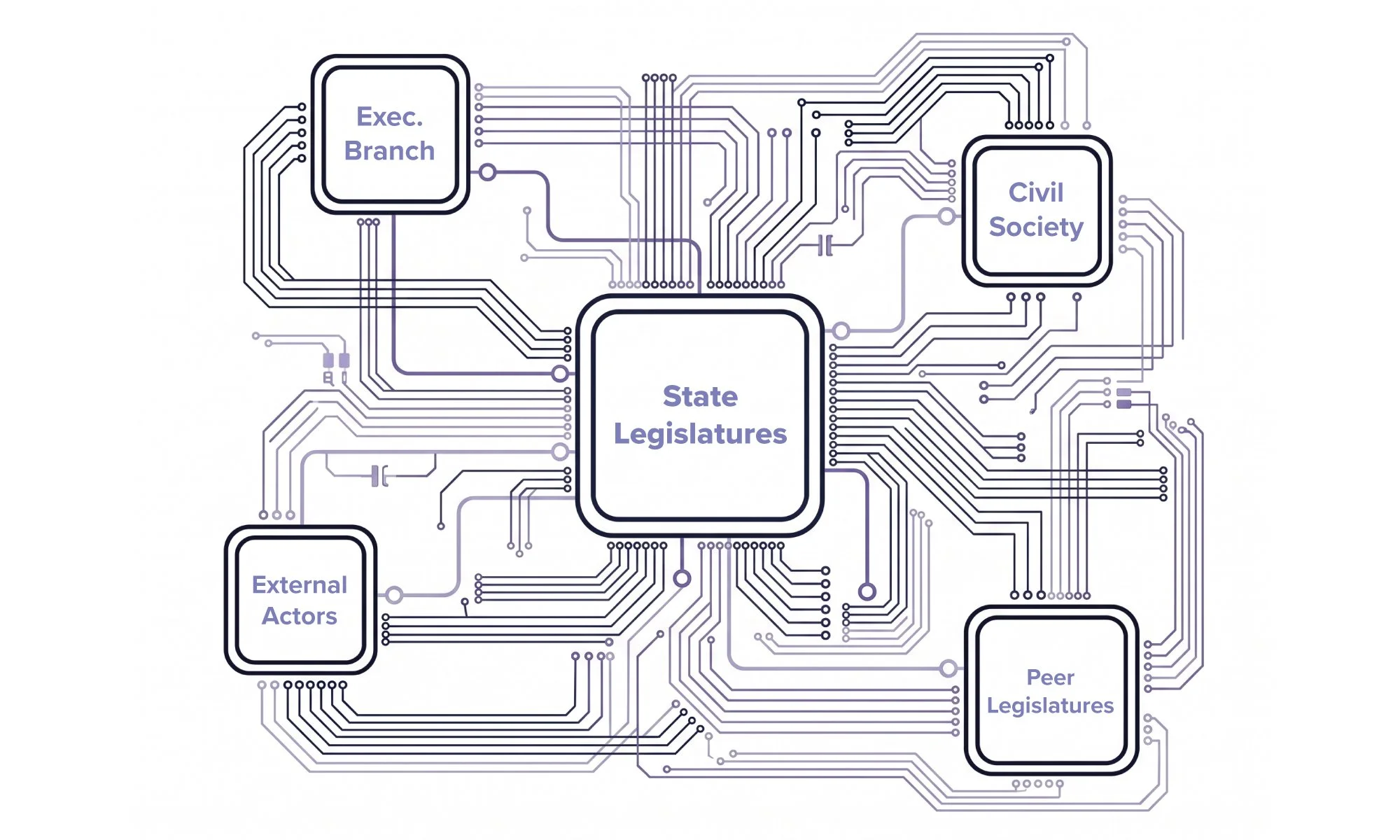
State legislatures operate within a complex ecosystem of external relationships: with the Executive branch that implements their laws and supplies much of the data they need to do oversight; with peer legislatures they look to for models and precedent; with civil society organizations, academic partners, and advocacy groups that fill research, training, and policy gaps the institution cannot meet on its own; and with external actors such as lobbyists and outside interest groups, who play their own roles as keepers of procedural and policy information and as tactics and strategy advisors — albeit with incentives of their own. Understanding how that ecosystem functions — what it provides, what it demands, and where it creates dependencies that raise their own capacity questions — is essential to a complete picture of legislative capacity.
The Executive Branch Relationship
The relationship between the Legislative and Executive branches is one of the most significant structural conditions shaping state legislatures. In most states, legislatures rely heavily on the Executive branch for the data, projections, and fiscal analysis that inform their core functions. Most legislatures do not have a state-level equivalent of the Congressional Budget Office (CBO). That means the fiscal scores attached to legislation are produced by the governor’s office or by executive agencies rather than by an independent legislative body. A researcher and former legislative staffer who has worked across multiple states described the implications plainly: executive fiscal scores can be more rigorous in methodology than what the CBO produces, but they can also reflect the governor’s priorities with a thumb on the scale for or against specific bills.
The oversight dimension of this relationship further complicates this dependence. In most states, formal legislative oversight of the Executive branch is reactive and limited. A senior staffer in Massachusetts described a common dynamic in states: legislators tend to pass bills and not follow up on implementation. His own office’s experience illustrates the consequence. Legislation requiring overdose reversal medication in transit stations was enacted and then went unimplemented by the responsible agency, prompting a second bill to enforce the first.
The Executive branch relationship also creates a structural pacing problem. A former Texas representative described the challenge in his health policy work: when new synthetic drugs emerge and need to be added to the controlled substances schedule, the fix requires legislative action that can only happen during session. If the issue surfaces between sessions, it must wait — sometimes more than a year given Texas’ biennial schedule. The same gap applies to technology regulation, public health emergencies, and any fast-moving domain where the pace of events outstrips the legislative calendar. In states with biennial or part-time legislatures this leaves substantial room for the Executive branch to move on emerging issues without direct legislative deliberation, deepening the interbranch capacity asymmetry.
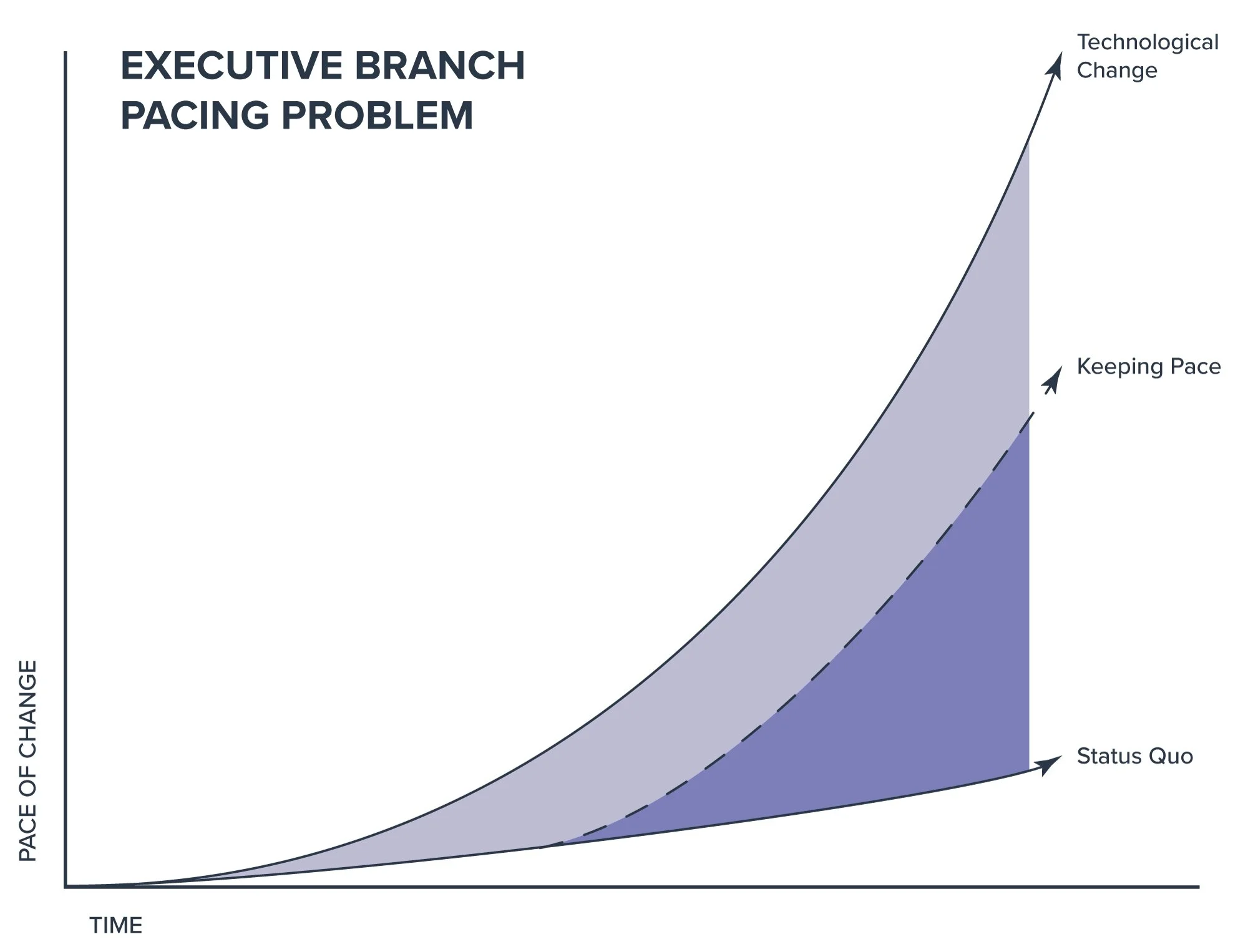
That asymmetry is now repeating in the AI governance domain, and forming faster there than most legislatures have recognized. In North Dakota, an Executive branch agency, North Dakota Information Technology, provides the legislature’s IT infrastructure and issues the state’s AI policy under the same statutory authority, so the executive’s framing of appropriate AI use reaches legislative staff through the systems they work on daily.²³ In New Jersey, the Executive branch built an AI assistant platform and later extended it to legislative employees, though the legislature played no role in designing or procuring it.²⁴
A further dimension of the Executive branch relationship concerns the separation of IT infrastructure. Idaho’s legislature operates on a separate IT contract from the rest of state government specifically because some legislators do not want their communications accessible to the Executive branch, an arrangement that is reportedly not uncommon among states. This instinct toward informational separation reflects how legislatures understand their institutional independence, and it carries downstream implications for technology procurement, AI adoption, and data governance.
Interstate Networks and Peer Dynamics
State legislatures do not operate in isolation. They follow each other’s leads, learn from each other’s experiments, and calculate deliberately about moving early or late on policy and institutional practice. Much of this exchange is informal, structured by geographic and constitutional proximity. An Idaho staffer captured the state’s orientation in a common saying, “If Utah sneezes, Idaho catches a cold.” Rocky Mountain and western states with similar constitutional structures, ratification dates, and political cultures look to one another first, since states admitted to the union in the same period often adopted similar frameworks, and a policy that works in one translates more readily to a peer sharing its structural foundations. Innovations therefore spread through regional networks rather than uniformly, and the states positioned to set precedent within them, whether through first-mover status or stronger resources, exert outsized influence on their neighbors’ choices.
Much of this exchange is informal, structured by geographic and constitutional proximity. An Idaho staffer captured the state’s orientation in a common saying, “If Utah sneezes, Idaho catches a cold.”
Member-driven convenings create their own informal networks along regional lines. In Massachusetts, Senator Lydia Edwards’ office hosts an annual New England Black Legislators Summit that brings together a bipartisan group of elected officials to compare legislative priorities, share communications strategies, and ground their work in historical context.
Beyond informal channels, a formal civil society infrastructure exists to convene and support cross-state peer exchange. NCSL and CSG are the primary connective tissue: both convene legislative staff and Members across policy issues, technology adoption, and professional development. Specialized convenings like NCSL’s RELACS event — focused on research, legal, and other legislative staff functions — create peer communities within specific professional roles across states.
A broader set of affiliate organizations foster networks and relationship-building along other lines. Identity- and demographic-focused organizations — the National Association of Latino Elected and Appointed Officials (NALEO), the National Caucus of Black State Legislators (NCBSL), the National Foundation for Women Legislators, and the Future Caucus, among others — convene legislators from groups underrepresented in state legislatures for peer learning, professional development, and policy coordination.
These affiliate networks can function as more than peer-support venues. They often serve as policy expertise and development supplements, sources of model legislation, strategic advising resources, and points of connection to civil society organizations working on related issues. A representative from Ohio described close collaboration with the NAACP on issues directly relevant to his majority-minority district as an example of how these relationships extend into day-to-day legislative work.
When Knowledge Migrates: The Lobbyist Dynamic
When knowledge does not transfer within the legislature, it tends to migrate outward — and a common destination is former legislative staff who have moved into lobbying and government affairs. A legislative staffer in Florida described this dynamic directly. When the internet went down at the Florida Capitol during session, a former-staffer-turned-lobbyist walked her through filing a paper amendment, because no one currently on staff knew the process. A former Colorado caucus staffer identified the influence asymmetries between legislatures and the external advocacy ecosystem as a top priority: there are no term limits for lobbyists, he observed.
There are no term limits for lobbyists.
The geographic dimension of this dynamic compounds the inequity. Lobbyist knowledge is relationship-based and concentrated in state capitals and urban centers. Members and staff in rural districts do not have the same access to the informal networks that better-connected offices rely on to fill knowledge gaps. A staffer in Florida named the Panhandle specifically: the lobbyist networks that urban offices draw on as an informal backstop are largely absent there.
In Massachusetts, where there is no dedicated legislative research service, Members and staff turn to lobbyists, trade associations, and outside policy organizations to fill the research function. The structural knowledge gap and the influence dynamic reinforce each other: the less capacity the institution builds internally, the more it relies on actors whose perspectives on the outcome of legislation are rarely neutral.
Model Legislation
A distinct form of external influence operates through model legislation organizations, which supply pre-drafted bills, policy templates, and advocacy infrastructure to legislators and staff who lack the capacity to produce them independently. When a legislature cannot generate well-researched, context-appropriate legislation internally, it depends more heavily on what external actors provide, and what those actors provide reflects their own priorities.
An analysis by the Center for Public Integrity, USA Today, and the Arizona Republic found that legislators have introduced model bill language from external organizations thousands of times across state legislatures.²⁵ External policy support is not inherently inappropriate, and drawing on outside expertise is often rational when internal research capacity is limited. Difficulties arise when model legislation is imported without adequate attention to the constitutional, statutory, and cultural context of the receiving state. A staffer in Idaho’s LSO described model legislation arriving without full account of the state’s constitutional specifics, requiring significant staff time to identify and address before a bill could advance. In thin-staffed offices, the time spent evaluating and adapting imported language constitutes a meaningful tax on capacity.
Adaptation: Civil Society Partnerships in Nonpartisan Support Roles
Beyond peer legislatures, state legislatures draw extensively on civil society organizations, academic institutions, and national networks to fill research, training, and policy gaps that the institution cannot meet on its own. In many states, this external support is structural rather than supplementary.
The most developed example is the Carl Vinson Institute of Government at the University of Georgia, which serves as an institutional partner to the Georgia Assembly across multiple functions. The Institute runs new Member orientation with topics chosen in consultation with the lieutenant governor and the speaker, trains chiefs of staff, convenes joint policy and state-federal committees, and handles data analytics on request from legislative leadership.²⁶ This arrangement reflects outsourced core function, enabled by the legislature’s long-standing investment in the University of Georgia as a statewide resource. With significant Member turnover expected in upcoming cycles, the Institute’s role as a knowledge and training backstop grows more consequential. Massachusetts maintains a smaller version of this for staff through Suffolk University.
What This Means for AI Adoption
Each relationship documented in this section shapes how AI will move through state legislatures. The Executive branch dependence is already reproducing itself in the AI domain, with executive agencies procuring tools and building governance frameworks that legislatures then inherit — a dynamic complicated by the informational separation that leads legislatures like Idaho’s to maintain independent IT infrastructure. The interstate networks that spread policy will likewise spread adoption: Legible’s expansion from Iowa outward follows the same regional diffusion pattern this section describes, meaning precedent-setting states will disproportionately shape adoption norms for their neighbors. Meanwhile, the external actors surrounding legislatures are often adopting faster than the institutions themselves — Iowa caucus staff can tell when lobbyists are using the same AI platform they use — and AI lowers the cost of generating model legislation at volume, sharpening the asymmetry between external drafting capacity and internal evaluative capacity. A legislature’s position within this ecosystem, as precedent-setter, fast follower, or dependent, may predict its AI trajectory better than its staff count does.
4D — Technology Adoption
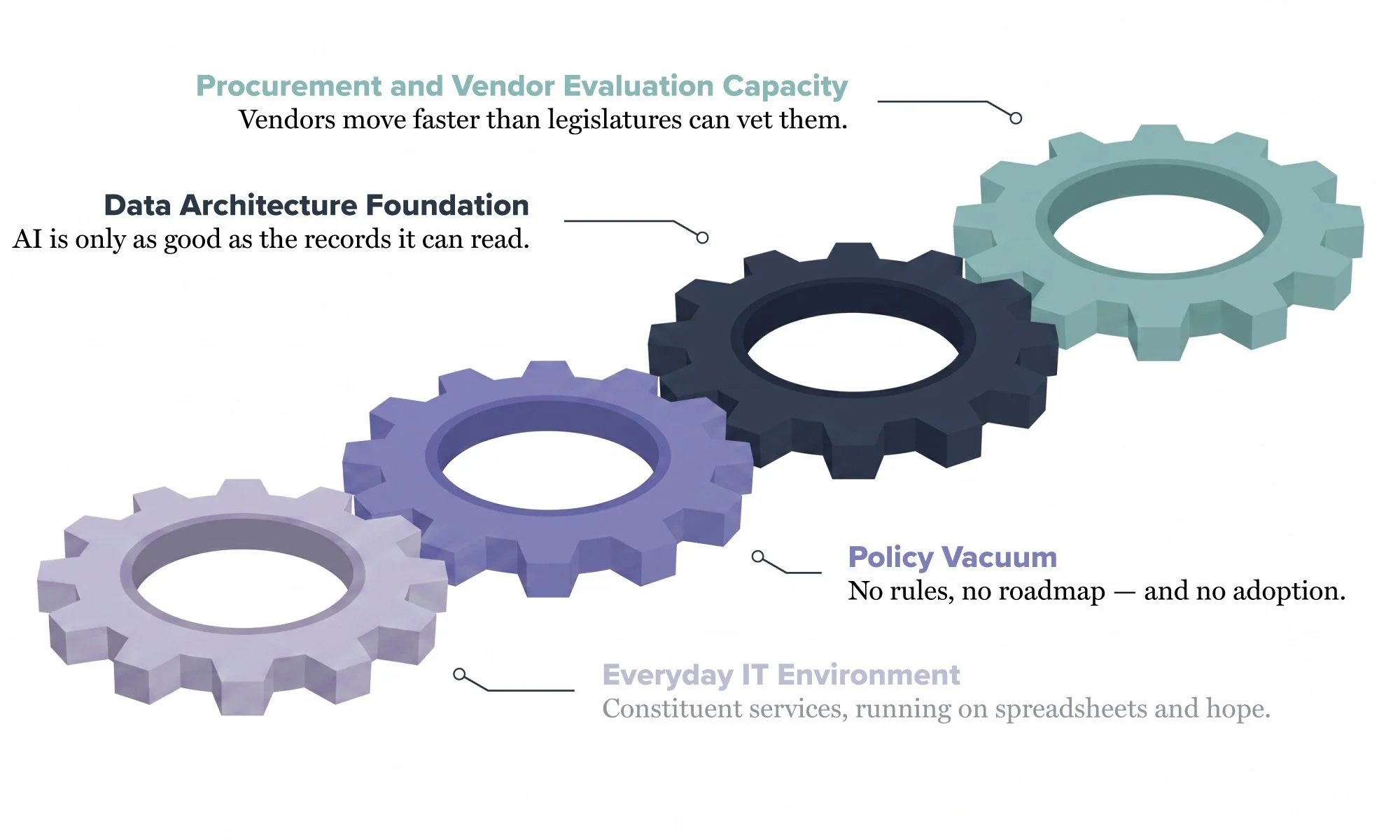
If the preceding dimensions describe who does legislative work and how, technology describes the infrastructure underneath it. It is also where the gap between state legislatures and comparable institutions is often widest, even as a handful of states run ahead of Congress on specific practices. Three components of that infrastructure recur across this research as structural determinants of the adoption picture in Section 3: the state of legislative data, the presence or absence of AI policy, and the institutional capacity to evaluate and procure tools. A fourth, the everyday IT environment, sets the baseline against which everything else is judged.
The Data Architecture Foundation
Before AI tools can be deployed effectively in legislative settings, the underlying data those tools would work with has to be in a usable form. Across state legislatures, that condition is inconsistently met. Legislatures file bills, conduct hearings, and maintain committee records — but the formats, accessibility, and completeness of that information vary significantly from state to state and within individual states over time.
In Idaho, a staffer at the LSO noted that committee records are only digitized through the mid-1990s, with everything older on paper and territorial-era records especially sparse. This situation is not unusual: many state legislatures hold substantial portions of their historical record in non-machine-readable formats. Texas was among the first states to adopt XML for legislative data, and the Legislative Reference Library is currently scanning every piece of legislation going back to 1886 — but much of that structured data is still accessed via an FTP site, which the IT director there acknowledged was not state-of-the-art infrastructure for tools that would benefit from queryable, structured records.
Investment in AI capability without corresponding investment in data infrastructure yields tools that perform well on recent material but fail once a query requires historical depth. AI-assisted institutional knowledge retrieval, 50-state case law comparison, cross-session bill tracking, and rulemaking analysis all presuppose a digitization baseline many legislatures have not reached. Several staff identified this as a practical constraint on what they can ask AI to do, independent of any policy or trust concern.
Investment in AI capability without corresponding investment in data infrastructure yields tools that perform well on recent material but fail once a query requires historical depth.
Procurement and Vendor Evaluation Capacity
Legislatures evaluating AI tools generally lack the technical capacity to assess vendor claims, and the pace of vendor development outpaces the pace of institutional procurement. Tools arrive faster than the institutional capacity to choose between them, leading either to delayed adoption or to adoption shaped more by vendor sales effectiveness than by genuine fit.
Procurement capacity also determines who adopts, not just what gets adopted. Where institutional procurement is slow, expensive, or absent, adoption routes around it: Members draw on campaign funds and personal relationships, and caucuses procure their own tools — Arizona’s Skywolf being the clearest case.
The Policy Vacuum
With limited exceptions, state legislatures have not developed formal policies governing how Members and staff use AI tools. What exists in most states is informal, inconsistent, and largely driven by individual office practice rather than institutional guidance — a dynamic that shapes both what staff feel permitted to do and how much they trust what they are doing.
Washington State is among the few legislatures with anything approaching an institution-wide AI use policy, and even there it is not highly prescriptive: focused on bias awareness, copyright compliance, accuracy verification, and avoiding hallucinated or invalid citations. Washington has also faced a complication most states have not yet encountered: the state legislature has no exemption from its public records act, and whether a ChatGPT prompt constitutes a public record subject to disclosure is a live question the legislature is actively working through.²⁷
Elsewhere the picture is considerably thinner. In Arizona, there is no written policy; department heads prefer AI as an analytical rather than generative tool, but this preference is informal and not binding. In New Jersey, the legislature sends periodic best-practices communications to staff covering confidentiality considerations, but it has no formal restrictions in place and provides no tools. In California, the research bureau operates under a formal prohibition on AI use without official state procurement approval.
The absence of policy carries its own effects. A staff member at Idaho’s LSO described a counterintuitive effect of the previous policy vacuum: the absence of rules deterred adoption among older and less tech-savvy staff, who were reluctant to use the tools without clear guidance on what was allowed. Policy clarity, in his observation, functions as an adoption accelerant rather than just a guardrail. Staff who cannot answer the question “is this allowed?” are less likely to use AI themselves and less likely to model its use for others.
Staff who cannot answer the question “is this allowed?” are less likely to use AI themselves and less likely to model its use for others.
The Everyday IT Environment
Increases in constituent outreach often outpace existing office systems. Across nearly every state examined in this research, constituent relationship management systems are unavailable, unaffordable, or inadequate. Most state lawmakers interviewed for this report use Excel or Google Sheets to manage constituent service cases. A handful of states, including New York, have begun offering centralized tools to their Members, though these tend to be recent developments and limited in functionality. Most offices have no dedicated system at all and lack the budget to procure one independently. A former staffer from Massachusetts noted that a commercial CRM option exists at roughly $100 per month per office but falls outside the typical office budget; offices there have improvised with Microsoft Forms feeding into Excel as a DIY substitute. Several lawmakers described testing constituent management tools within their budget only to find them inadequate. Most off-the-shelf options they explored lacked AI integration. The strain also extends to the email systems that serve as the default intake channel: a Florida staffer reported that her office’s inbox crashes regularly under constituent volume, requiring manually constructed rules to batch mass advocacy mail.
Copilot and the Hesitant Middle
Microsoft Copilot is the most widely available AI tool in state legislatures, distributed through enterprise licensing that reaches most institutions without a deliberate procurement decision. Across interviews, staff assessments of it were frequently mixed. An Idaho legislative services staffer characterized Copilot’s outputs as trailing the underlying GPT models, which he attributed to Microsoft’s integration lag. A bill drafter at Iowa’s LSA reported that in his own informal testing, Copilot did not consistently stay within the materials he had assigned it, which he flagged as a confidentiality concern for a nonpartisan agency serving multiple clients whose information cannot be cross-contaminated. In Massachusetts, staff reported that Copilot saw little use when first deployed but that adoption has increased over time as the broader culture has shifted toward viewing AI as something to embrace rather than avoid.
A recurring pattern across these accounts is that staff whose first AI experience came through a broadly distributed, general-purpose tool sometimes found it a poor fit for their specific work and have not yet tried other tools. This helps explain part of the hesitant middle of the bell curve introduced in Section 3a. For these staff, the barrier appears to be exposure to a tool poorly matched to their tasks rather than a considered rejection of AI, which points to a training and onboarding challenge.
Adaptation: Policy Clarity and Domain Constraints as Trust Infrastructure
As with the other dimensions, the adaptations here are real but uneven. Idaho’s LSO turned its own policy vacuum into the most developed Legislative branch AI framework in the country (Section 3b), and its central lesson — that policy clarity functions as an adoption accelerant rather than just a guardrail — is among the most transferable findings of this research. Washington’s institution-wide policy, though minimal, does similar work while also mapping the emerging intersection of AI use and public records law that most legislatures will eventually face. On the data side, Texas’s early adoption of XML and the Legislative Reference Library’s scanning of every bill back to 1886 show what long-horizon data investment looks like, even where the access infrastructure lags behind it. And the domain-constrained platforms inventoried in Section 3b — Legible, Skywolf, Westlaw AI Co-Counsel — are themselves technology-capacity adaptations: where general policy and procurement infrastructure is weak, bounded tools substitute for the trust that infrastructure would otherwise have to provide.
What This Means for AI Adoption
Of the four dimensions, technology capacity is the most direct determinant of the Section 3 picture — the barrier staff experience on the ground (Section 3c) is largely its symptom. Data architecture sets the ceiling on what AI tools can do; policy clarity determines whether the hesitant middle engages; procurement capacity gates which tools arrive and who gets them. It is also the fastest dimension to change: unlike staff culture or network position, a data plan, an AI use policy, and a vendor evaluation framework are all things a legislature can build quickly.
²¹ “Capital Fellows Programs,” Center for California Studies, California State University, Sacramento (n.d.).
²² “Frequently Asked Questions,” Texas Legislative Reference Library (n.d.).
²³ “Artificial Intelligence Guidelines,” North Dakota Information Technology (n.d.); N.D. Cent. Code § 54-59-09.
²⁴ “Governor Murphy Unveils AI Tool for State Employees and Training Course for Responsible Use,” Office of the Governor of New Jersey (July 3, 2024).
²⁵ “Copy, Paste, Legislate” (investigative series), Center for Public Integrity, USA Today, and The Arizona Republic (2019).
²⁶ “Legislative Training,” Carl Vinson Institute of Government, University of Georgia (n.d.).
²⁷ Sam Drysdale, “Without Rules, AI Use Spreading Fast Among Legislators, Staff,” WWLP (August 6, 2025).