
5. Assessing Legislative Capacity in the AI Era
BY CAITLIN MCNALLY, ANNE MEEKER, AND AUBREY WILSON
Capacity metrics measure how legislatures, funders, and researchers currently decide where institutional investment is needed and how much progress an institution has made. A rigorous measure of adaptive capacity, not just professionalization, is a precondition for allocating resources and attention to where they will actually expand a legislature’s ability to respond to fast-moving technological change. Traditional political science metrics of legislative capacity focus on three variables: salary, session length, and staff numbers. While these remain vital benchmarks, this research documents that these measures alone no longer sufficiently assess capacity. Widely accessible AI tools, deeper technical infrastructure requirements, and denser networks connecting legislatures to each other and to civil society and global peers all shape what a legislature can do in ways these dimensions do not capture.
This report proposes a new Legislative Adaptive Capacity Index (LACI) as a framework for assessing how well legislatures can respond to emerging technologies like AI. Borrowing a framing from resilience and adaptation literatures, legislative adaptive capacity may be defined as the ability of a representative institution to absorb changing demands, preserve and mobilize institutional knowledge, draw on external networks without surrendering institutional autonomy, and evaluate and integrate new technologies in service of its constitutional functions. Fully developing LACI as an operational index is beyond the scope of this report; however, the emergence of AI represents a clarifying opportunity to examine what specific capacities within a legislative body give it the ability to adapt and respond, along the four dimensions covered in depth here.
This report proposes a new Legislative Adaptive Capacity Index (LACI) as a framework for assessing how well legislatures can respond to emerging technologies like AI.
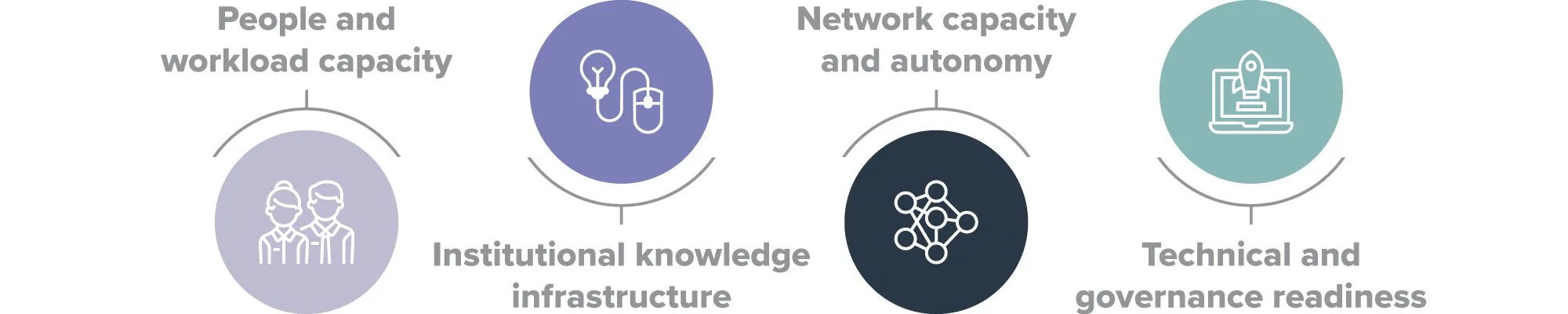
People and workload capacity
Do staffing levels, workload, office budgets, and the professional-development infrastructure available to Members and staff — along with the elastic capacity that caucus structures and campaign resources provide — give an institution the bandwidth to evaluate and adopt an emerging technology, rather than leaving it to individual initiative? Do staff and Members have the time, tools, and resources to solicit constituent input and proactively communicate decisions around emerging technology to the people they represent? Critically, this dimension turns on the ratio between resources and the work flowing in: constituent communication volume, bill volume, casework volume, and the complexity of incoming materials all shape what a given level of staffing can actually absorb. This dimension also encompasses political culture which, although not a central focus of this report, shapes how readily an institution moves on new technology.
Institutional knowledge infrastructure
Can the legislature access trustworthy expertise on an emerging technology, and has it captured its own expertise in documented, structured form rather than holding it only in individual memory? AI literacy sits within this dimension — how well Members and staff understand what these tools can and cannot do — but so does the deeper question of whether institutional knowledge is transferable at all. Captured knowledge is what makes a domain-constrained AI tool possible in the first place: a legislature that has never written down what its experts know has nothing for such a tool to train on. Section 4b’s discussion of fragile institutional knowledge points to a dimension current frameworks do not measure.
Network capacity and autonomy
Do relationships with Executive branch agencies, peer legislatures, civil society partners, and academic institutions extend a legislature’s capacity to understand and respond to an emerging technology, or does the legislature depend on those relationships in ways that limit its own capacity and independence? Section 4c examined this dimension; assessing it requires looking beyond the legislature itself, and requires distinguishing capacity-extending relationships from capacity-substituting ones.
Technical and governance readiness
Does the legislature have the data architecture, AI policy clarity, IT capacity, and procurement infrastructure in place to act on that expertise once it exists? This dimension also includes the presence or absence of domain-constrained tools that can serve as trust bridges for broader adoption.
Our research demonstrates that traditional capacity metrics do not necessarily predict the answers to these questions. Idaho’s LSO, which would not rate particularly high on a traditional measure, has produced one of the more sophisticated internal AI adoption frameworks in the country. California’s legislature, which rates very high on professionalization measures, faces structural barriers to AI access that effectively exclude its research bureau from the state’s primary AI investment. A framework that captures professionalization but misses adaptive capacity will mislead anyone using it to make resource allocation or comparison decisions.
Operationalizing a complete LACI index that allows for comparison between different levels of government and between US and international systems is beyond the scope of this report. Several of these dimensions resist the kind of clean quantification that salary, session length, and staff numbers allow. There is no simple headcount for network capacity, and knowledge infrastructure does not reduce easily to a single figure the way session length does. That measurement difficulty is a feature of what these dimensions are, not a reason to discount them: the traditional three metrics are easier to measure in part because they capture the aspects of legislative capacity that are easiest to observe from the outside, not necessarily the aspects that matter most to how a legislature actually adapts to a fast-moving technology. LACI treats empirical tractability as a research challenge still to be solved, not a reason to omit dimensions this research shows are consequential.
Beyond the academic value of a more robust comparative measurement of capacity, LACI is also a service to legislatures themselves. A capacity framework for the AI era is not only a measurement instrument: it is a build list. The dimensions above describe both what researchers should measure and what legislatures should invest in, because the systems a revised framework would assess are the same systems that will determine whether AI expands legislative capacity over the coming decade or deepens the asymmetries this report has documented. Future work developing LACI will refine these dimensions, propose specific indicators for each, test the framework empirically across a sample of legislatures, and examine its relationship to legislative outcomes. Empirical, authoritative academic research along these lines is a powerful tool for internal legislative modernizers to make their case for why investment matters.