
Keeping Pace is POPVOX Foundation’s monthly newsletter helping the Congressional workforce learn and adopt modern technology so every staffer is empowered to innovate. Each issue delivers practical, nonpartisan AI and technology education with no vendor bias, no policy asks, and no partisan agenda. Learn more and subscribe here.
Get your footing with foundational vs. frontier models, tokens, custom bots, and more!
This is the June edition of Keeping Pace, formerly Future-Proofing Congress. POPVOX Foundation’s mission is to help Congress close the gap between how fast technology is moving and how well institutions understand it. We call this the Pacing Problem. Keeping Pace hits inboxes monthly, giving Congressional and legislative staff across institutions practical, nonpartisan AI and technology education: no vendor bias, no asks, no politics.
Newsletter length: This is a 6-minute read.
LETTER FROM THE EDITOR
No matter your comfort level with AI, education about basic functionality and cutting edge use cases can empower you to be a more effective staffer, informed policy maker, and insightful overseer of federal programs that are beginning to pilot AI programs.
In the last edition of Keeping Pace, we highlighted agentic AI and AI agents. In the month since, I took on a personal challenge to build one myself: I purchased a new MacBook Neo (to create a secure sandbox environment my agent can work within), downloaded OpenAI’s Codex tool to use as my coding assistant (since I do not have a professional technical background), and deployed my own OpenClaw agent. (If I’ve lost you, here is an Agentic AI 101 explainer.) I designed my agent to be a personal and household assistant. So far, I have used it to plan my family’s weekly menu, create grocery lists, and build packing and travel itineraries for an upcoming trip. I’m now working with it to catalogue all my children’s toys so that we can better use them for educational lesson planning.
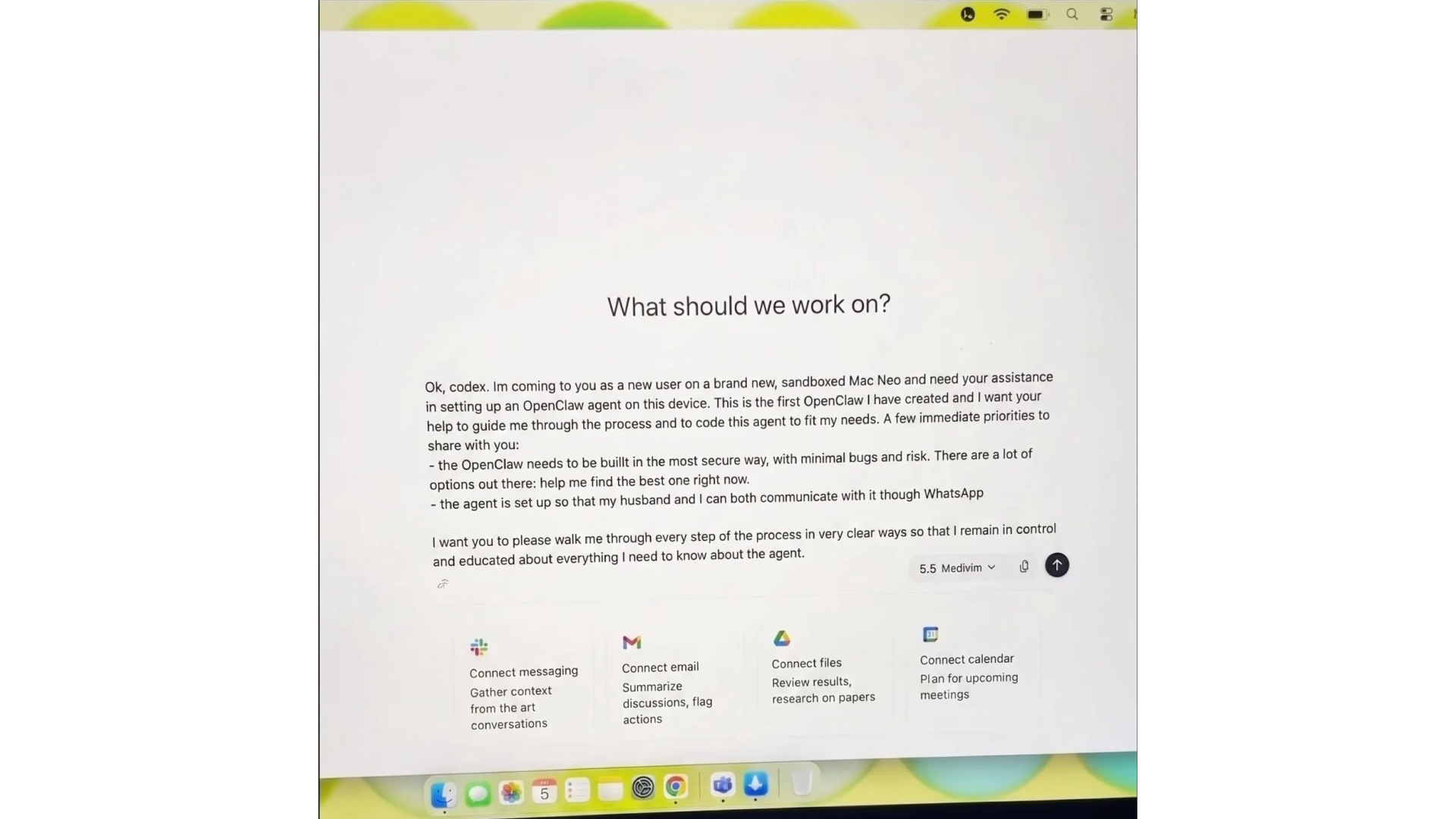
A screenshot of my initial prompt to Codex to begin the process of creating an OpenClaw agent.
These are not use cases that map to a legislative work place. Agents aren’t approved for official House or Senate use, and Congressional offices have not yet come to us asking about deploying them. But this kind of hands-on experimentation is how POPVOX Foundation will be ready when offices do start asking. The safe, controlled experimentation with cutting edge technology is equipping me to keep pace and not be left behind.
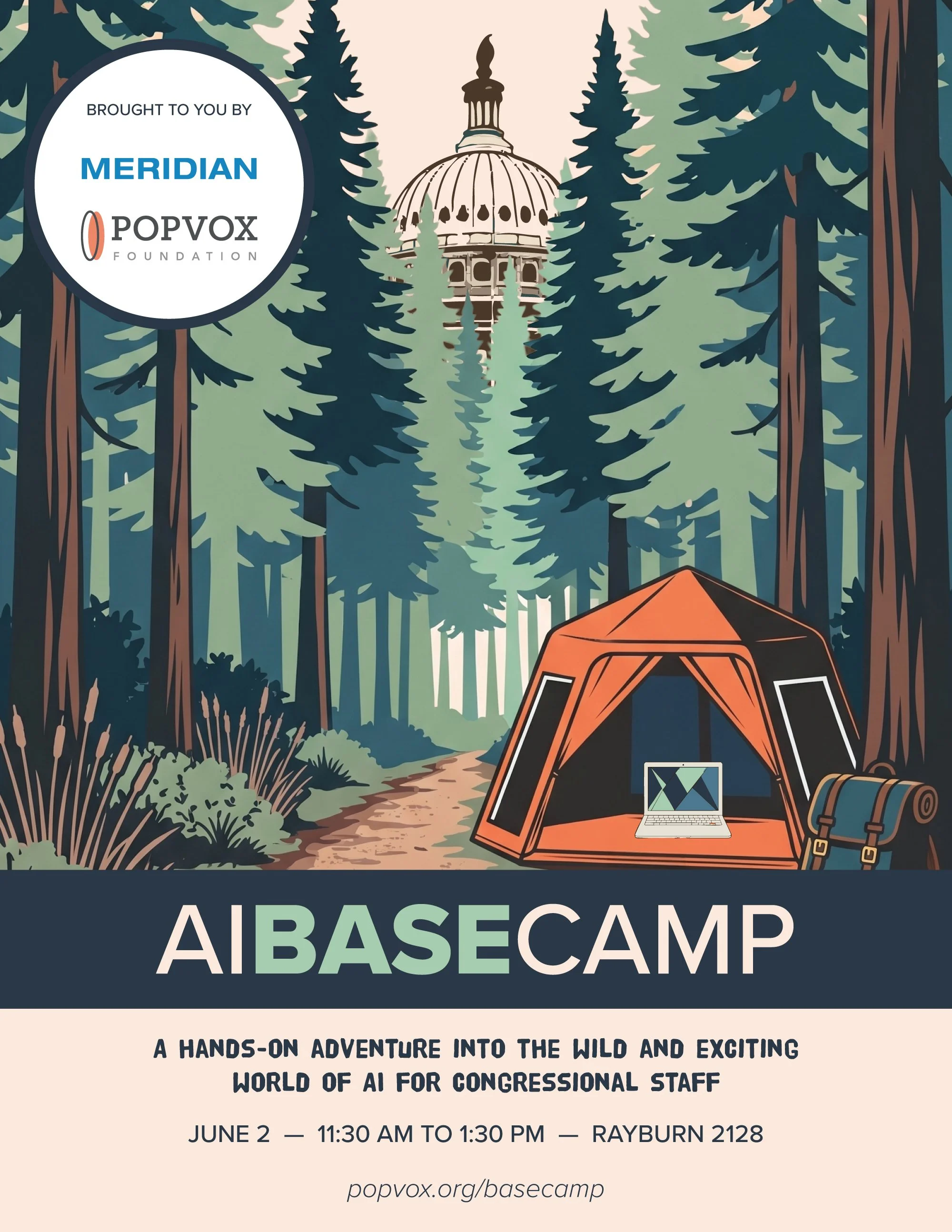
AI has a steep learning curve, and building an agent at home isn’t a normal evening activity, but I share it to say: if I can figure this out, you can too. We are partnering with Meridian and the AI Staff Association to bring a full range of AI use cases, hands-on demos, and educational resources to Rayburn 2128 on Tuesday, June 2. This AI Base Camp event will have six stations ranging from prompting basics to AI agents. Our team will be there leading stations, answering questions, and exploring your use cases in real time. Like all good summer camp experiences: the s’more the merrier and all are welcome.
This month, we’re looking at:
The distinction between foundational and frontier AI models
Tokens and why some companies are burning through budgets faster
How to create custom bots using approved Congressional LLMs
How AI is democratizing app creation and Congressional information
Some additional reports, AI tools, and items that caught our attention
Looking forward to meeting you in person on Tuesday!
Aubrey Wilson
Managing Director
POPVOX Foundation
TECH WATCH
Foundational models, frontier models, and why the distinction matters
Over the last month, the White House has been drawing a distinction between AI tools by identifying a suite of frontier models. Frontier models are the most capable AI systems that exist at a given moment: the current ceiling of what the technology can do. Frontier models are not necessarily more useful for routine tasks than commercially available LLMs, but have capabilities that go beyond general assistance. That includes conducting advanced scientific research, writing complex software at scale, and identifying vulnerabilities in critical IT infrastructure. Often, they are not publicly accessible. Anthropic’s Claude Mythos Preview, which we highlighted last month, continues to be a timely example.
A foundational model is a large language model (LLM) built for general-purpose use, which you might be familiar with; ChatGPT, Claude, Gemini, and Copilot are examples. These systems are commercially available and increasingly common in everyday environments, including on the Hill. The parent companies of these tools (OpenAI, Anthropic, Google, and Microsoft) may have many models (both foundational and frontier). They may also have many versions of foundational models released. For example, Claude models include Opus 4.8, Sonnet 4.6, and Haiku 4.5. Similarly, ChatGPT offers models by number: 5.5, 5.4, 5.3, etc.
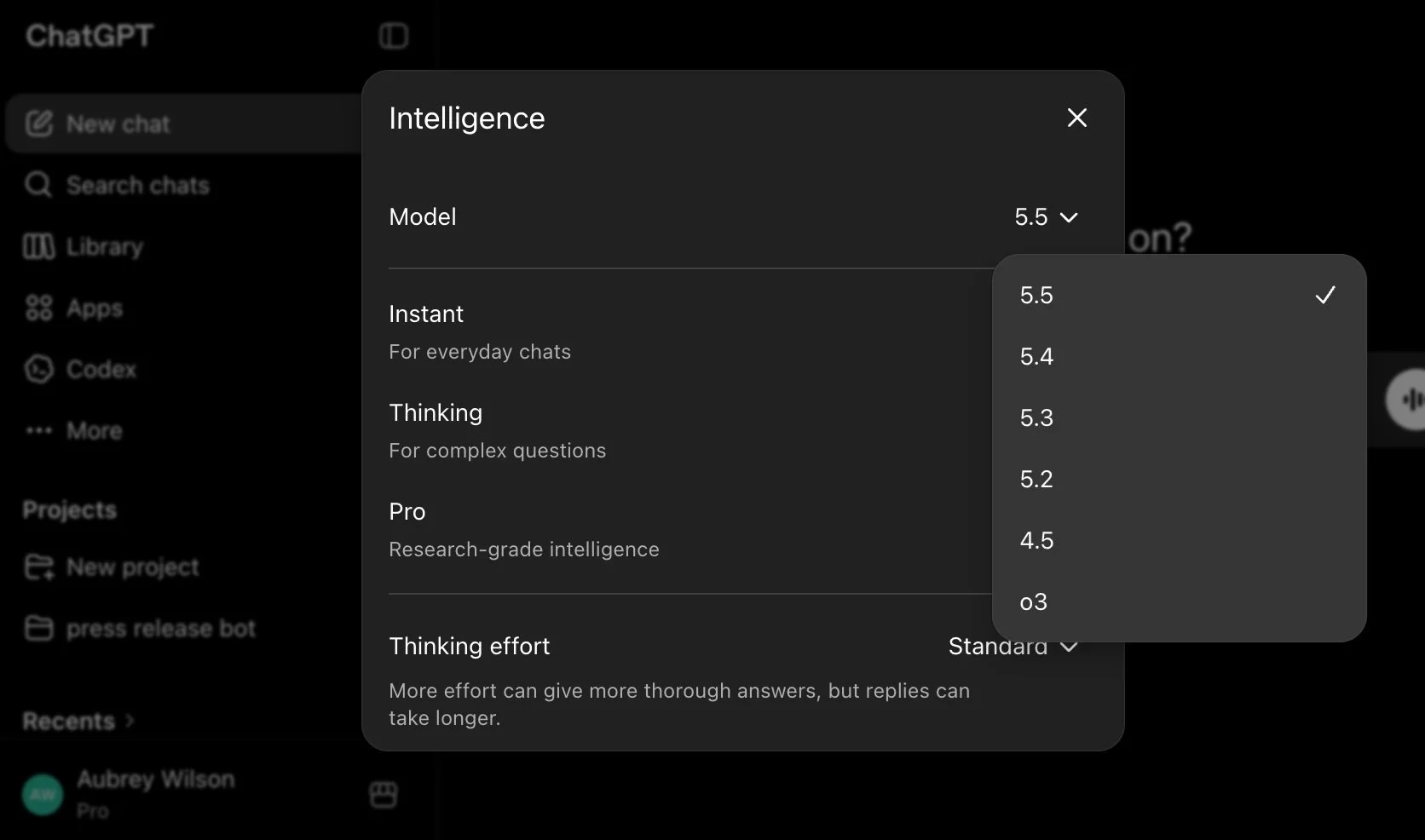
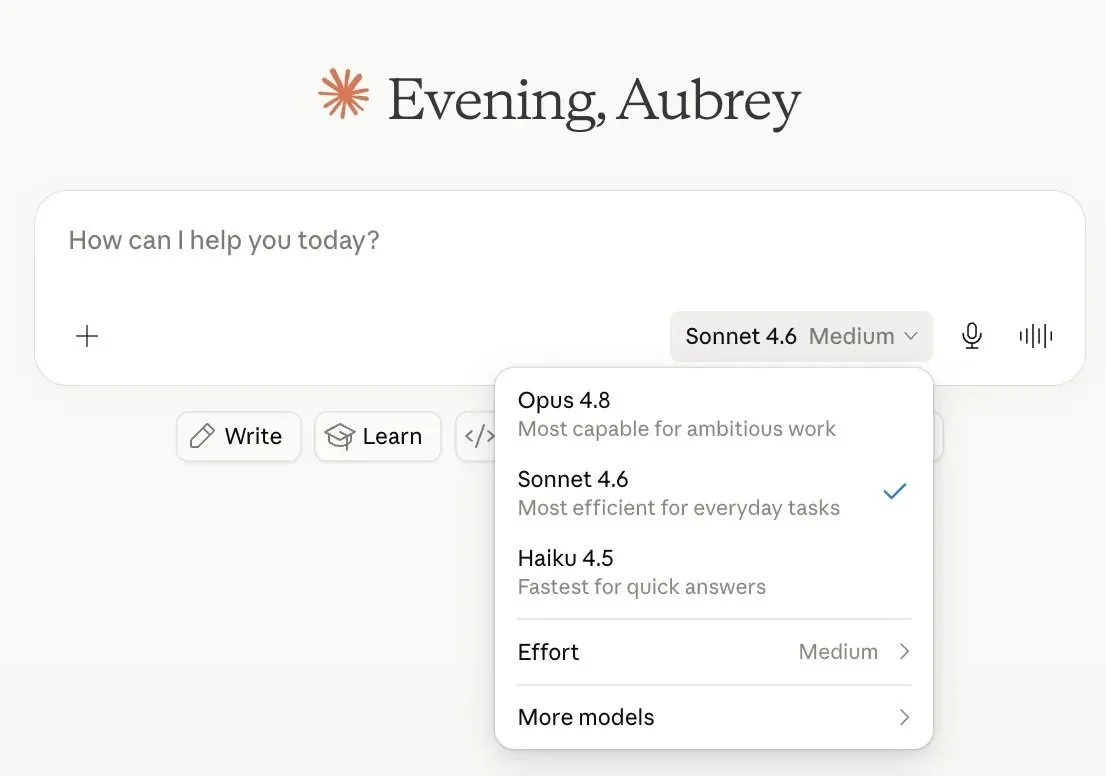
Screenshots capturing ChatGPT Pro and Claude Pro Plan interfaces with model configuration windows open to show foundational model options.
The White House’s attention to frontier models signals that this category raises distinct questions from the tools already in broad use. Whatever the policy outcome, the distinction matters: the tools approved for Congressional use are foundational models. The frontier model conversation is happening at the Executive branch level, and Congress will need to engage with it.
NOTEWORTHY NEWS
Token usage outpaces predictions due to advanced model adoption
The Wall Street Journal reported last week that major companies including Uber, Meta, Microsoft, and Salesforce are exploring ways to improve employees’ use of AI or limit access after usage costs spiraled out of control. The cause comes back to foundational and frontier models: the more advanced the model, the more processing power it uses to respond to prompts.
When an LLM processes a prompt, the exchange gets measured in tokens. A token is roughly three to four characters of text. Short words like “the” or “and” each count as one token; longer words break into several. A typical prompt and response together might use hundreds or thousands of tokens, and AI providers charge for every one (including shifting from flat subscriptions to usage-based pricing). As AI models and their functionality become more advanced, token usage rates are increasing along with costs and individuals may be using powerful, advanced models to do simple tasks, burning token budgets.
As employees begin adoption of AI at scale, companies are evolving in their strategic approach to the tools and realizing that education on AI model choices, prompting best practices, and productive use cases goes hand-in-hand with responsible experimentation.
SKILLS HUB
Repetitive tasks? Create a custom bot within your House/Senate approved LLM.
If you turn to your LLM (Claude, ChatGPT, Gemini, or Copilot) for assistance on a repetitive task, creating a custom bot within your LLM can save significant time. Custom bots can handle copy-editing, press release drafting, form letter creation, and more. You can configure them to draw from a specific resource bank, match a particular tone or voice, and mirror your preferred formats. You can also build them as specialized research assistants or knowledge hubs to help with employee onboarding, policy research, stakeholder analysis, and oversight work. Every approved LLM supports custom bots, though each uses a different name: Claude Projects, ChatGPT GPTs, Gemini Gems, and Copilot Agents (not to be confused with AI agents). POPVOX Foundation has a bot creation guide using the ChatGPT interface, but the process works across platforms. Live demos of creating custom bots will also be taking place at the AI Base Camp event on June 2.
AI USE INSPIRATION
Three students built a civic tech app in under three months after a summer in Congress
After navigating websites like Congress.gov, three international relations majors with no coding experience built Politik. The app helps constituents access information about Members of Congress by inputting their zip code and is available publicly through app stores (where it reached #2 on the Mac App Store and #15 on IOS). James VandeHei Jr., Charlie Stallmer, and Chris Brophy do not have software development backgrounds, and their developer, Nate Laquis, taught himself to build using AI tools. Together, they completed the app in under three months.
If you have ever wanted a tool that does not exist yet, Politik is a useful reminder that the barrier to building one has dropped considerably.
CAUGHT OUR EYE
Judges share AI use cases and experiences
The National Center for State Courts published a report of key benefits and risks identified by judges who are early adopters of GenAI in the courtroom. The findings mirror what we’ve heard from early AI adopters on the Hill.
Library of Congress requests $5.4 million for an enterprise AI platform
In testimony to Senate appropriators, the Acting Librarian of Congress Robert Newlen argued that an enterprise AI platform could help the Library across multiple divisions, including CRS with bill summaries and the Library Collections and Services Group with bibliographic data and collections workflows.
Pope Leo XIV’s AI Encyclical
Pope Leo XIV released his first encyclical to the public on May 15. In the ModParl newsletter, Dr. Beatriz Rey offers a thoughtful response from a democracy and governance angle.
$9 billion awaiting Congressional approval for CIA and NSA AI advancement
The intelligence agencies cannot fully deploy their latest AI models because they lack the cutting-edge chips and infrastructure those models require. The White House approved the funding request; Congressional authorization is still needed.
AI tool releases
On May 19, Google announced Gemini Spark, a 24/7 personal AI agent.
On May 28, Anthropic released Claude Opus 4.8.
Talking about AI in Congress
Since 2023, POPVOX Foundation has trained Congress and legislatures around the world on AI adoption to improve capacity and effectiveness. This month, I joined Charlie Hunt and SoRelle Gaynor on Highway to Hill, as well as American Enterprise Institute’s Shane Tews on Explain to Shane to talk about Congressional AI adoption, use cases, best practices and more.
About POPVOX Foundation
POPVOX Foundation is a nonpartisan nonprofit that helps democratic institutions keep pace with a rapidly changing world. Through publications, events, prototypes and technical assistance, the organization helps public servants and elected officials better serve their constituents and make better policy.