Conferences, Convenings, and Capacity
A new report on AI adoption, a model for legislative collaboration, and our hopes to see you at NCSL!
State of the Art is a newsletter spotlighting innovation, technology, and institutional capacity in America’s statehouses. Learn more and subscribe at stateoftheartgov.substack.com.
Read the report
Hi everyone,
Welcome back to State of the Art!
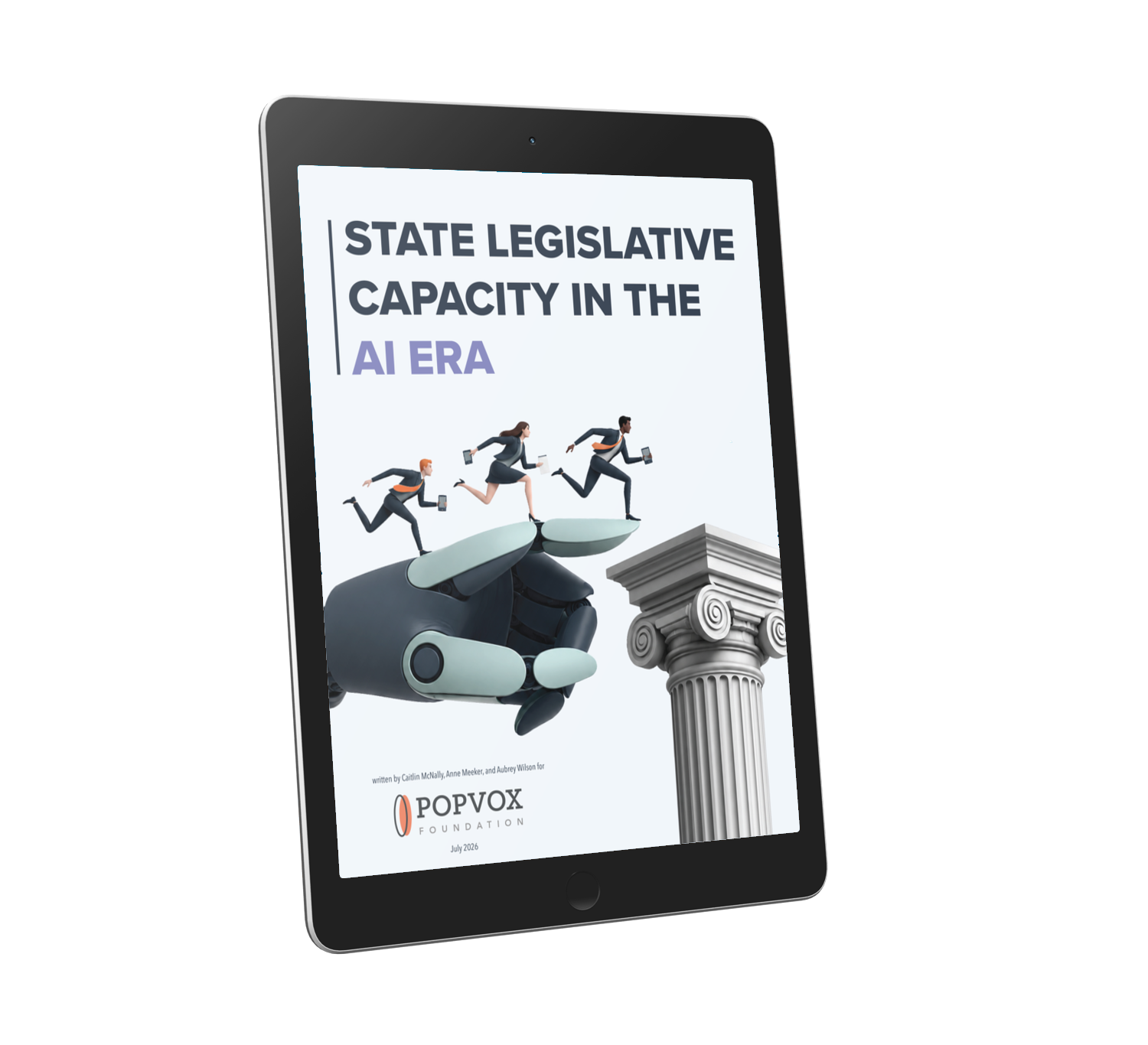
Over the last six months, I had the pleasure of talking with staff and elected officials across many state legislatures about their internal AI adoption progress and challenges. Today, POPVOX Foundation released a report presenting the findings: State Legislative Capacity in the AI Era
This follows the 2024 Representative Bodies in the AI Era, which explored how Congress and parliaments around the world were beginning to prepare for AI. At the time, many of the questions were hypothetical: How might AI change legislative work? What should responsible adoption look like?
Today, those questions are more concrete, especially within state legislatures.
Across the country, legislators and staff are using AI tools to assist with researching bills, communicating with constituents, and streamlining office operations. Some are “vibe coding” their own legislative tools.
The report presents examples of how lawmakers are using AI today, what they’re learning, and what others can take from those experiences. We argue that legislative capacity in the AI era is about much more than adopting new tools. It’s also about investing in the people, policies, infrastructure, and partnerships that help legislatures adapt over time. More than anything, we hope you will flip through and think, “That’s an idea we could try.”
A sneak-peek at some of the findings follows. And if you’re heading to NCSL in Chicago, please drop by Booth 4241 to meet the team, explore our new AI Sandbox and other AI tools for legislatures, and chat about what we’re seeing across the states.
Monday, 4-5 PM: Hear our Cofounder and Executive Director, Marci Harris, speak on the panel, When Generative AI Joins the Staff, where she’ll share some of the most interesting AI use cases we’ve seen in state legislatures, Congress, and parliaments around the world.
Tuesday, 5-7:30 PM @ Brulee: Join us for Making Constituent Services Work: Happy Hour & Panel, where we’ll discuss how AI tools can help stretched legislative offices meet rising casework demand and constituent needs. Stop by for as long as your schedule allows!
And one more thing: we know this report isn’t the end of the story. If your legislature is experimenting with AI in a way we didn’t capture, we’d love to hear about it. Come find us at NCSL or send us an email.
Cheers from Chicago,
Caitlin McNally
Program Associate
POPVOX Foundation
The Adoption Tracker
No two states are taking exactly the same approach on AI, but together these examples reveal inspiring trends. If you’re thinking about where AI might fit into your own office or legislature, here are four places to consider.
Research & drafting
Our interviews point to one clear lesson for broad staff use: purpose-built legislative AI tends to gain traction more quickly. Arizona’s Skywolf helps staff search, summarize, organize, and monitor legislation, while Westlaw AI Co-Counsel, which we saw adopted in several states, supports legislative and legal research. Because these tools are designed around legislative workflows and trusted legal or legislative information, staff told us they were more likely to trust them and incorporate them into their day-to-day work than general-purpose AI tools.
Constituent services
For many legislators, especially in part-time legislatures or one-person offices, responding to correspondence is an ever-demanding capacity challenge. Alabama Representative Mike Shaw shared with us how he uses a customized autonomous AI agent (OpenClaw) to identify trends across incoming constituent messages and prioritize where attention is needed most. He still personally writes every response and believes that having AI communicate directly with constituents would be a dereliction of duty. He’s a great example of a lawmaker using AI to create more time for the conversations that matter most, not replace them.
Back-office operations
You don’t need an institutional AI budget or a technical team to build tools tailored to your work. Mississippi Representative Zakiya Summers partnered with a local school superintendent who was already integrating AI into K-12 education to build three custom GPTs (OpenAI’s tool for custom chatbots) — one for legislative research, one for bill comparison, and one personal application. The lesson: identify the tasks you do over and over, then build a purpose-specific tool for each rather than relying on a general-purpose tool. And look to your district for the people already working with AI in your community.
Building the foundation
If your legislature is thinking about AI, it’s also worth thinking about the systems behind it. Texas’ effort to digitize legislative history and New York’s investment in constituent management systems show that successful AI adoption often starts long before a new tool is introduced. Strong digital infrastructure makes future AI tools more useful, reliable, and secure.
Governance & Risk
One message came through clearly in nearly every conversation we had: AI adoption is moving faster than governance.
Legislators and staff across the 22 states we studied are already experimenting with AI to research bills, manage information, and improve office operations. But many are doing so without legislature-wide guidance, shared policies, or training to help ensure those tools are used consistently, responsibly, and securely.
If your legislature is thinking about expanding AI adoption, our report goes beyond use cases. It offers practical recommendations to help you move from individual experimentation to institution-wide capacity, including governance frameworks, staff training, modern digital infrastructure, and policies that support responsible AI use. Whether you’re just getting started or building on existing efforts, we hope these recommendations help you lay the groundwork for AI adoption that can grow with your legislature.
State Spotlight
Massachusetts Builds Capacity Across State Lines
Our new report also argues that one of the most overlooked ways to strengthen legislatures is by expanding learning beyond a single chamber or state. Massachusetts’ Third Annual New England Summit of Black State Electeds, convened by State Senator Lydia Edwards, is an example of what that can look like. Legislators from Massachusetts, Vermont, Maine, and Connecticut exchanged ideas on legislative priorities, constituent engagement, and shared challenges. Experts from American Oversight and the Bloomberg Center for Cities at Harvard led discussions on public messaging, social media, and communicating effectively with constituents.
The New England Summit demonstrates the value of regional networks. After three successful years, it is an annual tradition and a model to emulate.
As legislators and staff gather for the NCSL Legislative Summit this week, it is a useful reminder that capacity is built not only through new tools and technologies, but also through stronger relationships.
What We Are Watching
NCSL Legislative Summit
Sessions we’re tracking:
Tuesday, 9-10 AM, The Promise and Peril of AI. Nobel laureate Geoffrey Hinton on the risks and rewards of today’s AI, and what it means for state legislatures as it reshapes work, economies, and government.
Wednesday, 11:15 AM - 12 PM, AI in Action: Innovation to Improve Lives. Real-world examples of how AI can improve outcomes, increase efficiency, and help government serve communities more effectively.
Full agenda.