
Public Witness Testimony on Modernizing Constituent Engagement Through Emerging Technology
POPVOX Foundation Director of Global Initiatives Aubrey Wilson submitted testimony to the Committee on House Administration’s Subcommittee on Modernization and Innovation on how emerging technologies — particularly AI — are reshaping constituent engagement in legislatures around the world and what lessons the US House can draw from these efforts.
Drawing on POPVOX Foundation’s work with parliaments globally and Wilson’s experience as a former House staffer on the Committee on House Administration, the testimony highlighted how legislatures are using technology to improve access to information, enable two-way public participation, and scale high-quality constituent engagement without sacrificing trust or accountability.
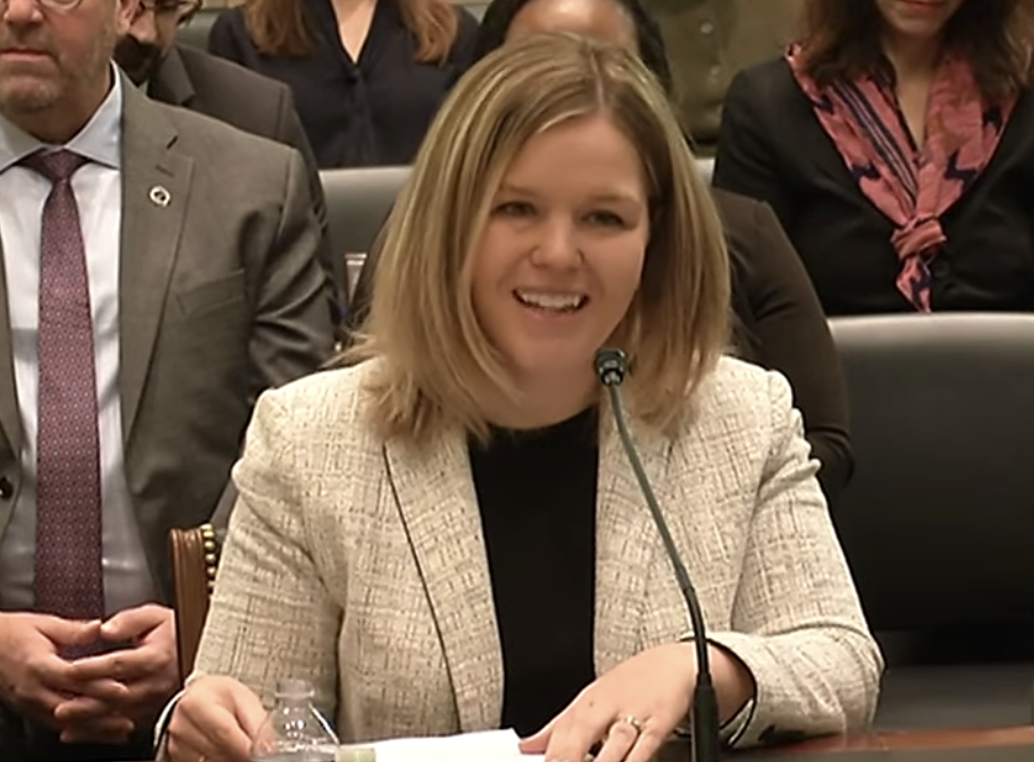
“Chatbots represent some of the lowest hanging fruit — they are familiar to users, quickly deployable, and capable of providing 24/7 assistance regardless of a user’s age, language, or education level,” Wilson wrote, pointing to international examples that demonstrate how conversational tools can expand public access to legislative information.
The testimony emphasized that while innovation is already happening across the House, sustained progress will require institutional processes that allow experimentation, learning, and responsible deployment. “The House has all the inspirational components it needs,” Wilson noted, “but must go beyond one-off initiatives by adopting a new way of doing things that allows ongoing experimentation, learning, and refinement.”
The testimony calls on the House to build on existing modernization initiatives and to:
Leverage AI-enabled tools, such as chatbots and conversational interfaces, to provide constituents with 24/7 access to legislative information and government services, drawing on international examples from Estonia and beyond;
Enable meaningful two-way engagement at scale by adopting platforms that collect, analyze, and synthesize constituent input on legislation, as demonstrated by Brazil’s Ulysses Suite;
Use emerging technologies to facilitate high-quality dialogue among large and diverse groups, ensuring constituent voices can inform policymaking in actionable ways;
Institutionalize innovation by moving beyond one-off pilots and establishing processes that support ongoing experimentation, iteration, and refinement across the House;
Reform House IT procurement, in partnership with the Chief Administrative Officer, to increase transparency, expand access to existing commercial and open-source tools, and create clear pathways for Members to pilot promising technologies;
Establish rapid-pilot authorities, innovation sandboxes, and guardrails for low-risk experimentation, including support for initiatives such as the House Digital Service’s data lake;
Modernize cybersecurity review processes so that authorization timelines align with the realities of a two-year election cycle; and
Ensure the next Chief Administrative Officer is positioned to work closely with the Subcommittee to build on recent modernization efforts and advance a new era of responsible House innovation.
Concluding her testimony, Wilson emphasized that the pace of global legislative innovation is accelerating: “Around the world, legislatures are experimenting with emerging technologies, deploying new tools, and learning from each other about new approaches to the future of constituent engagement.” She noted that the House can benefit from this innovation “only when it has adopted the internal processes to institutionalize new ways of doing things.”
Testimony for the Committee on House Administration’s Subcommittee on Modernization and Innovation Hearing, “The Future of Constituent Engagement.”
December 17, 2025
Submitted by: Aubrey Wilson, Director of Global Initiatives, POPVOX Foundation
Chairwoman Bice, Ranking Member Torres, and Members of the Subcommittee,
Thank you for the opportunity to be part of this hearing and for hosting this exciting and proactive discussion on the future of constituent engagement. My name is Aubrey Wilson and I’m Director of Global Initiatives at the nonpartisan, nonprofit organization, POPVOX Foundation. I'm also a true believer in Congress and a prior House staffer, having had the immense pleasure of working for the Committee on House Administration during the 117th and 118th Congresses. My extended biography is attached as Appendix 1.
At POPVOX Foundation, our mission is to help democratic institutions keep pace in a rapidly changing world both by raising awareness to emerging trends and challenges, and also by proposing solutions, sharing best practices, and celebrating smart, responsible innovation. This effort includes working with legislatures around the world to build solutions, partnering with international organizations to develop resources, participating in conferences to share lessons learned, and building networks for knowledge exchange. Yet this important work began here—in the Halls of Congress.
The majority of the POPVOX Foundation team, myself included, are prior Congressional staffers who have made the commitment to support our First Branch. Since its founding in 2021, POPVOX Foundation has been on the forefront of the bipartisan effort to broadly modernize the Legislative branch, providing research and ideas to policymakers and staff. Our approach to advancing progress is practical and collaborative. Beyond making recommendations, we test the ideas we put forth through piloting initiatives, hosting workshops where we actively solicit feedback, and prototyping beta versions of tools utilizing cutting edge technologies. This approach informs the best practices that we hone and share, and has built our reputation as a reliable resource beyond the United States Capitol.
Over the last two years, much of our work both domestically and abroad has focused on legislatures’ response and adoption of artificial intelligence, specifically as it relates to improving internal, day-to-day operations. Constituent engagement falls under this umbrella, and it comes as no surprise that you’re not the only representative body beginning to realize that we’re in a time of rapid change that requires intentionality.
I’ve been asked to contribute an international element to this discussion by sharing examples of innovation we’re witnessing abroad that improve or fully reimagine constituent engagement.
In its rules, this Subcommittee adopted an important directive to “evaluate and advance new and emerging innovations to ensure that congressional modernization efforts are ongoing.” In pursuit of that aim, there is much to learn from legislatures around the globe, as Members and staffers have discovered through numerous CODELs and engaging in international conversations. There is also much to celebrate in the strong technical foundation that the US Congress has established over the past decade, such as Congress.gov, HouseNet, the House Digital Services and the websites and Constituent Management Systems that every office uses to communicate with constituents. For many legislatures, these are aspirational tools that are only becoming possible with the new capabilities that generative AI (GenAI) makes possible (such as rapid transcription, enhanced document scanning, and automatic summarization) . We are seeing some legislatures seize these opportunities and leapfrog previous limitations while others are paralyzed by legacy systems and ossified review processes not suited for rapidly changing constituent expectations and standards.
Today’s hearing is the continuation of a conversation that began with the Select Committee on the Modernization of Congress, an effort that exceeded all expectations and broke through partisan defaults. This committee has overseen the implementation of numerous Select Committee recommendations and is now in the position to set new goals to ensure that the institution continues its move forward. Fulfilling the Subcommittee’s directive requires recognizing that “modernization” and innovation can never be one point in time or set destination but a way of responding to new challenges and opportunities.
With that perspective set, let me share a couple inspiring technology case studies from abroad where emerging technology is being used in ways that could improve constituent engagement with Congress.
Chatbots
Constituents shouldn't need a law degree to understand their government or be left to navigate complex, inflexible systems to engage with their elected officials. Chatbots represent one of the most accessible entry points for AI-enabled constituent engagement — familiar to users, quickly deployable, and capable of providing 24/7 assistance regardless of a constituent's age, language, or education level.
Estonia is often recognized as a leader in e-parliament operations, and in recent years it has undertaken two notable chatbot initiatives. One is a pilot project that began in late 2023 to develop two AI legislative search assistants for use by Members of Parliament and staff. They are specially trained chatbots (built on the OpenAI API) that have the ability to search through the parliament’s legislative databases and official gazette. The tools “allow users to discover details about current Estonian laws as published in the official gazette, offer information on documents processed in the legislative database, answer questions in both Estonian and English, help users find specific legislative texts or details about legal provisions, and clarify the status and content of legislative proposals and amendments.” While these tools are not public facing, they are an inspiring model for how constituents — and Congressional Members and staff — might one day interact with data on Congress.gov to understand what bills have been introduced, which have become laws, and how those laws affect them.
Estonia's second chatbot initiative, Bürokratt, demonstrates the public-facing potential of this technology. Unlike the legislative search assistants built specifically as a means of accessing parliamentary information, the vision for Bürokratt is a network of interoperable chatbots deployed across more than thirty government agencies, accessible to any citizen 24/7. Today, through a single chat interface, Estonians are able to access integrated services across eighteen agencies, enabling them to file consumer complaints, apply for permits, renew identification cards, report car accidents, or borrow library books,— tasks that traditionally required navigating multiple agency websites or making phone calls during business hours. Notably, Estonia has made Bürokratt's code open source and available for free on Github, actively encouraging other governments to adopt the platform. This is an exciting prospect. A similar tool implemented in America could not only streamline individuals’ interactions across the complex ecosystem of federal agencies, but also assist Congressional caseworkers in being able to find information to help constituents requesting assistance. This vision of constituent engagement transcends the Legislative branch — it reimagines government as an integrated service accessible from any device, in any language, for any constituent, at any time.
The European Parliament has implemented a tool called Archibot leveraging the Anthropic Claude API to allow anyone (policymakers, citizens, researchers, students, etc.) to access over two million legislative documents in multiple languages. Anthropic’s analysis of the tool reports an 80% reduction in document search and analysis time for users.
These chatbots demonstrate how barriers to legislative information and government services can be overcome in ways not previously possible. Imagine a chatbot on a Member's website that answers "What do I do if I lost my passport?" by connecting the constituent to the appropriate caseworker while also providing links to the online forms that will be required to be submitted. Or, place yourself in the shoes of a concerned constituent who is intimidated by the thought of calling their Representative, but through a chatbot can submit an opinion that can be taken into consideration. When designed with intentionality, AI-enabled chatbots can transform how constituents navigate government and engage with their elected officials.
Public Participation Platforms
Beyond streamlining constituent access to information, AI enables meaningful two-way dialogue at scale. Virtual convenings powered by AI can capture detailed constituent input — the kind of nuanced feedback that builds trust and demonstrates that voices are heard — without creating impossible data processing burdens for policymakers and staff. Where traditional methods force a trade-off between depth and breadth, AI tools make both possible.
Brazil’s Chamber of Deputies’ Ulysses Suite is a laudable collection of eight innovative tools, custom built to support Members, staff, and parliamentary operations. One tool in this collection, Ulysses 6, is a module that processes the data collected from public polls on legislation. Brazil’s e-Democracia portal creates electronic polls on legislative drafts that are open for public engagement. Instead of a binary poll of “for” or “against,” these polls empower constituents with the ability to leave detailed remarks. Some legislative items receive tens of thousands of remarks — an untenable amount of data for legislative staff to adequately consume. To address this challenge, Ulysses 6 is used to group, analyze, and present findings to policymakers including sentiment analysis. As described by the Director of Bússola Tech, Luís Kimaid,
“The module's ability to cluster similar arguments is particularly noteworthy. Despite the diversity of expressions and language used by different individuals, U6 can group comments that share common themes or sentiments. This clustering is vital for parliamentarians, as it brings a wide array of opinions into comprehensible thematic categories, highlighting the main arguments for and against a bill.”
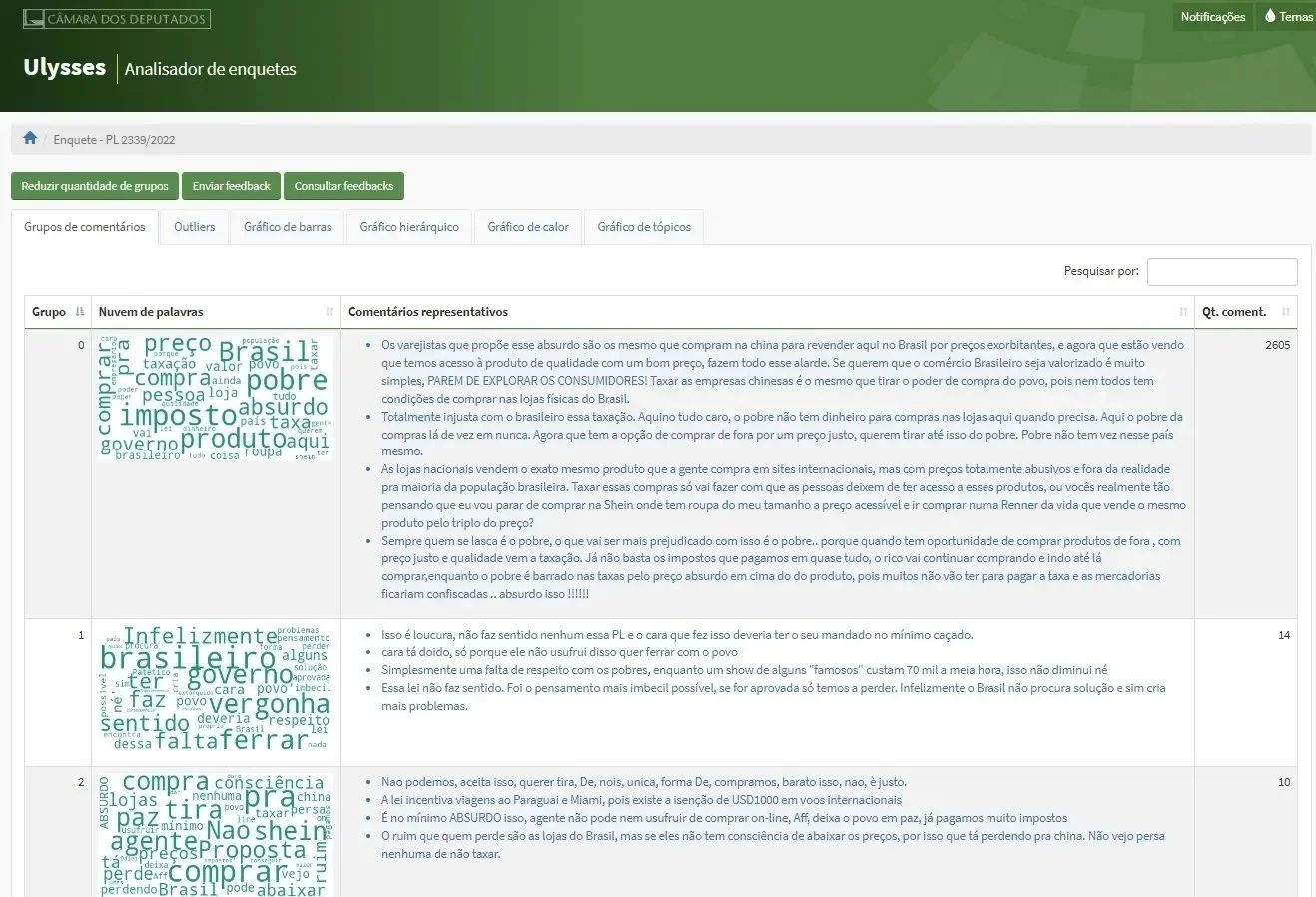
Screen capture of Ulysses 6 module, source: LegisTech Library, Bússola Tech
Ulysses 6 exemplifies how AI can bridge the gap between constituent voice and legislative action. Instead of choosing between gathering broad input and actually being able to process it, Brazilian legislators can now do both — giving constituents meaningful participation while equipping policymakers with actionable insights.
Emerging technologies are beginning to unlock the ability for elected officials to foster quality interactions with constituents at scale, and in ways that can promote both civility and safety.
Perhaps the most compelling example of this approach originates not within a legislature, but from an international dialogue designed to build consensus across diverse stakeholders. Remesh, a US-based company, has created a platform that can be used to host AI-assisted community conversations to identify key points of agreement and uncover key ideological differences. In 2024, Remesh partnered with the Alliance for Middle East Peace to hold four online dialogues focused on uncovering consensus between Israeli Jews, Palestinians living in the Occupied Palestinian Territory, and Palestinian citizens of Israel. Through that exercise, participants shared values and thoughts on their desired future outcomes, which Remesh aggregated into insights for policymakers. This information was shared with international negotiators and contributed to the ultimate contours of a final agreement.
Another example of how AI-assisted platforms can help scale meaningful conversations between individuals and policymakers is the Departure Dialogues Project. Launched in 2025 by POPVOX Foundation, Niskanen Center, Civil Service Strong, Partnership for Public Service, and the Foundation for American Innovation, Departure Dialogues is a project to capture the institutional knowledge of prior federal civil servants regarding improvements to federal law or regulation implementation they wish to share with Congress. Using the platform, TheirStory, participants submit personal insights via video recording or by completing a written survey. All submissions are processed through the platform Talk to the City, an open-source AI tool that helps transform large amounts of input into digestible insights. Initial findings of Departure Dialogues, are now available on POPVOX Foundation’s website, demonstrating the interactive nature of this type of information collection approach.
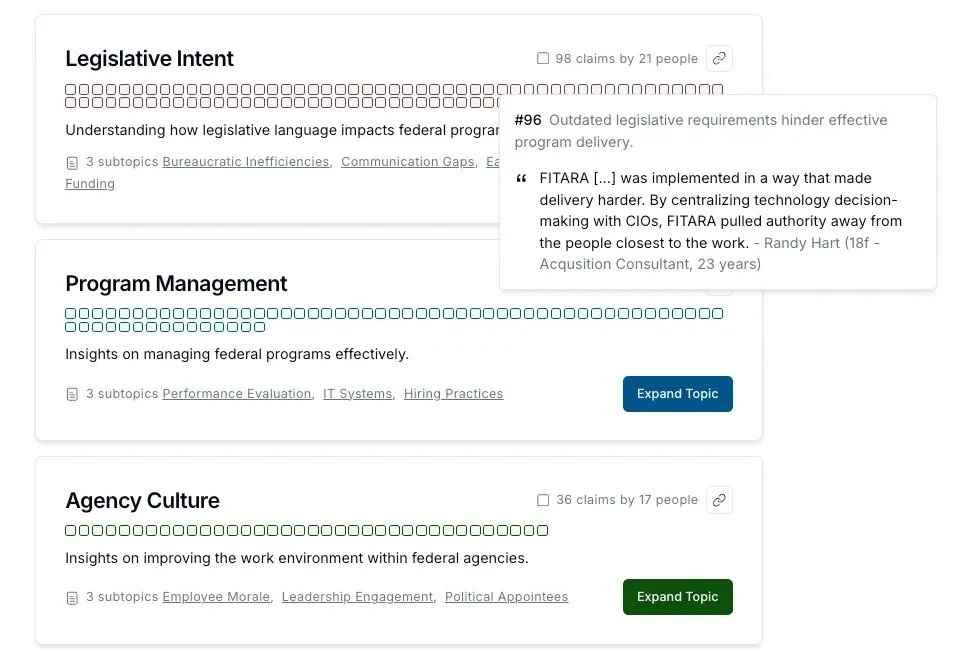
A sample view of the Departure Dialogues Initial Findings. Source: POPVOX Foundation
Members or committees could launch similar initiatives, leveraging platforms like TheirStory and Talk to the City to engage stakeholders on specific legislation or gather constituent experiences with federal programs and services — at a scale previously unimaginable.
Recommendations
The projects and tools I just described show what is possible. And they also demonstrate that legislatures and lawmakers do not have to accept the all-too-common public perception that they are slow to innovate or do not understand emerging technologies. This Subcommittee and its Select Committee predecessor have shown what is possible, and the House is rich with innovation already, but the problem it faces is encountered in the ‘last mile.’
This institution has every component needed to usher in a new era of constituent engagement except a few key elements that are required to materialize the innovation. Members and their staff are reimagining traditional constituent engagement models in creative ways. The House’s greatest asset is its diversity of membership and Members’ autonomy to serve their unique constituency. With 441 lawmakers with diverse backgrounds, approaches, and expertise, the House is already witnessing the deployment of technology in new ways to engage with constituents, from reinventing the telephone town hall to employing technology on-the-go in support of mobile district offices. The now institutionalized Congressional Hackathon is an annual celebration of the vibrant ecosystem of individuals — including lawmakers, institutional staff, policy staff, civic technologists, students, journalists, scholars, and civil society members — who spend a day showcasing new ideas, beta-versions of tools, and brainstorming technology solutions for Congress. The House Digital Service, Legislative Branch Appropriations Modernization Initiatives Account, and Congressional Data Task Force exemplify the institutional resources and support available to foster innovation within the House.
Yet, in this era of rapid technological change caused by the emergence of GenAI, the House has fallen behind because it has failed to grasp these individual points of innovation and systematize them as institutional progress. The House has all the components needed to foster in the future of constituent engagement — and legislative processes more broadly — but still stands to overcome institutional barriers that are preventing progress.
The rapid, continual evolution of technology requires the US Congress — and all legislatures — to go beyond one-off initiatives or projects by adopting a new way of doing things: one that allows ongoing experimentation, learning, and refinement. To enable this, I offer the following recommendations.
Reform House IT procurement and introduce transparency.
While few tools are built specifically for legislative use, a vibrant marketplace of platforms and tools that can be used for Congressional purposes exists - Remesh, TheirStory, and Talk to the City are just the beginning. As other governing institutions and legislative bodies around the world create and share open source models, the selection of customizable legislative tools will also expand. Members who identify promising tools need a clear pathway for institutional approval, and innovators who build these tools need access to information about House procurement and authorization processes. Currently, both of these avenues for Member and staff use of new technologies are a black box to those looking to navigate them. The institution’s technology and cybersecurity requirements, procurement guidelines and processes, and additional qualifications — administered by the Chief Administrative Officer (CAO) — should be publicly posted and easily accessible. Additionally, Members should be provided with and encouraged to participate in a transparent process through which the CAO can be made aware of tools that might fit their needs in performing their official duties and serving their constituents in new impactful and efficient ways.
Beyond enhancing transparency around the House’s procurement processes, the Subcommittee should direct the CAO to explore new, agile procurement reforms. It is time for Congressional procurement to break away from multi-year contracts to explore new contracting vehicles, establish rapid-pilot authorities for low-risk experiments, and create innovation sandboxes where offices can test before institution-wide deployment.
Streamline the cybersecurity review process.
Thorough, rigorous cybersecurity review of technology approved for official use by Members and staff is critical to institutional health and continuity. At the same time, a one-year authorization timeline for new tools is incompatible with two-year election cycles. At the beginning of the 119th Congress, POPVOX Foundation undertook the creation of an a narrow-scope, open-source AI-powered chatbot (accessed via website) designed with newly hired Hill staff and interns in mind, but publicly available to also benefit constituents and students wishing to learn more about Congress. Through a congressional sponsor, the chatbot was submitted for consideration to become approved for congressional use in February 2025. At this time, this request has neither been approved or denied. In conversations with Members who have submitted additional tools for consideration, consistent with the process outlined in the September 2024 House AI Policy, we’ve received similar reports regarding delays in new tool approval.
In addition to the increased transparency of procurement processes and technological requirements, a robust but expedited cybersecurity review process should be implemented. I encourage the Subcommittee to explore what resources and organizational updates are needed to support the CAO’s cybersecurity office to reduce cybersecurity review delays. Addressing this timeline-related barrier to technology approval will result in new, exciting tools being put in the hands of all Members, unlocking new possibilities for constituent engagement.
Encourage House Leadership to select a Chief Administrative Officer who prioritizes innovation.
The future of constituent engagement for the House depends on the health of the House’s IT infrastructure and its adaptability to keep pace in our rapidly changing world. As shown in the two prior recommendations, the CAO holds the critical responsibility of adopting processes that foster an environment of innovation throughout the institution. In a recent post, POPVOX Foundation Program Associate Caitlin McNally and I describe the importance of the upcoming CAO appointment for the future of the House. In addition to building off of Catherine Szpindor’s legacy of innovation, the next individual to fill that role must work hand-in-hand with the Subcommittee to identify actionable solutions that empower Members to pilot new tools, experiment with new technology, and reimagine how best to serve their constituents.
Conclusion
Around the world, legislatures are watching Congress. They are not waiting for the House to move first — they are experimenting, deploying, and learning. We can benefit from this innovation but also, recognize that the future of constituent engagement is not something Congress needs to imagine from scratch — the foundation is already here. You have the technical infrastructure. You have Members pioneering new approaches across 441 distinct districts. You have institutional resources dedicated to innovation. What stands between the House and the next era of constituent engagement is not capability, but process.
The recommendations I've offered today are changes that could allow the innovation already happening in Member offices to flourish across the institution: transparent procurement processes, expedited cybersecurity review, and leadership committed to agility. The future of constituent engagement is the US Congress's to design. I urge this Subcommittee to ensure it has the tools to build it.
Thank you for the opportunity to contribute to this vital conversation.
APPENDIX I
Aubrey Wilson, Extended Biography
Aubrey Wilson is Director of Global Initiatives at POPVOX Foundation, where she works directly with parliamentary staff worldwide to improve internal operations, harness emerging technology, and share best practices on legislative modernization. Since 2024, her work has focused on how institutions are adapting to generative artificial intelligence (GenAI). Aubrey leads POPVOX Foundation's efforts to educate Members and staff of the US Congress and parliamentarians worldwide on how responsible AI adoption can augment capacity and inform policymaking.
In 2025, POPVOX Foundation launched the Digital Parliaments Project (DPP), a first-of-its-kind technological support initiative working hand-in-hand with legislative institutions in the Global South to adopt emerging technologies and improve parliamentary operations. As manager of the DPP, Aubrey actively engages with parliamentarians on a continual basis to assist with their most pressing modernization priorities to foster rapid legislative digital transformation.
As Deputy Staff Director for the Committee on House Administration (CHA) during the 118th Congress, she played a lead role in making the House work more effectively - directing the committee's oversight agenda, organizing hearings, and liaising with Members to align institutional support with their offices' needs. With a driving belief that bipartisan agreement results in long-lasting implementation success, Aubrey worked to build bridges across the aisle. In this role, Aubrey also served as the Staff Director of the Joint Committee on Printing, the longest running joint committee of Congress, and oversaw the inaugural session of CHA’s Subcommittee on Modernization, the successor of the impactful House Select Committee on the Modernization of Congress.
Previously, Aubrey served as Director of Oversight and Modernization for CHA during the 117th Congress, witnessing firsthand the House's institutional response to the COVID-19 pandemic and the events of January 6, 2021. In January 2020, she was appointed as a Congressional Fellow and assigned to CHA to track implementation of the Select Committee on the Modernization of Congress's initial package of Member-driven recommendations across the Legislative branch.
To welcome the 119th Congress, Aubrey hosted POPVOX Foundation's Gavel In podcast for new Members of Congress, sharing institutional knowledge to support those new to Capitol Hill. Her expertise and insights have been featured in Roll Call, FedScoop, Washington Examiner, Bloomberg Law, and Tech Policy Press furthering the conversation on Congressional reform and governance. In 2024, Aubrey was selected as a Bertelsmann Foundation Fellow, where she focused on the future of democracy, bringing her Congressional experience to broader discussions about democratic institutions.
Aubrey graduated from Hillsdale College with a BA in Political Economics, is a former House legislative assistant, and a former member of the R Street Institute Governance Policy and federal affairs team. Originally from northern Idaho, Aubrey lives in the DC area with her husband and twin daughters.