
Building the Future of Parliaments, Together: Digital Parliaments Project 2026 Q3 Convening Progress Report
The Digital Parliaments Project's Q3 2026 convening recaps summer regional workshops in Albania, Ghana, and Miami, new ParlLink updates including a chatbot creator and added languages, upcoming AI assessment and training resources, vibe coding experiments, and plans to expand the global parliamentary community.

AI and Legislative Modernization Workshop with Balkan and Moldovan Parliaments
POPVOX Foundation, in collaboration with the House Democracy Partnership and hosted by the Albanian Parliament, convened parliamentary staff from Albania, Kosovo, North Macedonia, Serbia, and Moldova in Tirana from July 20 to 23 for a workshop on AI and parliamentary modernization.
Congress is Investing in Custom AI. Here are the Questions that Need to be Asked.
The House of Representatives and Library of Congress are pursuing custom AI initiatives like Mia and PRISM, raising key questions about model selection, security, and vendor lock-in. Weighing closed versus open-weight models, retrieval-augmented generation, and fine-tuning, durable success depends on investing in institutional data infrastructure rather than any single AI model.
AI Model Customization: Why it Matters for Policy Makers
Meta's Muse Glimmer, Moonshot AI's Kimi K3, and Thinking Machines Lab's Inkling mark major open-weight AI releases, reshaping competition with closed providers and raising policy questions around foreign models, security, and accountability.

AI Sandboxes, AI Staff, and the Global Pacing Problem: POPVOX Foundation at NCSL 2026
POPVOX Foundation brought AI sandboxes, casework research, and global parliamentary partnerships to the 2026 NCSL Legislative Summit in Chicago, unveiling State Legislative Capacity in the AI Era, demonstrating hands-on AI tools for legislative staff, and convening state and international leaders on constituent services, casework innovation, and the Digital Parliaments Project.
New Report: State Legislative Capacity in the AI Era
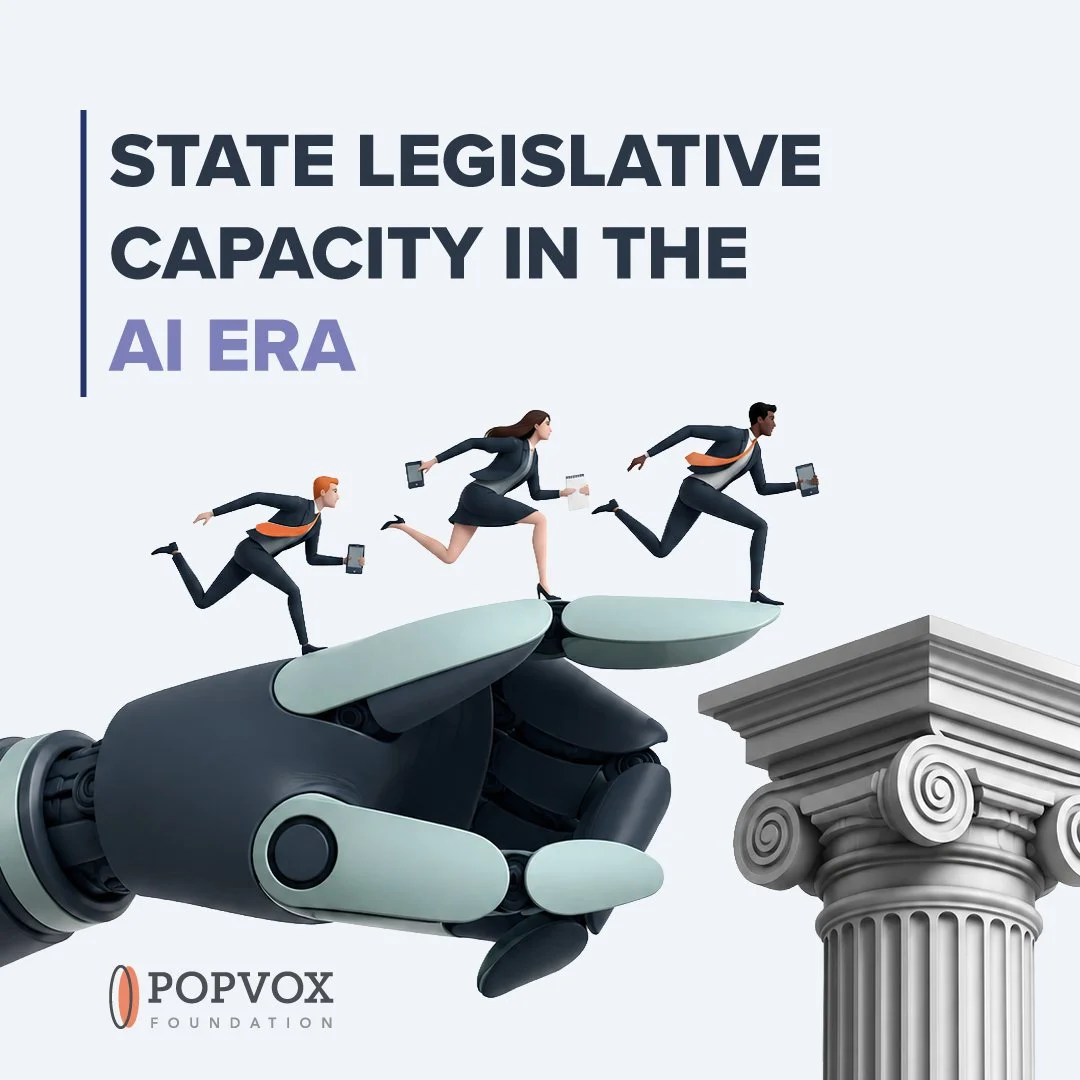
State legislatures face a widening “pacing problem” as generative AI reshapes lawmaking faster than institutions can adapt. Drawing on interviews across twenty-two states, State Legislative Capacity in the AI Era examines staffing, institutional knowledge, network relationships, and technology adoption, revealing where legislative capacity lags and where states are quietly outpacing Congress.

AI Is a New Input in Young People’s Career Calculus
AI is reshaping how young people weigh career decisions, but San Francisco and Washington calculate the risk differently. San Francisco channels AI anxiety into startup bets and Big Tech tradeoffs, while Washington treats it as another policy input shaping mission-driven work, prestige, and personal brand.
Building the Future of Parliaments, Together: Digital Parliaments Project 2026 Q2 Convening Progress Report
POPVOX Foundation's Digital Parliaments Project Q2 2026 convening covered ParlLink platform updates including bulk upload, a new data agreement, and AI prompting guides for parliamentary staff. Looking ahead: DPP launches in the Balkans and Africa, plus a Caribbean Parliamentary Modernization Summit in Miami this September.
Building the Future of Parliaments, Together: Digital Parliaments Project 2026 Q1 Convening Progress Report
Explore how the Digital Parliaments Project is modernizing legislatures through shared learning, open-source tools like ParlLink, and AI-powered digitization. This Q1 2026 progress report highlights global collaboration, field insights, and practical innovations helping parliaments streamline workflows, manage data, and accelerate digital transformation.
POPVOX Foundation Appropriations Requests: A Focus on Future-Proofing, Constituent Services, Security, and the Member Experience
POPVOX Foundation submitted fiscal year 2027 appropriations requests to House Appropriations Committee Members focused on modernizing Congress and strengthening its capacity to serve constituents. Key proposals include responsible AI adoption, improved casework coordination, continued modernization funding, enhanced security training, and better support for Members, staff, and Congressional families.

The 2,800-Mile Gap
A widening cultural divide between San Francisco and Washington, DC reveals contrasting attitudes toward risk, innovation, and career advancement. These differences shape how technology evolves and how government responds, with implications for policymaking, institutional adaptation, and the future of democratic governance in a rapidly changing world.
Updated: Where the House and Senate Are on Internal Use of AI
A detailed overview of how the US House of Representatives and Senate are governing internal use of artificial intelligence, including a summary of current AI policies, approved tools, and key limitations on staff use.
What Is RAG And Why It Matters for Legislative AI Use Cases
Retrieval-Augmented Generation (RAG) is a powerful approach that improves AI accuracy by grounding answers in trusted documents. For legislatures and government offices, RAG helps reduce hallucinations, surface relevant policies, and power reliable tools, making AI more transparent, accountable, and useful for Congressional and parliamentary workflows.

View From the West Balkans: North Macedonia, Kosovo, and Albania
An on-the-ground look at parliamentary modernization in North Macedonia, Kosovo, and Albania, highlighting how legislatures in Skopje, Pristina, and Tirana are approaching AI adoption with urgency and care. Conversations with MPs, parliamentary leaders, and the National Democratic Institute underscore a regional focus on legislative technology, institutional capacity, and cross-border collaboration to strengthen oversight and governance in the digital age.
The Call to Create the Congressional Capacity and Technology Office
As AI rapidly reshapes governance, Congress risks falling behind the institutions it oversees. POPVOX Foundation proposes creating the Congressional Capacity and Technology Office (C-TECH) to provide dedicated training, change management, and strategic tech support — strengthening Congress’s ability to oversee emerging technology effectively.
AI Resources for MPs and Parliament Staff
AI is already changing how parliaments operate, and MPs and staff need practical, responsible guidance. Drawing on global legislative use cases, this post introduces AI resources designed for parliamentary offices, including policy templates, research workflows, and custom AI tools. Built for busy legislatures, these guides help boost capacity, support smart adoption, and keep human accountability at the center of parliamentary work.
When Law Becomes Data: What Brazil’s LexML Reveals About Akoma Ntoso
What Brazil’s LexML reveals about the future of structured law—and what Akoma Ntoso makes possible when legislation becomes interoperable data. A conversation with Monica Palmirani on digital standards, institutional silos, and why legal infrastructure matters in the age of AI.
From Slip-Up to Solution: How AI Can Help Fix Lawmaking in Estonia
A single missing word in Estonia’s gambling tax law nearly made online casinos tax-free, exposing how fragile legislative drafting can be. The error also sparked fast civic innovation: a former government CIO built an AI tool in a day to scan draft bills for mistakes, showing how artificial intelligence can strengthen lawmaking, improve oversight, and help catch costly errors before they become policy.
Why Legislative Modernizers Need to Pay Attention to this New Wave of AI
Claude Opus 4.5, Claude Code, Gemini 3 Pro, and agentic AI introduce stronger reasoning, automation, and multimodal capabilities with direct relevance to legislative research, drafting, analytics, and internal systems. For legislative modernizers, the shift signals a move from experimentation to real operational use inside parliaments.

Seasonal Greetings and a 2025 Recap
ModParl closes out 2025 with a practical example of AI in action, spotlighting Anguilla’s House of Assembly and its new AI-powered Hansard and legislative website. We also look back on a year of legislative modernization — from Europe to Africa and Asia.