
Inside the NYC Council’s Policy “Primeval Soup”
How the Council built a digital infrastructure to manage ideas, drafting, institutional memory, and legislative implementation
BY BEATRIZ REY
One of the first classes I took in graduate school was on agenda-setting, taught by my mentor Frank R. Baumgartner. Early in the course, we read the book Agendas, Alternatives, and Public Policies, in which political scientist John Kingdon introduces the idea of a “policy primeval soup” — the chaotic, competitive, and often messy environment where policy ideas float around, evolve, collide, and gradually become viable proposals. In Kingdon’s account, ideas are “softened up” over time through discussion, modification, and recombination long before they emerge as formal policy solutions.
I never imagined I would encounter the policy primeval soup in physical form. Yet that was exactly my reaction while speaking with staff from the New York City Council, the city’s Legislative branch responsible for passing local laws and overseeing city agencies, about the internal systems they use to manage legislation.
Inside the Council, every policy proposal begins as what they call a Legislative Service Request, or LS request. Council members can submit ideas into an internal database even if they have no intention of moving forward with them immediately. Sometimes they submit dozens of ideas at once. The purpose is not necessarily to begin drafting legislation, but to establish that they were “first in time” with a proposal. As Alaa Moussawi, chief data scientist, explained to me, council members often submit ideas because “they want to make sure that they’ve told us about their idea and that they had this idea at this point in time potentially before any other council member.”
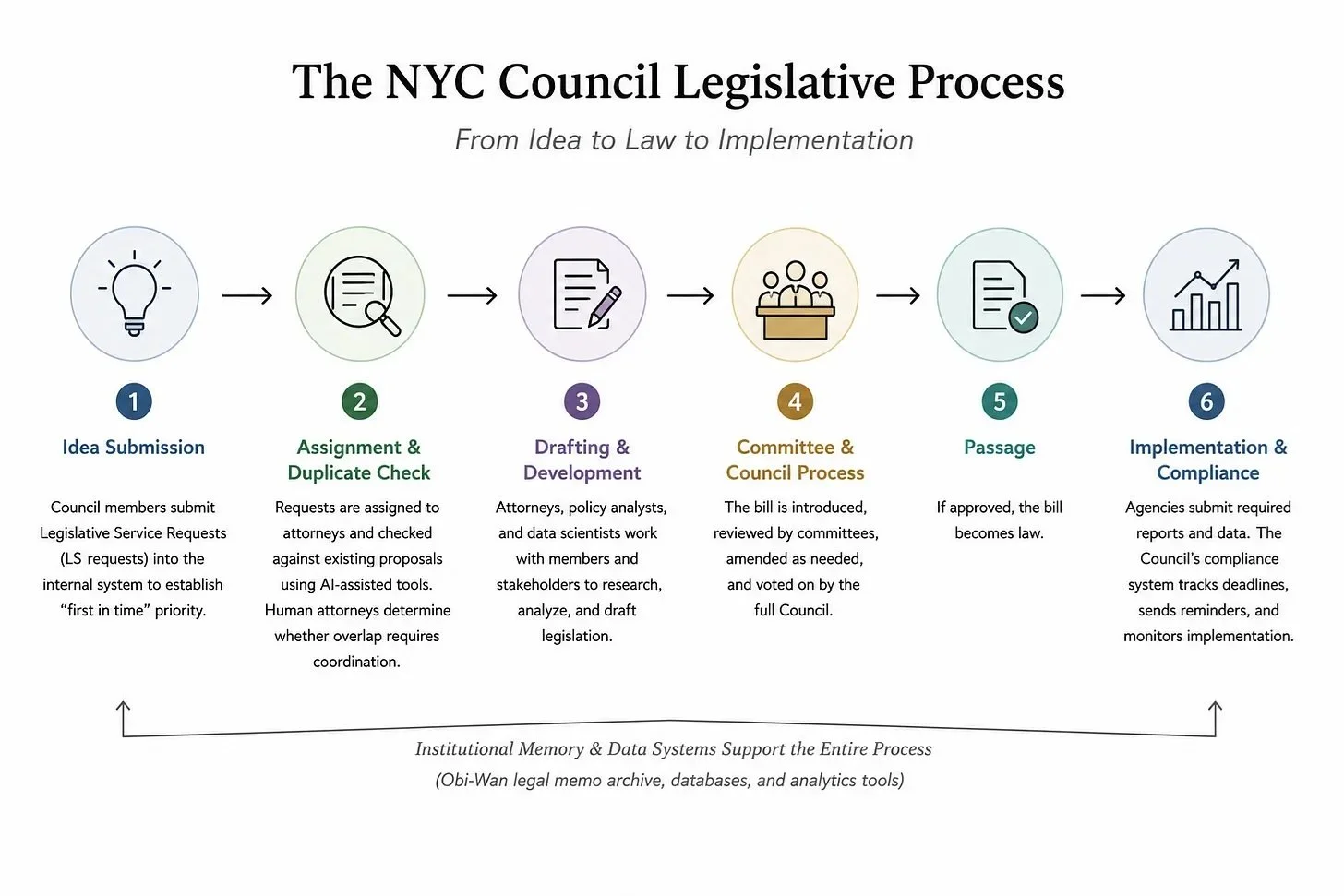
The result is something remarkably close to Kingdon’s metaphor made operational: a constantly expanding repository of partially formed policy ideas, overlapping proposals, dormant concepts, and competing legislative ambitions. Ideas enter the system before they are fully developed. Some remain inactive indefinitely. Others are later “activated” by council members when they decide to move them forward into drafting.
Once activated, a proposal is assigned to an attorney in the Legislative Council and Drafting Division. These attorneys work directly with council members to transform broad political ideas into draft legislation. Before drafting begins, however, the system performs one of its most consequential functions: an AI-assisted duplicate search.
The duplicate checker compares the newly activated proposal against thousands of existing requests in the database and ranks earlier proposals according to the likelihood that they overlap. Importantly, the system does not make the final determination itself. Human attorneys review the results manually and decide whether proposals are sufficiently similar to require coordination. “We do have to look through all of the results and based on our judgments see: do we think that these ideas are kind of overlapping, or are they distinct enough where they can be drafted separately?” legislative counsel Jessie Foong told me.
This matters because legislative credit is politically valuable. In the NYC Council, the member who first submitted an idea generally becomes the prime sponsor if overlapping proposals emerge. That member gains priority in directing the drafting process and receives primary political credit for the initiative.
In practice, the system functions not only as an administrative tool, but also as a procedural arbitrator. It reduces disputes over authorship, creates a transparent timeline of idea ownership, and formalizes something that is usually opaque in legislative politics: who actually thought of an idea first. As Rose Martinez explained, “We’re trying to reduce conflict between the council members.”
From Ideas to Drafts
The legislative process itself is deeply collaborative and iterative. Attorneys in the drafting division conduct legal research, coordinate with council members, manage communication with stakeholders (if members have them onboard at this stage), and attempt to reconcile competing priorities into a workable legislative text. As Foong described it, “We work with them to figure out how to make their idea into a bill.”
Alongside attorneys, policy analysts and data scientists can also become involved depending on the nature of the proposal. Policy analysts sometimes work on drafting resolutions, which are not legally binding, while the data science team is organized by committee area, such as housing or transportation, and contributes statistical analyses, dashboards, maps, demographic breakdowns, and cost-estimation tools.
One example discussed during the conversation involved jaywalking decriminalization. Council staff analyzed data from other municipalities to test whether decriminalization increased pedestrian collisions. According to the team, the data did not support the claim that decriminalization would increase accidents. In other cases, data scientists help identify geographic concentrations of housing violations, estimate the cost of fare subsidy programs, or map demographic patterns across council districts.
AI as Administrative Infrastructure
Yet despite the extensive technological infrastructure, the interviewees repeatedly emphasized that politics itself remains fundamentally human. The systems, they argued, are designed to improve efficiency, consistency, and accuracy, not to replace political judgment. As Alaa Moussawi put it, “the creativity and the spontaneity” still come primarily from elected officials and from the issues emerging within their communities.
The interviewees described the AI tools primarily as administrative support systems. In their account, the duplicate checker helps reduce conflicts over sponsorship and attribution, the retrieval‑augmented generation (RAG) system speeds up legal research and retrieval of institutional memory, and the compliance system improves oversight of implementation and reporting requirements. Rather than generating policy agendas, these systems were described as helping staff manage legislative information and workflow more efficiently.
The politics doesn’t seem to have fundamentally changed. What has changed is the way the information is organized, retrieved, and managed inside the institution. This becomes especially clear in another internal tool the Council built: a RAG system called Obi‑WOMM — a playful nod to the underlying system, IWOMM, named after the classic “it works on my machine” sticker that inspired its creation.
The Obi-WOMM system is connected to a large archive of internal legal memos produced during previous legislative drafting processes. Every bill drafted by the Council generates a legal memo summarizing the legal landscape surrounding the proposal, documenting policy concerns, and explaining why certain drafting choices were made. These memos are not public-facing documents. Rather, they function as institutional memory for future attorneys working on similar topics.
The RAG system allows staff to retrieve relevant prior memos quickly, ensuring consistency across legislation and reducing the likelihood that important precedents are overlooked. Again, the emphasis is not on replacing human judgment, but on accelerating research and improving coordination.
Governing After Bill Passage
Another important aspect of the Council’s infrastructure appears after legislation is passed. Many laws require city agencies to submit periodic reports or data back to the Council. Historically, tracking compliance with these requirements was fragmented and difficult. According to Council staff, the previous system relied heavily on spreadsheets and manual monitoring.
The Council responded by creating an integrated compliance system that automatically tracks deadlines, sends reminders to agencies, alerts committee staff about overdue reports, and stores submissions in a searchable archive. A dedicated Compliance Division now oversees the process and manages follow-up with agencies.
Looking at the NYC Council, what stands out is not just the use of AI tools, but the gradual construction of an institutional infrastructure around legislative work. The NYC Council has gradually built a digital architecture that structures how ideas emerge, how legislative ownership is determined, how institutional memory is preserved, and how implementation is monitored over time.
Kingdon’s policy primeval soup was originally a metaphor for the disorderly process through which ideas compete for attention in democratic systems. The chaos Kingdon described is still there. Ideas continue to collide, compete, overlap, and evolve politically. What the NYC Council has done is build systems that make those processes easier to track, search, and manage.
For scholars of legislatures, the implications are significant. We often think about parliamentary or Congressional modernization in terms of transparency, participation, or digitization. The NYC Council points to a different dimension of legislative modernization: the growing importance of internal systems for managing information, workflow, and institutional memory.
Modern Parliament (“ModParl”) is a newsletter from POPVOX Foundation that provides insights into the evolution of legislative institutions worldwide. Learn more and subscribe at modparl.substack.com.