
San Francisco and Washington are weighing it very differently
BY CAITLIN MCNALLY
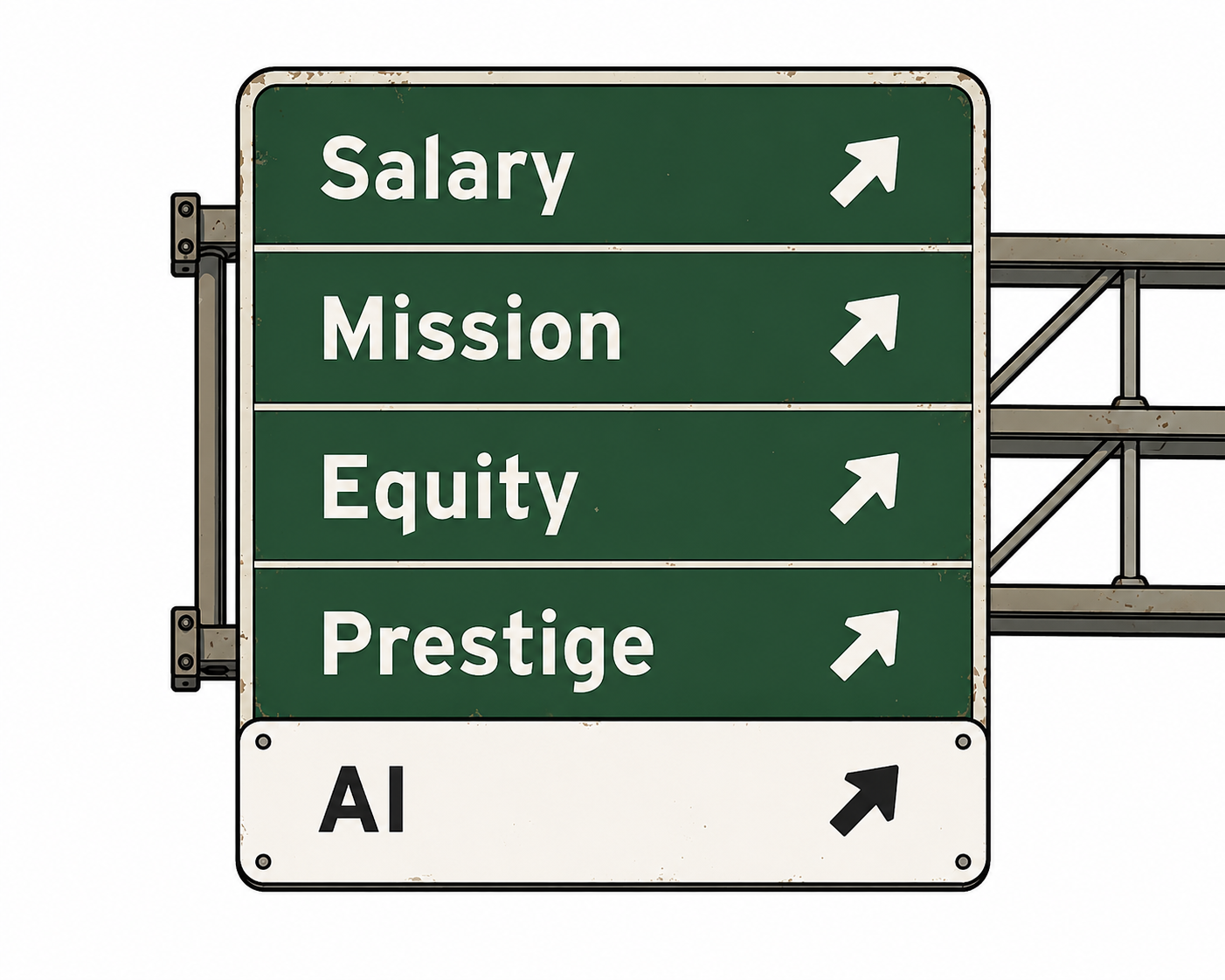
Every career decision is a weighing of inputs: pay, lifestyle, prestige, mission. Nobody sits down with a spreadsheet, but everyone runs the math. As AI changes the nature of work, it is adding new inputs and shifting the weights of the old ones.
So far, economists and policymakers have mostly treated this as a long-term policy issue. But for young people, the recalculation is already underway. In a Harvard Youth Poll, 59% of Americans ages 18 to 29 said they see AI as a threat to their job prospects, and 42% of bachelor’s degree students say they have seriously considered changing their major because of it. From conversations with my peers, I have come to think that young people in SF and DC see this math differently, and AI is now widening that gap even further.
The SF Calculus
Right now in San Francisco, the questions hanging over every career conversation are about AI: who is at a lab, who is getting rich, and who is about to be left behind. Those questions landed in a city that already had its own way of thinking about careers. The classic early-career decision is still whether to work for Big Tech (think Meta, Google, Apple, and now Anthropic/OpenAI) or a startup. Having this choice at all is a privilege, one that mostly belongs to people coming out of certain schools or with skills the market happens to want. But for those weighing it, the obvious inputs are pay, mission, and time.
On pay, engineers who leave Big Tech for a startup typically take a 20% to 45% pay cut, depending on the stage of the company. That sounds significant, but many entry-level engineers at Big Tech clear $200,000, so they still out-earn most other industries after the cut. The real calculus is not what you give up today but what you stand to gain in equity if the bet pays off.
Equity in the startup world is its own construct. Startups cannot match Big Tech salaries, so they make up the difference in ownership. Early employees commonly receive stock options, a small slice of the company that is worth nothing if the company fails and potentially millions if it succeeds. The earlier you join, the more risk you take on, so the larger your slice. That dependence on success brings up the most personal input: how much you actually believe in what you are joining. I have friends who joined startups less because the product convinced them than because the founder was the smartest person they knew. Even absent that conviction, trying is often worth it on its own terms. In SF, a failed startup does not taint a resume. If anything, it signals that you were willing to take a risk and learn from it, which in many circles opens more doors than it closes.
Time is another major consideration, and young people in SF are willing to give a lot of it. The 9-9-6 schedule (9AM to 9PM, six days a week) originated among Chinese e-commerce giants in the mid-2010s and was declared illegal by China’s Supreme People’s Court in 2021 after several deaths linked to extreme fatigue. It has nonetheless found a quiet foothold among American startups. Not every early-stage company expects this kind of commitment, but the general understanding holds: the earlier the stage, the more of your time.
Enter: the AI revolution. In SF, where AI is both a constant topic of conversation and the thing capital revolves around, it has become a key factor in many young people’s career decisions. Young people are reacting to a fear — not a fear of AI itself, but a fear of missing out, of becoming irrelevant, or of falling from a certain level. Some, though certainly not all, are fearful of the reality of a “permanent underclass,” a socioeconomic group trapped at the bottom of society with no path upward. Jasmine Sun’s piece in the New York Times explored the roots of this concept in Silicon Valley and explained how pervasive it has become; though many remain skeptical, its presence in memes and online culture is in some ways a barometer of what young people are actually thinking.
The fear comes from watching a small number of people make enormous amounts of money in real time. Most of that wealth is still prospective, but the first of it has arrived. SpaceX’s June IPO minted roughly 4,000 new millionaires among current and former employees, and the spending has already started: one former SpaceX data scientist recently bought $10,000 worth of meteorites and a $5,000 fire truck, while a former OpenAI executive used his earnings to buy a professional volleyball team. With Anthropic and OpenAI both filing to go public, engineers at other companies, even well-compensated ones, are watching friends and colleagues position themselves to accumulate wealth on a different scale entirely.
At the same time, the AI boom is raising the cost of living in the city. Hard Fork’s Kevin Roose and Casey Newton captured this tension well: crazy as it sounds, people earning mid-six figures are suddenly wondering whether the life they planned is still within reach. For some, that question is becoming a more immediate one about whether they can stay in SF at all — as Emmy Martin reported in the New York Times, rising rents and home prices are pushing even the well-paid out of the city. Sun’s interviews surfaced similar anxiety: she cited former OpenAI safety team member Steven Adler, who observed tech workers scrambling for lucrative AI jobs in hopes of securing perceived financial freedom, even when they have ethical concerns about the work. Underlying all of this is a fear that Silicon Valley’s lucrative jobs will grow scarcer as AI replaces software engineers.
People are responding to all of this differently. Some, as Sun captured, are pivoting into AI directly, others are trying their luck at startups, and some are staying in Big Tech to accumulate as much as they can before the market for engineers narrows. Which direction someone goes tends to depend on how much they believe AI is going to change things, and whether they want to be part of that change. For some, AI is the moment they came to SF to be a part of. Others never quite had the risk tolerance that runs the SF startup scene. None of them can ignore AI when thinking about their future job prospects. Even outside the tech bubble, young people in SF’s other industries feel it; every billboard serves as a reminder.
The DC Calculus
In Washington, the classic early-career decision looks quite different. For many young people, the first job out of college is less about what it pays and more about what it positions you for. The math runs on different inputs: the doors a job opens, the mission it serves, and the personal brand it builds.
Money is not irrelevant, but the payoff tends to be deferred: take the low-paying but prestigious job now, build the resume, and let the financial rewards follow later, whether through a lobbying jump or a pivot to the private sector. It is a bet on future value over present compensation — not unlike the startup equity trade, just slower and less dramatic.
Mission plays a large role, in ways harder to quantify. Many come to DC because they genuinely care about a particular issue or outcome, and the proximity to where decisions are made is part of the draw. It is what convinces a law school graduate to take a Hill salary over a firm salary, or a policy wonk to turn down a consulting offer for a think tank fellowship. Even between two Hill jobs at similar pay, the difference can come down to whether the Member sits on the right committee or shares your values.
Personal brand is its own input. Where you work in DC attaches itself to your name, and over time the two become difficult to separate. For most people, credibility is borrowed: an established name lends you some of its standing the moment you say it, while a newer or lesser-known one means your work has to introduce itself.
That personal brand input is starting to shift at the margins, though. This year, a small but visible cohort of interns and junior staffers has been building brands of their own rather than borrowing them from institutions, posting outfit checks and day-in-the-life videos from the Capitol grounds. The New York Times recently profiled the trend, which one intern captioned simply as “DC maxxing,” and Roll Call has covered the tension it creates with the Hill’s long-standing norms around staffers keeping their heads down online. One former staffer told Roll Call that “peeling back the curtain in any capacity is a good thing,” a sentiment that cuts directly against the old cardinal rule that interns are to be seen and not heard, there to increase the spotlight on the Member but never be in it themselves. To be clear, this is a tiny population, and that cardinal rule still governs the vast majority of offices. But it is a genuine break from precedent, and it hints at a generational shift in how young people in DC think about the relationship between their job and their identity.
AI is the newest input in DC too, but for most young people it is shifting where they invest their effort rather than generating the anxiety their SF peers feel. From what I’ve observed, conversations around AI in DC are less focused on its endless possibilities and more on its limitations. While this framing does not change what AI can actually do, it does change how threatening it feels.
Many are simply focused on AI’s outcomes: how to respond to mass layoffs, how to limit the environmental damage of data centers and the strain on energy bills, and how to protect against cybersecurity threats. Because AI overlaps with every policy portfolio, more people are working to understand its implications, and some, especially in tech-adjacent circles, are upskilling or shifting toward AI policy specifically. Programs like the Meridian Center’s Technology Fellowship and R Street Institute’s Congressional Fellowship in AI Policy have popped up to help staffers learn, and more are exploring how to fold AI into their workflows, something we at POPVOX Foundation have witnessed firsthand through our trainings with Congressional staff.
Still, the nature of the work is shifting, even if it does not feel threatening. Some offices are outsourcing repetitive tasks to AI, making more time for constituent conversations and deeper policy work. One staffer automated his office’s tour booking program and cut letter-drafting time significantly, training interns to serve as humans in the loop. That automation has shifted staffing in some offices: rather than hiring both a staff assistant and a legislative correspondent, the typical entry-level roles, some now combine the two. This trend began before AI but has become more feasible because of it. Intern roles are changing too as automation absorbs tasks previously reserved for them. Some worry internship experiences will disappear; others think they can become more meaningful with deeper policy work.
Overall, when it comes to personal career paths in DC, the perceived threat of AI is low. The kind of career reckoning common in SF — the pivots and startup bets and financial anxiety — is far less visible. The consensus is that political and community-based work cannot be replaced by AI the way engineering jobs can; after all, AI has not yet proved it can negotiate face to face or build consensus. One staffer told me they were not worried about their job prospects because they are “not building a product, but serving a community.” AI can make that service more efficient, they said, but nothing will replace face-to-face meetings with constituents.
Why the gap matters
These differences matter because the city responsible for drafting the policy response to AI’s cultural and economic shifts is not the one living them most immediately.
San Francisco is experiencing AI as something personal, playing out in career decisions and anxieties that policy has not caught up to. Some of that anxiety is likely an overestimate, but even the overestimates are useful: what surfaces in SF is an early look at how the rest of the country may come to feel these shifts. That preview should be worth something in DC, where the shift feels further away than it is — a product of both the nature of government work and a narrower view of what AI can actually do.
The understanding needs to run the other way too. SF’s proximity to AI places tech workers in their own kind of bubble. DC’s distance is not obliviousness; it is a wider lens and a more skeptical eye, concerned with what AI does to the country, not one industry, and unconvinced it will do everything SF says it will. Young people in SF would do well to remember that the impact of AI on careers will be felt by everyone to some degree, and therefore the solutions must be systemic. Snagging a job at Anthropic may help quell individual career concerns, but not everyone has the same escape hatch.
The pacing problem lives exactly here: DC has not yet recognized how fast the change is arriving, and SF keeps missing the bigger picture. Getting the policy right starts with each seeing what the other sees.
2,800 miles separate San Francisco and Washington, DC — but the cultural gap is much wider. This newsletter explores what these two worlds misunderstand about each other, and why it matters for how we govern. Learn more and subscribe at 2800miles.substack.com.