
The Pebble and the Boulder: Five Futures for Legislatures in the Age of AI
What global parliamentary leaders are thinking about and why American legislatures should be paying attention
BY MARCI HARRIS
Over Thanksgiving, I had the honor of traveling to Kuala Lumpur to speak at a joint conference hosted by the Parliament of Malaysia, the Commonwealth Parliamentary Association, the Inter-Parliamentary Union, and the United Nations Development Program on "The Role of Parliament in Shaping the Future of Responsible AI."
For the opening plenary, I was asked to set the stage with five potential “futures” for legislatures in 2040.
I started by sharing a parable from Vint Cerf. For several years, I served with Vint on the board of the People-Centered Internet, an organization he cofounded to make the internet work for people. (He also invented the TCP/IP protocol — you may know him as the “Father of the Internet.”) There's a story he tells that I find myself returning to again and again.
Imagine you live in a small town in a valley, surrounded by mountains. There's a giant boulder at the top of the highest peak. One day, you notice the boulder is loose. It's about to roll down the hill and destroy the village. You know you can't run up and stop it. You're too small, and the boulder is too big. Once it gains momentum, it's unstoppable.
But you're smart. You know that if you find a pebble or a small stone of just the right shape and place it in just the right spot before the boulder starts to roll, you can divert it. You can change its path entirely.
The secret is finding the pebble, not fighting the boulder.

Image created by Google Gemini/Nano Banana
The Pacing Problem
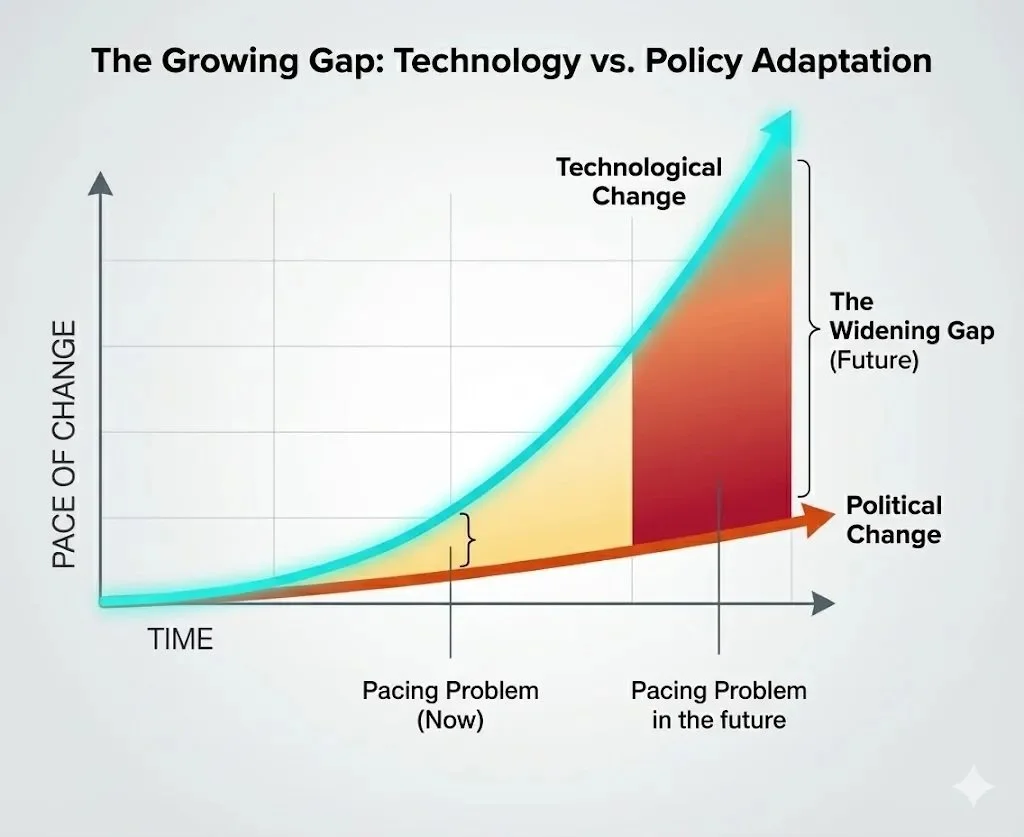
That boulder threatening the town is what I see when I think about “the Pacing Problem,” a concept developed by Dr. Gary Marchant of Arizona State University explaining that technology develops exponentially, while our democratic and governing institutions develop more slowly, leading to an increasing gap over time. As the gap widens, we fall further and further behind.
Back in 2019, I wrote about this in the context of legislatures. For those of us who work in and around Congress and state legislatures, this isn't just one problem — it's actually three:
The External: Understanding how fast society is changing around us.
The Inter-Branch: Keeping up with the Executive branch, which moves faster than the legislature by design.
The Internal: How legislatures deploy technology for their own operations.
Most AI policy discussions focus on the External, i.e. regulating the technology. But the Internal and Inter-Branch challenges may ultimately determine whether legislatures remain relevant institutions in the decades ahead.
Rehearsing for the Future
Scenario planning is a process of “rehearsing” the future: imagining potential paths in what futurists call the "Cone of Plausibility." By mapping these paths, we stop asking "What will happen?" and start asking “What would we do if this happened?”
In the short term, this kind of planning helps us identify “no-regret moves” that pay off whether the future is utopian or dystopian. For legislatures today, that could be investments in staff digital literacy or better data infrastructure. Futures thinking also helps us spot “signposts,” telling us exactly when to pick up the pebble and where to place it.
In the long term, this approach allows us to have more agency over our path. Instead of waiting for the boulder to crush the town, we identify leverage points upstream. We move from being reactive to proactive.
Five Futures for 2040
So what might that future look like? Here are five plausible scenarios I shared with parliamentary leaders from around the world:
Scenario 1: The Augmented Assembly
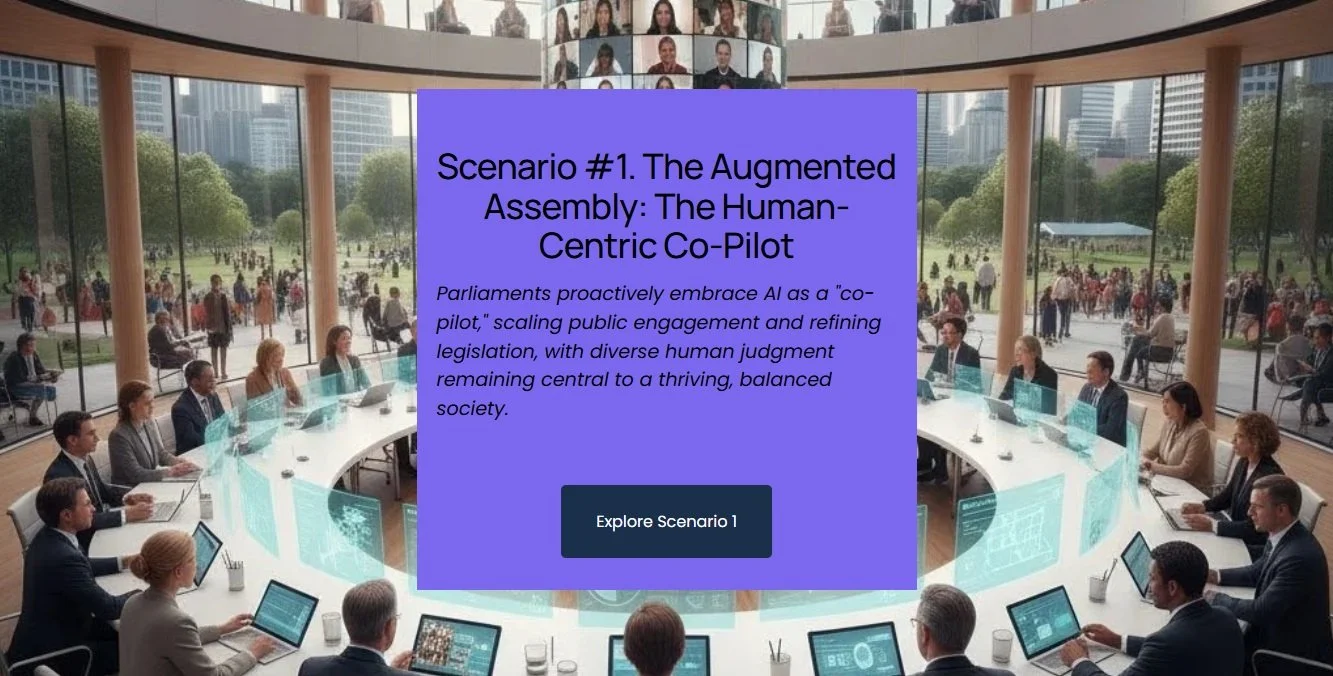
In this optimistic scenario, legislatures have successfully navigated AI integration, positioning it as a powerful helper. AI is embedded across functions, dramatically enhancing efficiency, constituent services, and data processing, yet ultimate ethical and policy judgments remain firmly with elected representatives.
In this future, a Member of Congress receives a constituent query about new educational programs or business incentives. Their AI assistant instantly synthesizes relevant legislative text, cross-references it with public feedback, and drafts a personalized response. The Member reviews, customizes, and approves it. During legislative drafting, AI identifies conflicts with existing law and flags unintended consequences. An AI-powered dashboard provides real-time transparency into Executive branch spending and program outcomes.
This scenario represents a deliberate choice to invest in legislative AI capabilities and governance frameworks, ensuring technology helps elected representatives make better decisions and better serve their constituents.
Scenario 2: The Data-Driven Legislature
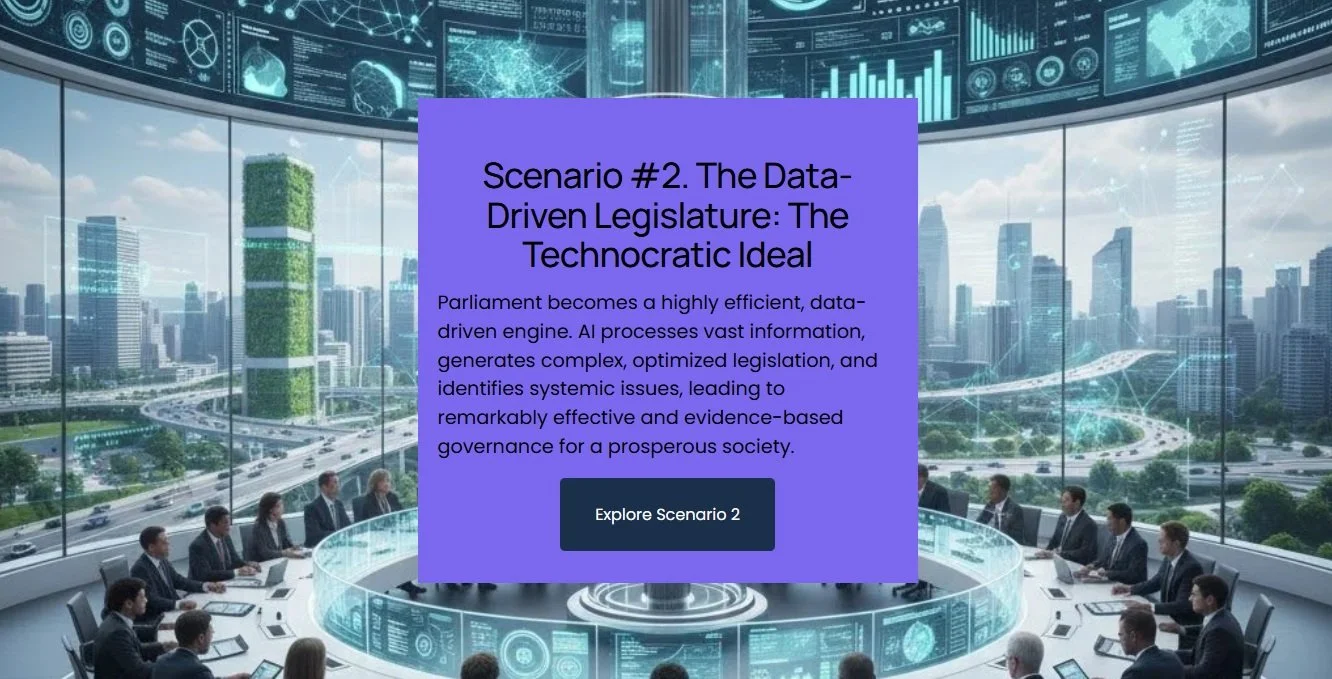
Here, the legislature transforms into a highly efficient, technocratic engine. Policy decisions become primarily evidence-based. Legislation is generated at machine speed. Systemic issues are identified with precision.
Elected officials are still present, but their role shifts toward expert interpretation of algorithmic insights and strategic guidance. An AI system fed with demographic, economic, and environmental data generates comprehensive draft legislation within hours, complete with projected outcomes and cost-benefit analyses. “Digital twin” models simulate long-term policy impacts before enactment.
This is a positive outcome in terms of pure efficiency and effectiveness, though it may subtly shift the nature of democratic representation.
Scenario 3: The Divided Democracy
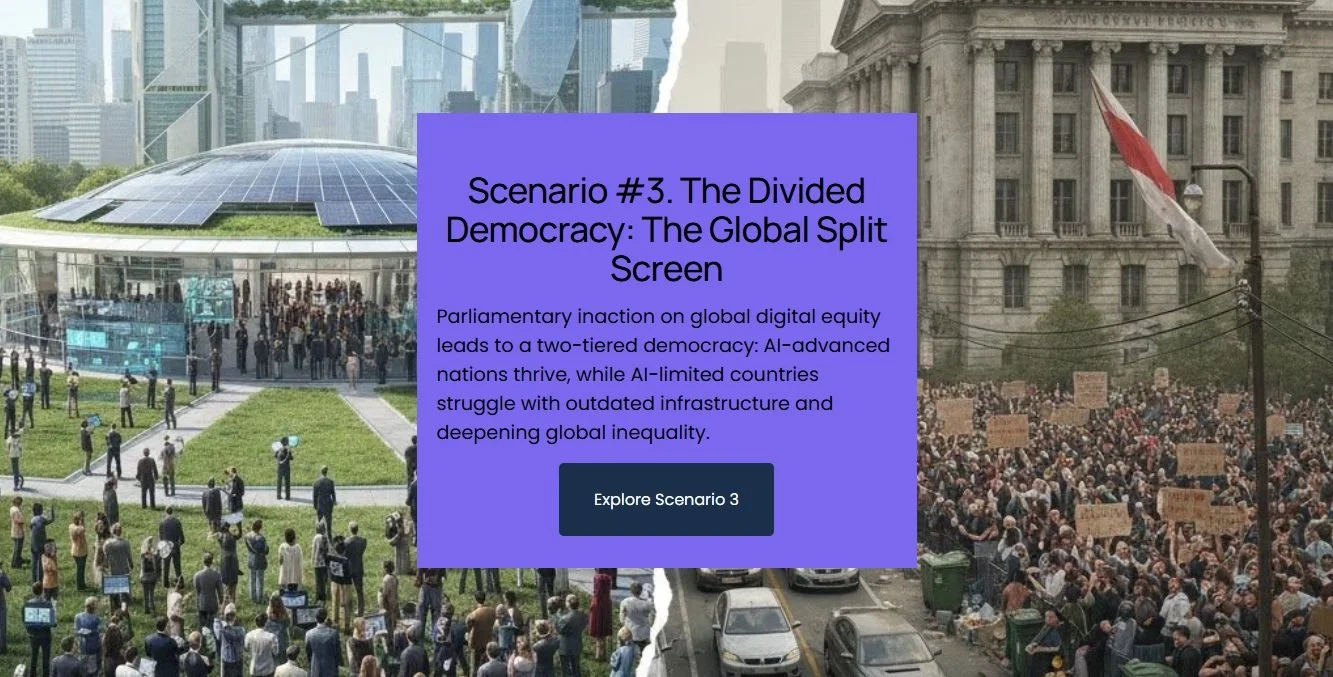
This is where global inequality meets technological capacity. A stark digital divide separates “AI-advanced” legislatures from “AI-limited” ones. While some leverage sophisticated AI for constituent engagement and robust oversight, others struggle with outdated infrastructure and traditional processes.
Think of this at the state level: today, some state legislatures operate with significant professional staff and technological resources. Others rely heavily on part-time legislators and minimal support. Now multiply that divide by a factor of AI.
In this future, citizens in well-resourced jurisdictions participate in AI-enhanced town halls while others queue to submit paper petitions. During complex policy debates, AI-advanced legislatures analyze thousands of pages in minutes while others take weeks to review a fraction of the material.
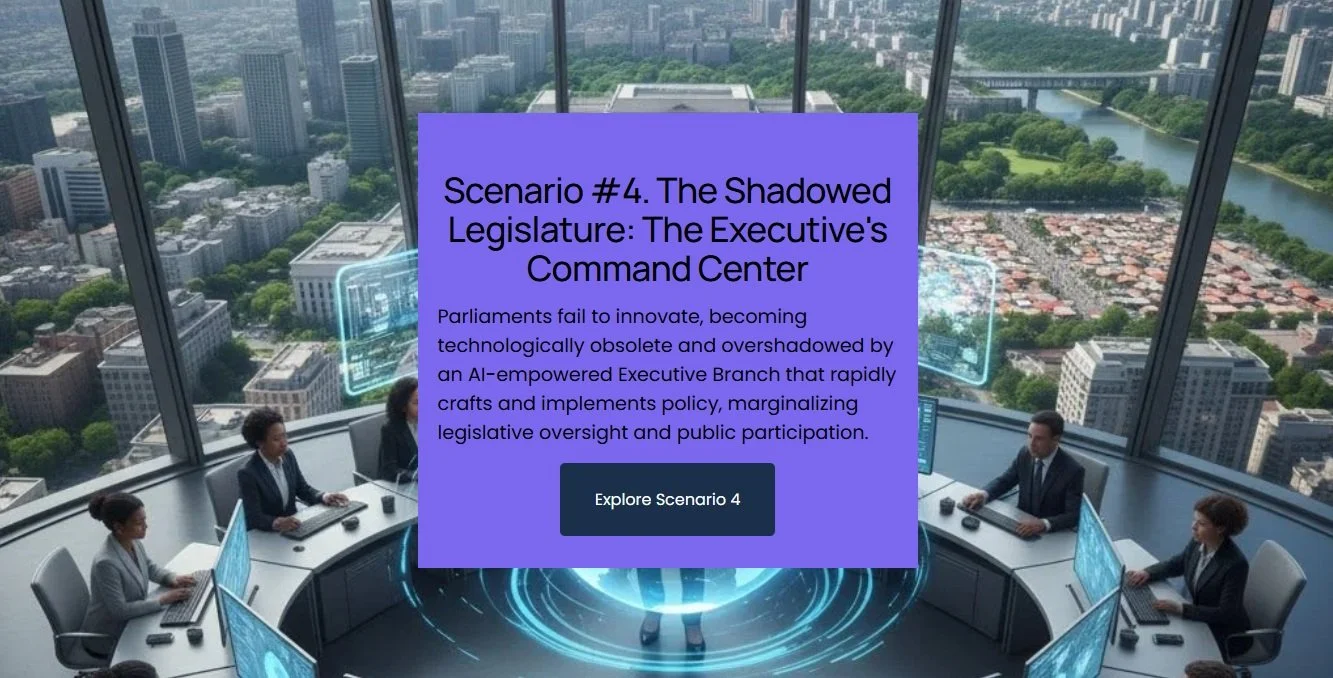
Scenario 4: The Shadowed Legislature
This is the cautionary tale of legislative inaction. Failing to innovate and integrate AI effectively, the legislature becomes technologically obsolete and is systematically overshadowed by an AI-empowered Executive branch.
The Executive leverages cutting-edge AI for rapid policy design, implementation, and citizen interaction, effectively centralizing power. The legislature is relegated to a diminished role — a distant, less dynamic body struggling to provide meaningful oversight.
The Executive launches AI-powered citizen engagement platforms that collect feedback and deliver personalized services. Citizens interact directly with the Executive, seeing little need for their elected representative. AI systems monitor and enforce regulations without legislative input. Budget proposals become so complex that legislative oversight becomes ceremonial.
This is a future where “efficiency” triumphs over representative democracy.
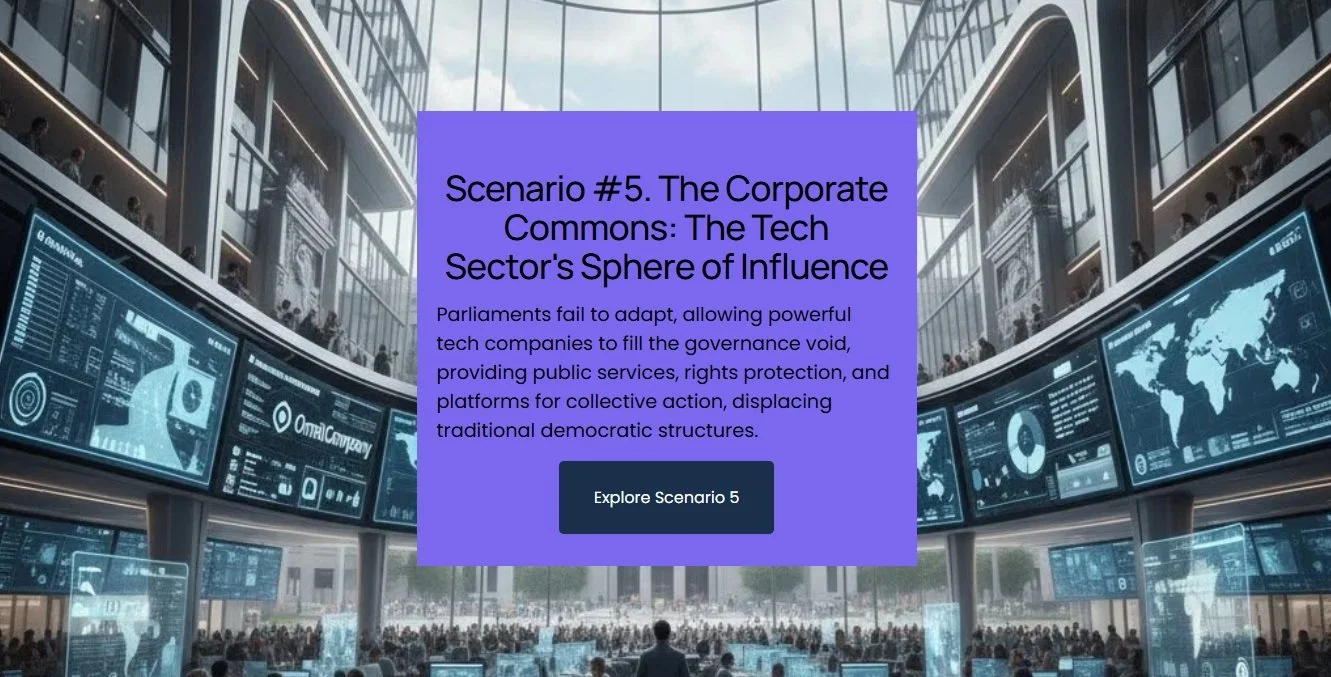
Scenario 5: The Corporate Commons
In this challenging future, legislatures have failed to adapt to the digital age, leaving a vacuum that powerful tech companies eagerly fill. These corporations become the de facto providers of essential public services, dispute resolution, and even platforms for collective action.
Citizens seeking efficient solutions increasingly rely on these corporate “commons,” bypassing traditional democratic structures entirely. When someone feels their rights have been violated, they don't appeal to Congress or the courts — they use the “Rights Protection” feature on a major platform. Tech companies “regulate” through algorithms and terms of service, creating a parallel system of governance that legislatures struggle to influence.
What This Means for Congress and State Legislatures
None of these scenarios are certain. They're merely plausible. But they help us imagine what it will take to chart a path to the future we want to see.
The parliamentary leaders I spoke with in Kuala Lumpur are grappling with these questions seriously.
The UK Parliament has established a cross-party steering group on AI and its leader, Deputy Speaker Nusrat Ghani, said that they aim to make the House of Commons “the most AI-proficient legislature in the world.”
Chile shared how its “Caminar” AI-enabled platform developed out of its long history of digitizing public information and experimentation with data-driven governing.
Even small countries like Mauritius are leveraging AI for transcription and instant summaries in English and French.
Meanwhile, American legislatures at both the federal and state levels have some hard questions to ask themselves:
Are we identifying the pebbles, or waiting for the boulder?
Are we making the “no-regret moves” that pay off in any scenario: investing in staff capacity, data infrastructure, and digital literacy?
Are we building the tools we need for meaningful oversight of an AI-empowered Executive branch?
Are we at risk of becoming the Shadowed Legislature or worse, ceding our role to the Corporate Commons?
The Pacing Problem isn't going away. If anything, it's accelerating. The question isn't whether AI will transform governance — it's whether legislatures will be architects of that transformation or its casualties.
The pebble is still within reach. But we have to be smart enough to pick it up, and wise enough to know where to place it.
