
According to Inter-Parliamentary Union’s 2024 edition of the World E-Parliament Report, 66% of parliaments have informal methods in place to encourage innovation. That number being so high may surprise some; legislatures are often portrayed as slow-moving institutions resistant to change but the reality is that they are full of people who innovate every day, often with little support or infrastructure formally in place. In that same report, 82% of parliaments cited “learning from other parliaments” as a key enabler of that innovation. That's a remarkable hunger for peer exchange.
We’ve seen that hunger firsthand. Since 2023, POPVOX Foundation has conducted several trainings, hosted briefings, and been a part of a multitude of discussions globally to provide guidance to policymakers and their staff to help them keep pace with the rapid developments in AI. These conversations have given us a front-row seat to how legislatures worldwide are putting this emerging technology to work: conducting policy research, summarizing phone notes, drafting constituent service emails, translating materials into plain language or other languages, producing hearing memos, and editing documents for consistency. The use cases are practical, numerous, and applicable across legislatures.
That hands-on experience prompted us to release a collection of online AI resources to meet the needs of a global legislature audience. This collection will grow, and below is the beginning of a resource bank designed not just to explain AI, but to help MPs and staff with step-by-step guides to foster responsible adoption to meet the needs of the people they serve.
Addressing the Pacing Problem Directly by Encouraging Smart Adoption
The pacing problem — or gap between accelerating societal changes spurred by technological evolution and government’s capacity to address them — is not just about understanding technology, it is about having the operational capacity to act while the window is still open. AI capabilities are evolving at a pace that even we can't believe.
The question for this generation is not whether AI will change parliaments (it will, and, already is) — but whether we will use this moment to make democratic institutions stronger and more capable of serving their people.
We believe the best way to understand these tools is to use them, but to use them with a smart, intentional approach. No matter how sophisticated the technology, the human is still responsible for the work produced. That means checking outputs, applying judgment, and never outsourcing accountability to a chatbot. Parliaments are uniquely positioned for this role: they can model what it looks like to have work augmented by AI (boosting capacity) while keeping humans firmly in control.
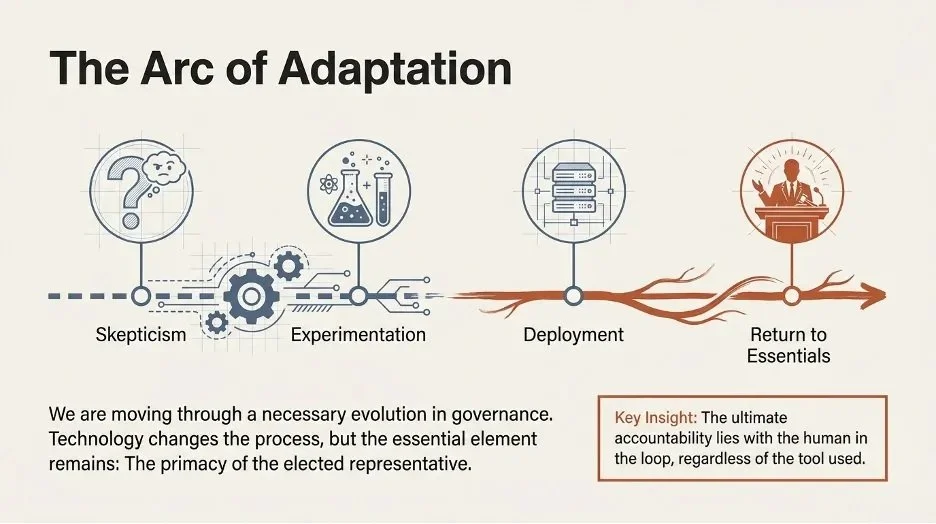
A visual explainer of what POPVOX Foundation believes to be the arc of adaptation with AI
Resources: AI Guides and Training Developed for Those in Parliament
Our resources are designed to compress the time it takes to go from “I should probably figure out AI” to “My office has a policy, a workflow, and staff who can use these tools effectively, confidently, and responsibly.” Our guides are built around the gaps MPs and staff asked us to fill.
First, we cannot overstate the importance of reviewing your institution's official guidance regarding generative AI (GenAI) tools before diving in. If your institution has not issued guidance, it is a best practice to create and use a paid subscription account when relying on commercially available LLMs — paid accounts come with additional data security features that should remain enabled to protect your data privacy.
Generative AI Use Policy: A Template for Parliamentary Offices
Parliaments need practical pathways for responsible experimentation. This customizable template gives offices a starting point to establish a policy: one that fits their specific needs, institutional requirements, and operational context. Consult with your institution's leadership or technical team for the latest guidance before implementation.
GenAI Change Management: A Starter Kit for Parliamentary Offices
Once guardrails are understood, integrating GenAI into your or your team’s workflows takes intention. Change management is essential to create conditions for people to understand how this new technology can augment their work while elevating their performance and highlighting the value they continue to contribute to the office.
Every office is different, and this guide is meant to support and recommend, not prescribe. We recognize the realities of serving in a parliament: limited time, varying comfort levels with new technology, and high stakes in the public eye. This kit helps MPs and staff make informed, intentional decisions about leading their office through adoption in ways that improve service to constituents.
Harnessing AI to Master A New Policy Topic: A Step-by-Step Guide for MPs and Parliamentary Staff
MPs and staff interact with incredible amounts of information on a daily basis. AI tools can help individuals rapidly build expertise in new subject areas, drawing on institutional or government resources and other trusted sources. This roadmap provides a 101-level guide for how AI can be used to assist with honing policy expertise, from understanding basic terminology to preparing for policy debate and deliberation, with sample prompts, recommendations, and a list of pitfalls to avoid.
Use AI as your brainstorm and learning buddy: draft questions for deeper learning, create briefs and memos, even quiz yourself on a topic. It helps break down “task paralysis” and reduces the overwhelming experience of going deep on something new.
Creating and Using Custom GPTs: A Guide for Parliamentary Offices
As you and your team build AI fluency, you'll want a tool that can be tailored to your office's specific needs — whether that's preserving institutional knowledge, drafting in the MP's voice, or preparing for oversight hearings. Members of Parliament and their offices manage a vast amount of institutional knowledge ranging from past statements, constituent service procedures, policy memos, oversight records, and agency correspondence to budget documents.
A custom chatbot is a tailored version of an LLM that draws exclusively from documents you provide, making it a powerful tool for internal knowledge management. This guide walks you through how to build and use one — so your office can create a secure, AI-powered assistant tailored to exactly how you work.
Understanding AI-Powered Deep Research Tools: A Primer for MPs and Staff
Complex policy questions rarely have simple answers, and legislatures must always pull from many sources at once. The Deep Research functionality (available only for paid accounts) on LLMs goes far beyond a single prompt-and-response interaction. This tool or setting allows the user to lead the LLM to conduct multistep investigations — automatically searching multiple sources, cross-referencing information, and synthesizing findings into comprehensive reports. It can prioritize academic databases, government repositories, or curated document collections rather than broad Internet searches.
Think of it as the difference between asking a research assistant one quick question versus assigning them a complex project that requires consulting numerous sources and preparing a detailed briefing. This primer helps you understand what deep research tools can do, how to use them effectively, and when they're the right choice for the task at hand.
Embrace the Learning Curve
The pacing problem is not a top-down problem to address; it requires innovation and a willingness to learn and evolve at every level of an institution. These resources are here to help MPs and staff start small and be inspired. Pick one resource, one use case, one task to try. The skills and habits you build now will shape how you, your office, and your institution meet what's coming next.
Should you want more tailored one-on-one training (we do them all the time!) — reach out to our Director of Government Innovation and Global Initiatives, Aubrey Wilson, at aubrey@popvox.org.
For more information on how parliaments around the world are innovating, subscribe to POPVOX Foundation’s Modern Parliament (“ModParl”) newsletter.