Every quarter, the Digital Parliaments Project (DPP) convenes clerks, Hansard secretaries, parliamentary staff, advisors, and partners from its global cohort for a virtual session covering progress updates, shared resources, and community exchange. We held the 2026 Q3 quarterly convening on September 25, 2026. Below is a summary of what we covered.
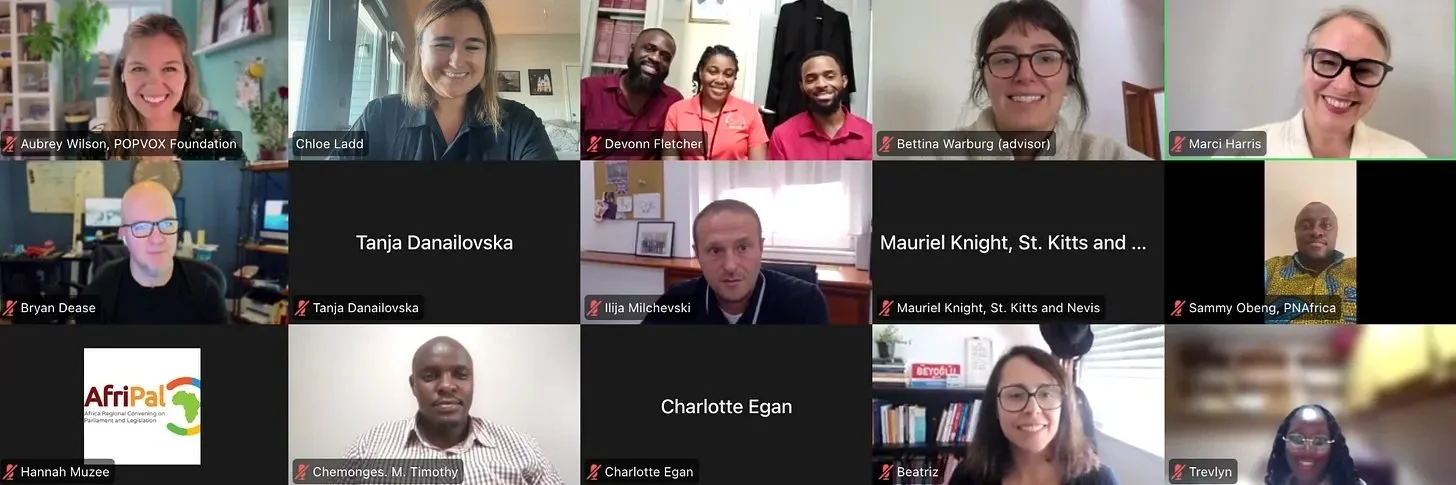
Group photo of the Digital Parliaments Project 2026 Q3 Quarterly Convening participants, representing parliaments from the Caribbean, Western Balkans, and Africa
A Summer of Regional Workshops
This summer, POPVOX Foundation held three regional workshops in collaboration with the House Democracy Partnership. Each workshop focused on legislative modernization, and included sessions on parliamentary AI adoption, records digitalization, and shared learning.
In July, the Albanian Parliament hosted our workshop in Tirana, where parliamentary staff from Albania, Kosovo, North Macedonia, Serbia, and Moldova spent four days assessing near-term AI opportunities, building working tools in AI sandboxes, and discussing legislative modernization with each other at length.
In August, the Parliament of Ghana hosted the launch of DPP in Africa in Accra. Staff from Ghana, Botswana, The Gambia, Senegal, South Africa, and the Pan-African Parliament joined our partners at AFRIPAL and PNAfrica for three days of self-assessment, ParlLink demos, and hands-on prompting practice in an AI Foundations Skill Lab. Africa has become the third region to join the DPP.
In September, we returned to Miami, where the idea for DPP originated in 2024, for the Caribbean regional workshop with our partners at ParlAmericas, and parliamentary staff from eighteen Caribbean legislative institutions. A full recap of the Miami workshop is coming soon.
The workshop discussions shaped several of the new resources below, and the summer brought several new partners into the Digital Parliaments Project, further expanding the network of knowledge sharing and community.
ParlLink Platform Updates
Through the Digital Parliaments Project, participating institutions receive free access to ParlLink, a parliamentary information management and records digitization platform developed by our technical partner, POPVOX, Inc. ParlLink provides AI-enabled functionality for parliamentary workflows and has already enabled several DPP parliaments to leapfrog from paper-records to AI-assisted meta-data generation and custom chatbot use.
Chloe Ladd, Program Manager for Global Initiatives, walked the cohort through several ParlLink platform updates that came directly out of the summer workshops during the Quarterly call and are now available to all ParlLink users:
New languages
ParlLink now works in Albanian, and French. Portuguese and Spanish are in progress. Partner feedback on translation accuracy directly shapes how the team improves each language.
A chatbot creator
In response to DPP participant requests, ParlLink now makes it possible to create chatbots that reference documents uploaded to ParlLink and embed the chatbot on the parliament’s website or applications. This is in addition to the Ask AI functionality within ParlLink allowing users to use AI to explore document content and the Document Chat feature that queries a parliament's whole digital library on ParlLink. The new chatbot creator lets parliaments select specific documents and build a bot that answers only from that select resource bank and design the chatbot with the colors and text of the parliament’s website. For example, a parliament can build a chatbot that references rules and procedure documents to give staff a real-time answer when a procedural question comes up during debate.
Coming soon
POPVOX Foundation will soon release an on-demand ParlLink demo video, providing a full walkthrough of the platform and features that DPP partners can share with colleagues. As a reminder, the POPVOX Foundation team is available anytime to provide 1:1 ParlLink training virtually.
Where to Start with AI
This summer’s workshops highlighted a shared trend around the world: policymakers and staff continue to be at different levels of AI adoption and use. No matter where you are, POPVOX Foundation's AI explainers and guides live at popvox.org/ai and on our refreshed global page.
Two new resources, open to the global parliamentary community, are forthcoming.
The first is an AI assessment. POPVOX Foundation uses a version of this assessment with every DPP country as it joins, establishing a baseline of how staff use AI and where each parliament stands in its digitalization journey. Yet, at the September 2026 Caribbean workshop, working sessions made clear that a strong AI pilot starts with the same kind of scoping, so the POPVOX Foundation team has tailored the assessment for parliaments to run themselves and use to guide their own AI working groups and roadmaps. It can help parliaments identify which tools staff already use, where the appetite for adoption and innovation lies, and where gaps in capacity might exist, giving each parliament a clear starting point to plan training, pilots, and scaling.
The second is a set of AI educational videos. Aubrey Wilson, POPVOX Foundation's Managing Director, will be providing an on-demand AI training course that can help build a foundation for how commercially available LLM tools can be used safely and effectively in parliamentary settings. Chloe is recording a session on best practices with AI chatbot prompting, using POPVOX Foundation’s mnemonic ORDER. The POPVOX Foundation team also continues to offer these training sessions live upon request for global parliaments.
AI 102: Vibe Coding
Once staff become comfortable with the core features of LLMs, the next step may be experimenting with vibe coding: building software by describing what you want in plain language and letting an AI tool write the code to build an app or website on demand. Policymaker and staff access to vibe coding tools is rare at this time, so during the summer workshops, POPVOX Foundation brought their AI Sandboxes, laptops running cutting edge AI agentic coding tools, providing staff the opportunity to experiment with them.
At POPVOX Foundation's booth at the National Conference of State Legislatures (NCSL), a delegate from Kenya built a national dashboard concept in about 15 minutes to track county-level legislation and progress on benchmarks. In Tirana, a delegate from North Macedonia built a meeting hall reservation system entirely in Macedonian, solving a long-standing pain point for her team. In Miami, the Cayman Islands used an AI coding tool to build its own public bill tracker that follows a bill through the legislative process.
Parliaments interested in learning the basics can request a virtual vibe coding training from the POPVOX Foundation team.
Streamlining Creation of Parliaments’ Public Websites
Many DPP partners share records digitization as a top priority and when parliaments structure their data and make it accessible, the public can more easily see what parliament does. For DPP parliamentary partners using ParlLink, the platform's API Explorer empowers parliaments to pull their structured data — including Member directories, documents, and the chatbots they build — straight onto their public websites.
For parliaments that do not have a public facing website established yet, the Parliamentary Website Template, available to DPP partners upon request, walks parliaments through building a site on Squarespace and connecting it to the ParlLink API so content updates automatically. Parliaments with an existing website can connect the API Explorer to it as well, and the team will walk them through the process.
What's Ahead: New Resources and a Growing Network
POPVOX Foundation will continue to roll out new resources as we enter into the final quarter of 2026 and prepare for another exciting year ahead.
To continue to foster an active community of knowledge-sharing, starting with the next quarterly call, POPVOX Foundation will spotlight case studies from the DPP community. DPPLink, the project's bimonthly internal partner newsletter, will also begin featuring cohort stories.
The next edition of DPPLink goes out in November, and the next quarterly convening takes place in early December. Between calls, the DPP WhatsApp group offers a space for quick questions, peer troubleshooting, and new resource announcements.
A Growing Community of Practice
The Digital Parliaments Project began with a single question about legislative modernization; it has become an active partnership spanning the Caribbean, the Balkans, and Africa. That community of clerks, Hansard secretaries, partner organizations, and parliamentary staff forms the foundation of the Digital Parliaments Project. POPVOX Foundation thanks everyone who joined the Q3 call and looks forward to reconnecting in December.
To learn more about the Digital Parliaments Project, reach out to Chloe at chloe@popvox.org.