POPVOX Foundation 2025: A Transformative Year
The gap between how quickly technology moves and how slowly legislatures adapt has never been wider or more consequential. In 2025, AI capabilities moved from experimental to operational across every sector of the economy. Executive agencies deployed machine learning for regulatory analysis. Companies rewrote their workflows around tools that didn't exist eighteen months ago. Yet, the legislatures charged with making society-level decisions around how these tools impact every aspect of our economy and culture risk being left behind.
POPVOX Foundation exists to close that gap by building the infrastructure that lets democratic institutions keep pace.
In the United States, that meant helping the 119th Congress navigate a year of shutdowns, partisan gridlock, and unprecedented uncertainty about the federal workforce. We again found that nonpartisan capacity-building is essential in times of crisis. When caseworkers needed real-time guidance on executive orders upending agency operations, our Casework Navigator delivered it. When appropriators sought evidence for modernization investments, our research and testimony helped secure legislative wins. The Supreme Court's Chevron decision raised the stakes for legislative drafting. Congress now needs modern tools to write clearer statutes. We continue pushing for those tools: publishing research, testifying before committees, citing international examples, and making the case.
Globally, we expanded our work building bridges to help legislatures learn from each other. At the OpenGov Partnership Summit in Spain and the Commonwealth Parliamentary Association’s 68th General Assembly, we launched the Digital Parliaments Project, a collaboration with a dozen Caribbean parliaments, Internet Archive, ParlAmericas, and Mozilla Foundation to help legislatures leapfrog from paper files to AI-ready data systems. We coauthored AI guidelines for parliaments with the Westminster Foundation for Democracy, signed onto a multi-year commitment with AFRIPAL in Uganda, trained legislators from Taiwan to Argentina, and contributed to the IPU's AI for Parliaments conference in Kuala Lumpur.
The common thread across all of this work is empowering people with modern tools. We believe that helping legislatures keep pace with technology is essential to preserving democracy and human agency in a rapidly changing world.
There's a lot more to do. But 2025 demonstrated that bipartisan progress in Congress remains possible, that innovations developed in one legislature can inform practices worldwide, and that the work of strengthening democratic infrastructure is more urgent than ever.
AI-Ready Legislatures: Exporting and Importing Innovation
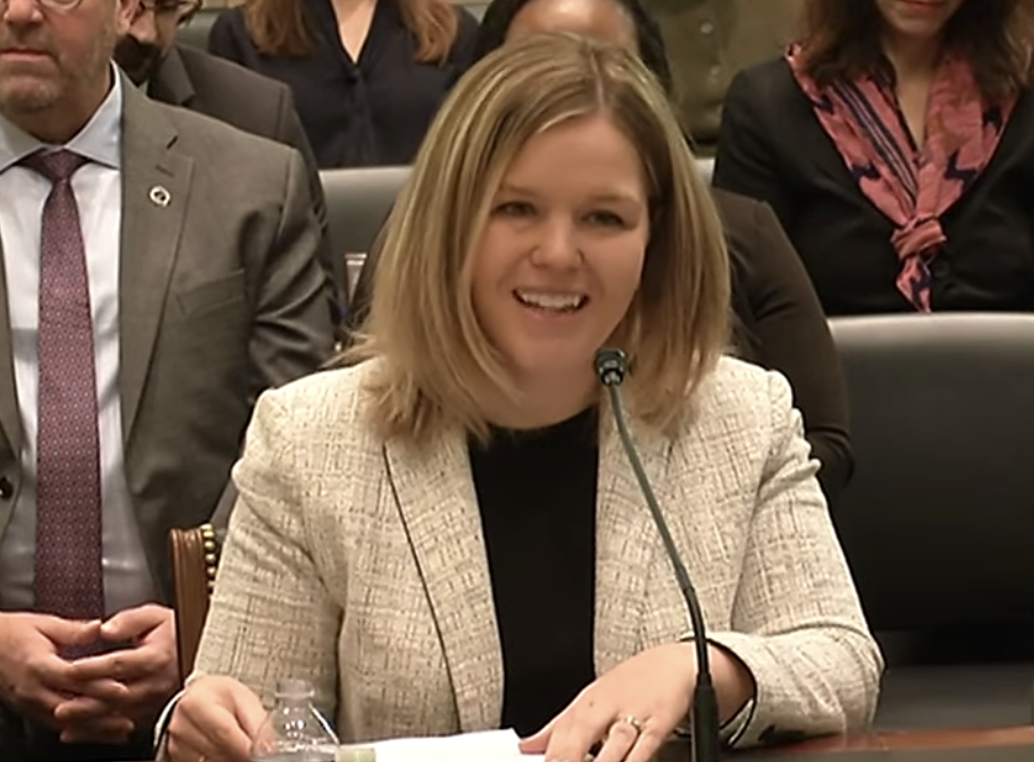
POPVOX Foundation’s Director of Global Initiatives Aubrey Wilson testified before the US House Committee on House Administration’s Subcommittee on Modernization and Innovation, presenting international case studies that can inspire the future of constituent engagement in the US Congress.
If Congress can’t understand and use AI, it can’t effectively integrate it into its infrastructure, regulate it, or oversee an Executive branch racing ahead. As Director of Global Initiatives Aubrey Wilson explained in The Washington Examiner:
This is the time for Congress to embrace the internal use of AI. We’re seeing the proliferation of the use of the technology by the Executive branch, and without the legislative branch doing the same to keep pace, it’s the equivalent of using a calculator to double-check the work of a supercomputer.
In testimony presented to the US House of Representatives Committee on House Administration’s Subcommittee on Modernization Innovation, Aubrey called for a new approach to managing technology for internal capacity equal to the challenge of the pacing problem, “The rapid, continual evolution of technology requires the US Congress, and all legislatures, to go beyond one-off initiatives or projects by adopting a new way of doing things: one that allows ongoing experimentation, learning, and refinement.”
This year, POPVOX Foundation put into practice the model we recommend by producing resources, building beta versions of AI-enabled tools, and transparently piloting new approaches to derisk them for institutions.
POPVOX Foundation is working to ensure that Congress doesn't fall behind:
To build AI fluency across the Legislative branch, we promoted House Rules updates, provided customized trainings for Member offices, offered staffers “AI Summer Camp” (a self-led training curriculum), and released StaffLink, an open-source prototype chatbot to aid junior staffers and help the public understand how Congress works.
One year after the overturning of the Chevron doctrine, Executive Director Marci Harris warned in The Hill that Congress is “defunding the very institutions that provide the expertise, oversight, and support it needs.” Courts expect Congress to write clearer laws, but clarity requires modern drafting tools. Those tools require structured data, which is the foundation we’re building with parliaments worldwide.
Our Departure Dialogues project modeled a proof-of-concept approach for Congress to use AI tools for sentiment analysis and qualitative research, enhancing evidence-based, outcomes-driven policymaking.
In 2025, the team expanded and deepened our global reach to build infrastructure for cross-border learning that strengthens legislatures everywhere:
We coauthored the Westminster Foundation for Democracy's AI guidelines for parliaments and trained legislators from Taiwan to Argentina. Taipei Times and Argentine media covered our international AI training efforts.
At the OpenGov Partnership Summit in Spain, Marci announced the Digital Parliaments Project, which houses a new data standard and the ParlLink platform we’re developing in collaboration with a dozen Caribbean parliaments to help them leapfrog from paper files to LLMs. Created in partnership with Internet Archive, ParlAmericas, and Mozilla Foundation, DPP creates AI tools that extract metadata from legislative documents into structured, machine-readable legislative data, optimizing legislatures and their transparency.
Through Mozilla’s CommonVoice, we’re also breaking ground to train AI models on Caribbean dialects and accents via parliamentary audio.
Information sharing across borders helps lawmakers worldwide stay on the leading edge of emerging technologies for policymaking and constituent engagement. Fellow Dr. Beatriz Rey's Modern Parliament (“ModParl”) newsletter connects legislative modernizers worldwide:
ModParl chronicled innovations from New Zealand’s procedure rules to the UK’s Lawmaker platform to Peru’s proxy voting rules to the EU's augmented LEOS tool. When Kenya’s Parliament launched its Dokeza platform, Caribbean legislators learned new ways of engaging the public. When Chile demonstrated Congreso Virtual, African parliaments saw possibilities.
We covered major convenings like the P20 Parliamentary Speakers Summit in Brasília, the Global Conference on Parliamentary Studies in Athens (120 researchers and parliamentary staff from 30 countries), and the Artificial Intelligence Conference in Kuala Lumpur hosted by the IPU, CPA, UNDP, and the Malaysian Parliament.
POPVOX Foundation is building the network of AI-ready legislatures for the next generation.
Nonpartisan Modernization in a Polarized Era
Institutional improvements benefit everyone; and POPVOX Foundation proves bipartisan progress in the US Congress is still possible.
In a year of shutdowns and partisan conflict, POPVOX Foundation secured bipartisan wins: legislative priorities signed into law, CaseCompass development supported by the Committee on House Administration, and coalition work spanning ideological lines. The organization's credibility with both parties, rooted in its team of former staffers from both sides of the aisle, makes it a trusted convener and advisor:
In April, POPVOX Foundation Advisor for Congressional Initiatives Danielle Stewart testified before the Legislative Branch Appropriations Subcommittee. Roll Call described the hearing as a “nerd convention,” quoting Danielle’s testimony about the need for Congress to invest in remote voting as “about ensuring continuity of operations during emergencies or when in-person gatherings become impossible…as national security threats evolve.”
In November, appropriators authorized $4 million for the House’s Modernization Initiatives Account and advanced three POPVOX Foundation priorities as part of the bipartisan funding package signed into law:
The unified casework data schema enabling CaseCompass
Language encouraging Legislative branch agencies to adopt AI responsibly
Support for studying legislative data standards
As NextGov put it, “the inclusion of these modernization efforts could help Congress keep up with changing technology.”
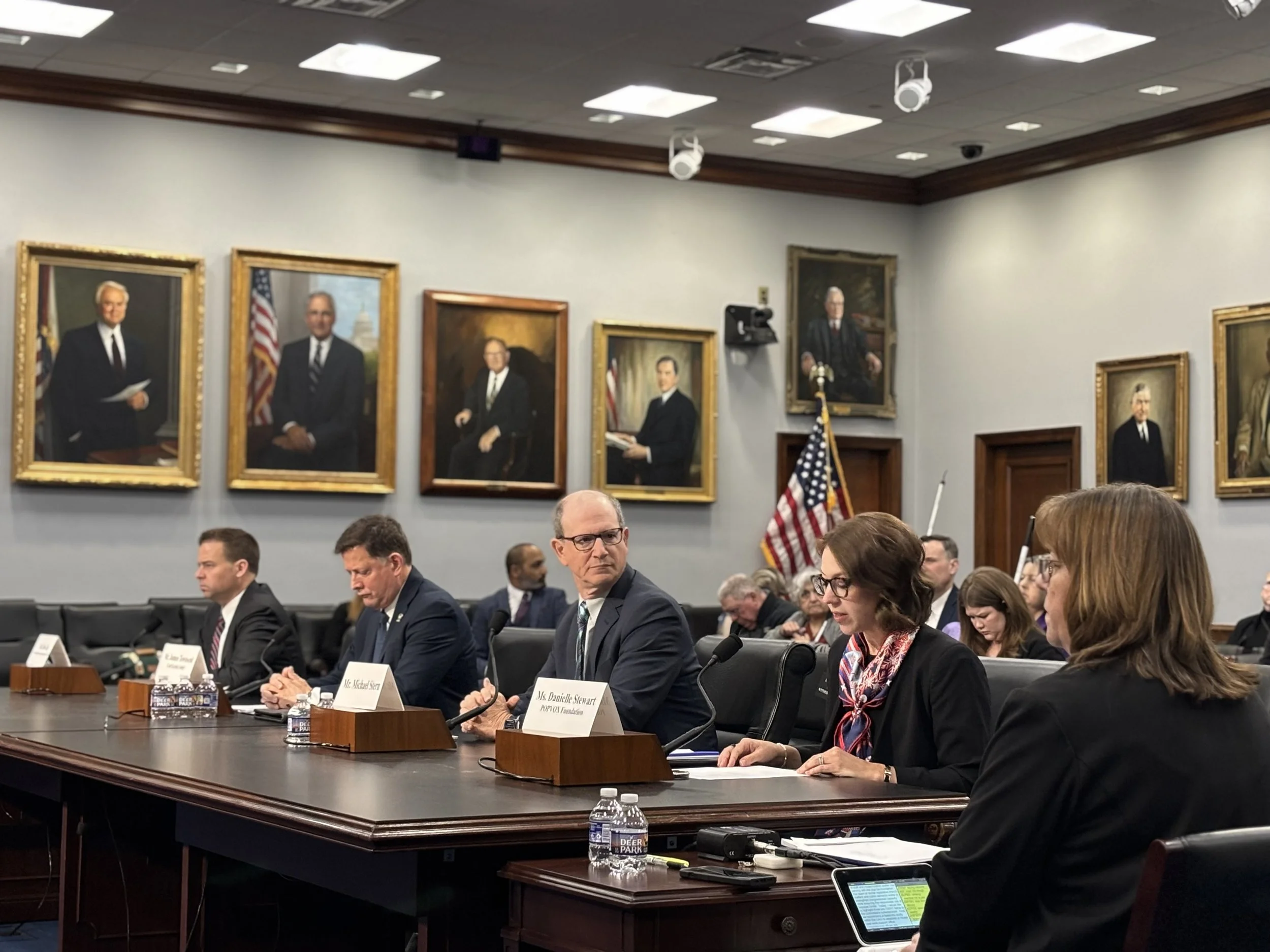
POPVOX Foundation Advisor for Congressional Initiatives Danielle Stewart testified before the Legislative Branch Appropriations Subcommittee.
These aren't glamorous reforms. They're infrastructure; the essential foundations that let institutions function effectively. Investments here yield durable, non-reversible improvements.
Closing the Feedback Loop: From Implementation Pain Points to Policy Solutions
Government works better when the people implementing policy can inform the people writing it. The gap between legislative intent and on-the-ground reality is where government often fails constituents. This year, we worked to continue building the connective infrastructure to close that loop:
Departure Dialogues, launched with a bipartisan group of five coalition partners, gathers insights from departing federal employees that reveal where outdated legislative requirements prevent agencies from delivering results and where civil servant input could inform better policymaking. Or as “The Federal Drive with Terry Gerton” aptly described: the project “gives departing civil servants a safe, nonpartisan way to share their wisdom and help fix the system they’ve spent years trying to make work.”
CaseCompass, championed by POPVOX Foundation Managing Director Anne Meeker in testimony, research, and outreach, is Congress’ first standardized approach to tracking how federal agencies serve constituents and will enable Congress to see systemic failures for the first time.
To spotlight how to improve the feedback loop between constituents and legislators, we launched Voice/Mail, a newsletter where Anne interviews leading constituent engagement experts and chronicles innovations like deliberative town halls while providing a rare nonpartisan lens on how disruptions to federal services impact civic engagement. Weeks after its launch, The Washington Post quoted Anne on how online activism lands on Capitol Hill and how “technology can boost, or potentially undermine, [elected officials’] relationships with voters.”
Director of Global Initiatives Aubrey Wilson testified before the US House Committee on House Administration Subcommittee on Modernization and Innovation on how AI is reshaping constituent engagement in legislatures around the world and what lessons the US House can draw from these efforts to improve public trust.
This is systems change: creating durable channels for information to flow from implementation back to policymaking, improving government performance regardless of which party holds power.
Casework as Legislative Infrastructure
Casework and constituent services aren't just customer service, they're a frontline signal of whether government is working, where abstract policy meets real implementation. From its inception, POPVOX Foundation elevated casework as a strategic priority: training caseworkers, advocating for better tools, and reframing constituent services as oversight intelligence:
Our Casework Navigator newsletter reaches 2,000+ staff weekly, providing a vital rapid-response channel. We began the year keeping caseworkers updated on executive orders that could directly impact their work. Partnering with former Department of Homeland Security Customer Experience lead Dana Chisnell, our Casework Navigator webinar series brought former agency staff and subject-matter experts to train caseworkers on the technical infrastructure behind agency programs, and up-to-the-minute changes to agency policies to help them anticipate and prepare for casework. Through these and other efforts, we're building caseworker capacity to serve constituents effectively and to spot systemic problems.
We championed better support for Congressional caseworkers and informed thoughtful coverage in the media, training journalists on covering casework to raise the profile of these aides who work tirelessly for the public.
Our casework resources are so valued, even the Congressional Research Service cites them:
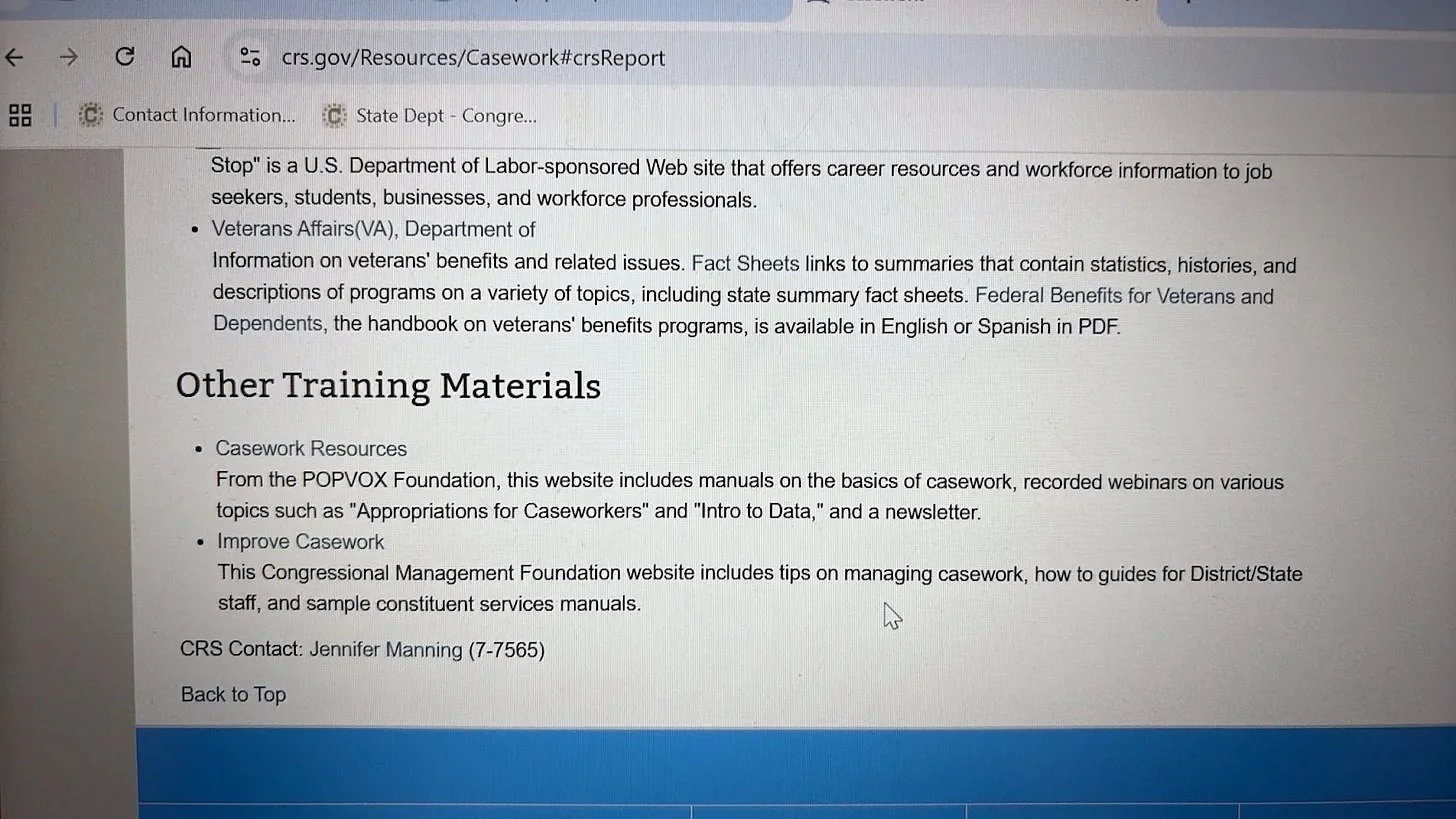
Screenshot of the Congressional Research Service’s resources on casework (behind firewall)
Strong casework infrastructure is state capacity: it’s how legislatures learn how to improve government performance and earn public trust.
Investing in the People Who Make Congress Work
Legislative staff are the engine of democratic capacity — and they're chronically undersupported. POPVOX Foundation is helping to lead the conversation around building a modern, representative, and adaptive Legislative branch workforce.
From family-friendly Congress initiatives to shutdown support resources to professional development, the organization invests in the people who make the institution function:
We supported the incoming 119th Congress with a suite of resources to support Members’ upskilling and professional development, and also to help Congressional families approach this big life change together:
A Transition Memo with recommendations to address the pacing problem that also encourages the House of Representatives to continue to build on its previous investments in creating a strong, responsive Legislative branch.
“Gavel In,” an explainer podcast series sharing best practices and procedures through interviews with current and former Members, Chiefs of Staff, and Congressional scholars from across the political spectrum.
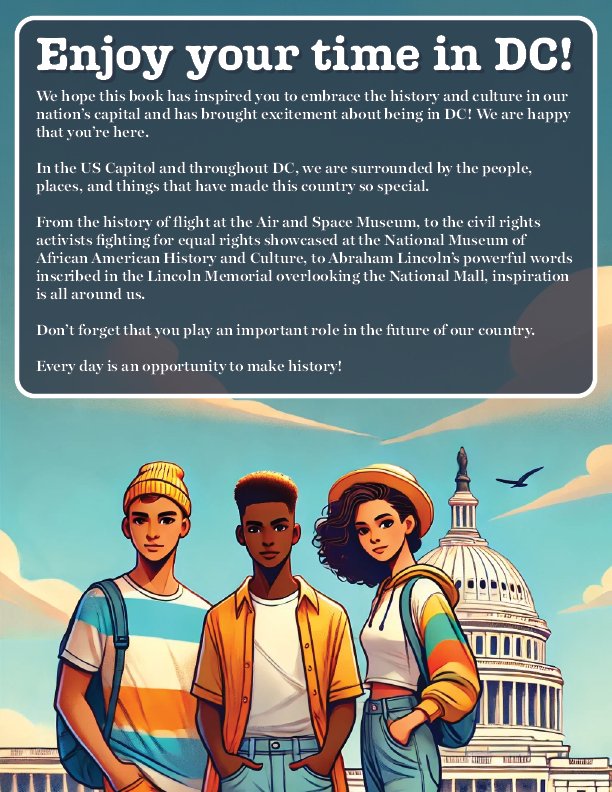
“Welcome to Washington: A Guide to Kids of Congress,” an illustrated book helping children of Members form friendships and explore what makes our nation's capital — and their parents’ new job — special.






Danielle Stewart, a new mom and former Chief of Staff, made the case to Members and the media about the importance of expanding voting options to ensure that Members can fulfill their constitutional responsibilities even when medical or family circumstances prevent them from being physically present.
As serving in Congress now comes with increasing security challenges, we backed initiatives prioritizing continuity, emergency preparedness, and practical safety planning — developing accessible tools for offices to use and encouraging full use of available security resources.
During the shutdown, we provided resources for staff and interns facing furloughs. The CapitolStrong relaunch and staffer appreciation day focused on staff well-being when Congressional offices needed it most.
POPVOX Foundation and Protect Democracy collaborated with a design firm on “Where Will They All Sit?” to visualize what a modern Capitol Campus could look like: respectful of tradition but responsive to the needs of a 21st-century workforce. As Marci explained to Spectrum News, expanding the physical footprint of the House of Representatives could foster more collaboration.

Congressional staff at the CapitolStrong thank you event with Teddy, the therapy dog
Looking Ahead: R&D for Modern Legislatures
As the US approaches its 250th anniversary, questions about whether governing institutions are equipped for the challenges ahead echo in parliaments worldwide.
POPVOX Foundation is doing the work of democratic R&D: testing, iterating, and scaling the innovations that will define how legislatures function in the age of AI and beyond.
In 2026, we’ll continue to help government and civil society imagine what it will take to chart a path to the future we want to see. We'll expand our US-based work to the state level and the Digital Parliaments Project to African legislatures. We'll continue prototyping new technology, training Hill staff and caseworkers, building feedback loops, and advancing the infrastructure that makes democracy work — in Washington and worldwide.